ENEnglish
 LTLietuviškai
 DEDeutsch
 FRFrançais
 RUРусский
 ESEspañol
 PLPolski
 ITItaliano
 UKУкраїнська
 CSČeština
 PTPortuguês
 JA日本語
 LVLatviešu valoda
 ETEesti
 HUMagyar
 IDBahasa Indonesia
 TRTürkçe
 HIहिन्दी
 ELΕλληνικά
 ARالعربية
 THไทย
 VITiếng Việt
 RORomână
 MSBahasa Melayu
 BNবাংলা
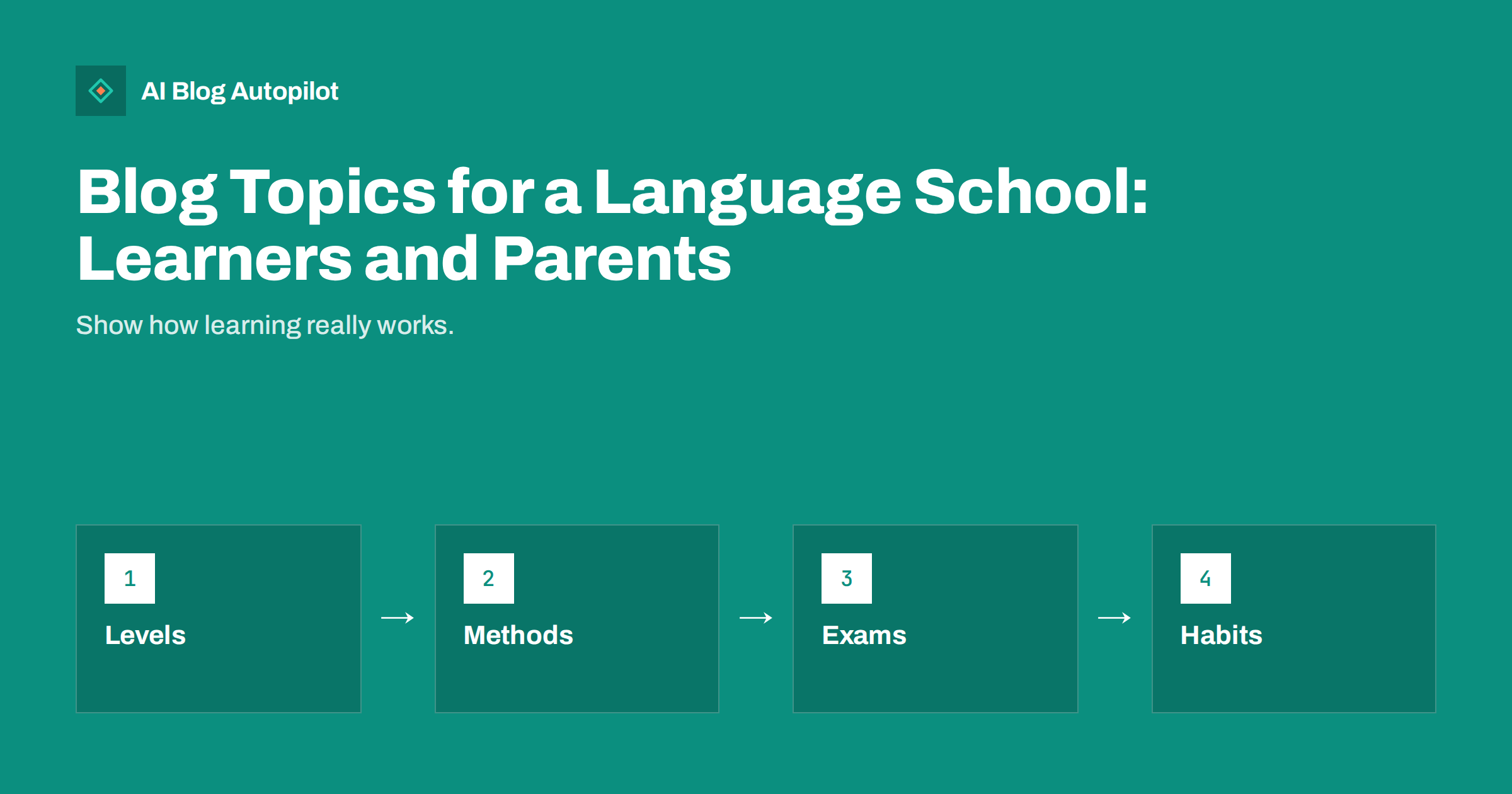
Short answer: a language school should blog about the questions learners and parents ask before they enrol: how to find the right level, how classes are taught, how long progress takes, which exams matter, how to practise between lessons, what the courses cost and how to fit study into a busy week. Use real examples from classes, avoid promises of fast fluency, publish in the languages your learners read and give every page an easy way to book a trial or a placement test.
People who want to learn a language often search with a clear goal: a job, a move, a family, an exam or a trip. They also search with doubts, such as whether they are too old, too busy or too bad at languages. A school that answers these doubts with patience and honesty earns trust before the first lesson.
This guide lists topic groups for a language school, large or small, and shows how to turn what teachers know into pages that attract learners and parents. It also covers how to write for readers who are themselves still learning, and how to keep claims honest.
Explain how parents can judge whether a course suits a child. Describe the age groups, the size of classes, the balance of games and structured work, the homework load and how progress is reported. Parents need to see that the school understands children, not only the language, and a short page that answers these points removes many doubts before the first call.
Finding the right level and course
Learners are often unsure where they stand. Write a guide to levels in plain words, using the scale that your school uses, such as the common European framework from beginner to advanced. Describe what a learner can do at each level, with examples of real tasks, such as ordering a meal, writing an email or following a meeting.
Explain how your placement works. Say whether there is a written test, a short conversation or both, how long it takes, whether it is free and how the results are used. A page that removes fear of the test brings more people through the door, and a sample question or two shows what to expect.
Describe each course type: general classes, intensive courses, business language, exam preparation, children and teenagers, private lessons and online groups. For each, say who it suits, how many hours a week it takes, how big the group is and what the learner will be able to do after a term. Avoid promises such as fluent in three months.
Write for people who are returning to a language after a break, or who learned it long ago at school. They need a different starting point from absolute beginners, and a page that speaks to them is rare and valuable.
Write about online and blended learning if you offer it. Explain what equipment and connection a learner needs, how groups meet, how materials are shared, how attendance and feedback work and what happens when the connection fails. Honest detail about the limits of online study, as well as its advantages, helps learners decide and avoids disappointment later.
How classes work
Many learners wonder what happens in a lesson. Describe a typical class in detail: warm-up, new material, practice in pairs, feedback, homework and review. Explain how much speaking time each learner gets, how mistakes are corrected and how the teacher adapts to different speeds.
Explain your method honestly. If you teach mostly in the target language, say so and say how beginners are supported. If you use a course book, name it only if that is accurate and permitted, and explain what you add. If you use technology, describe what it does and does not do. The aim is to help the reader judge whether the style suits them.
Introduce teachers with short profiles: languages spoken, qualifications, experience, teaching interests and a short statement of how they teach. Take photographs with consent. Learners choose people, and a warm, honest profile can decide the choice. The article on meet the team posts offers a structure.
Show a sample lesson with permission, perhaps a short plan or a few practice activities. Never publish recordings of learners without clear consent, and avoid showing children’s faces or names.
Add a guide to choosing between exams. Many learners do not know which certificate they need, and the answer depends on the university, employer or authority that will read it. Explain how to ask them, which questions to ask and what to check on the validity period. Your school gains trust by helping learners avoid paying for the wrong test.
Exams, certificates and goals
Exam preparation is a major search area. Write guides for each exam you prepare for: what it tests, how it is structured, what the levels mean, how long preparation takes, how it is scored, how to register and how recognised it is. Link to the official body, and check details each year, since formats and fees change.
Describe how your classes prepare learners: practice papers, speaking mocks, feedback on writing, timed exercises and advice for test day. Explain honestly what you cannot control, such as the examiner or the test conditions, and avoid claims of guaranteed results. If you publish pass figures, show how they are calculated and for which period.
Write for people with other goals: a job interview, a visa application, a university course, a business trip, a family move or a hobby. A page called learn the language for a move abroad, with a plan of the first months, speaks to real needs. Be careful with legal topics such as visa rules, and refer readers to the official sources.
Add guides on certificates and levels for employers, since many learners need proof for work. Explain what your school certificate shows and does not show, and how it differs from an official exam.
Include short guides on common mistakes for speakers of particular first languages, if your teachers know them well. A page on typical pronunciation or grammar problems for learners from one language group is specific and useful, and it brings in readers who search for exactly that. Ask teachers to supply real examples, and keep the tone encouraging rather than critical.
Study habits and practice
Learners value tips that make study easier. Write guides on vocabulary methods, listening practice, reading for pleasure, writing short notes, speaking with others, using subtitles, keeping a learning diary and fitting study into a few minutes a day. Base them on experience in your classes, and say honestly that methods work differently for different people.
Explain what to do when progress seems to stop. Many learners reach a plateau and lose motivation. A calm guide that explains why it happens and how to move on can keep them in class and bring them back after a break. Share stories of real learners, with consent, who recovered from such a phase.
Offer free resources that fit your school: a short word list, a pronunciation guide, a reading list or a weekly practice plan. Make them easy to use without signing up, and consider asking for an email only for larger materials. The article on calculators and free tools as content explains why free resources earn attention.
Include a guide for parents who want to support a child learning a language at home, with simple, realistic ideas that do not require fluency of their own.
Costs, schedules and practical details
Explain what a course costs and what is included: lessons, materials, level tests, certificates, exam fees and access to online platforms. State the length of a term, the number of hours, the group size and the discounts. If you cannot publish prices, explain what affects them. The guide on writing honest articles about what things cost offers a clear structure.
Describe the schedule options: mornings, evenings, weekends, online and in person. Say what happens if a learner misses a class, whether there is a catch-up, how holidays are handled and what the refund rule is. People who work and study need flexibility, and clear rules reduce friction.
Give practical information for newcomers: how to reach the school, where to park, what to bring, how to enrol, what documents are needed, how to pay and who to contact. Keep it identical to your business profile, as the guide on Google Business Profile updates advises.
Describe your policy on trial lessons, level changes and moving to another group. A friendly, flexible approach, clearly explained, supports enrolment.
Culture, travel and community
Language learning is also about people and places. Write about customs, holidays, food, films, music and everyday phrases that go with the language. Pages like these attract readers who are curious rather than ready to enrol, and some of them will become learners. Take care to be accurate and respectful, and avoid stereotypes.
Report on school events: conversation evenings, film nights, trips, exchange days and open lessons. Announce them in advance with clear details, and summarise them afterwards with photographs taken with permission. An event page shows that the school is alive and gives learners a reason to come back.
Write about learner stories: why a learner started, what helped, what was hard and what changed. Ask for consent, avoid private details and let learners tell the story in their own words. The article on customer stories and contributions on a business blog explains how to invite and edit such pieces.
If you serve readers in several languages, consider publishing selected pages in more than one, as the guide on choosing which languages to publish in suggests.
Writing for readers who are still learning
Many of your readers read in a language that is not their first. Use short sentences, common words and clear structure. Explain any technical term, avoid idioms without explanation and give examples. The article on writing for non-native English readers without dumbing down shows how to do this while remaining natural.
Add an audio version or a glossary where it helps. A glossary box with a few key words, translated or explained, turns a blog post into a learning page and keeps readers on the site longer. Make sure every translation is correct, and have a teacher check them before publication.
Avoid errors in your own language on the page. A language school with spelling mistakes loses credibility at once. Have a second person read every page, and keep a style sheet for names, levels and terms so that pages are consistent.
How AI Blog Autopilot helps
AI Blog Autopilot can write and publish articles on your chosen topics, with FAQ sections, tags and SEO meta, and share them to your social networks. Give it your courses and your area, and have a teacher check examples, translations, exam details and prices before each article goes live. See the pricing page for plans and monthly credits.
Related reading
- A Blog for a School, Nursery or Tutoring Centre
- Blog Strategy for a Local Business
- Translating Articles or Writing Natively in Each Language
The bottom line
Help learners find their level, show how classes really work, explain exams and costs honestly and write clearly for readers still learning.
FAQ
What should a language school blog about first?
Start with levels and placement, how classes work, course costs and the exams you prepare for.
Can I promise fluency in a set time?
No. Progress depends on the learner, so explain what affects it and what a typical course achieves.
Should I publish pass rates?
Only if you can show how they are calculated and for which period.
How do I show teaching without breaking privacy?
Use lesson plans and sample activities, and never publish recordings or images of learners without clear consent.
Should pages be in several languages?
Publish selected pages in the languages your learners read, and have a teacher check each translation.