ENEnglish
 LTLietuviškai
 DEDeutsch
 FRFrançais
 RUРусский
 ESEspañol
 PLPolski
 ITItaliano
 UKУкраїнська
 CSČeština
 PTPortuguês
 JA日本語
JA日本語 LVLatviešu valoda
 ETEesti
 HUMagyar
 IDBahasa Indonesia
 TRTürkçe
 HIहिन्दी
 ELΕλληνικά
 ARالعربية
 THไทย
THไทย VITiếng Việt
 RORomână
 MSBahasa Melayu
 BNবাংলা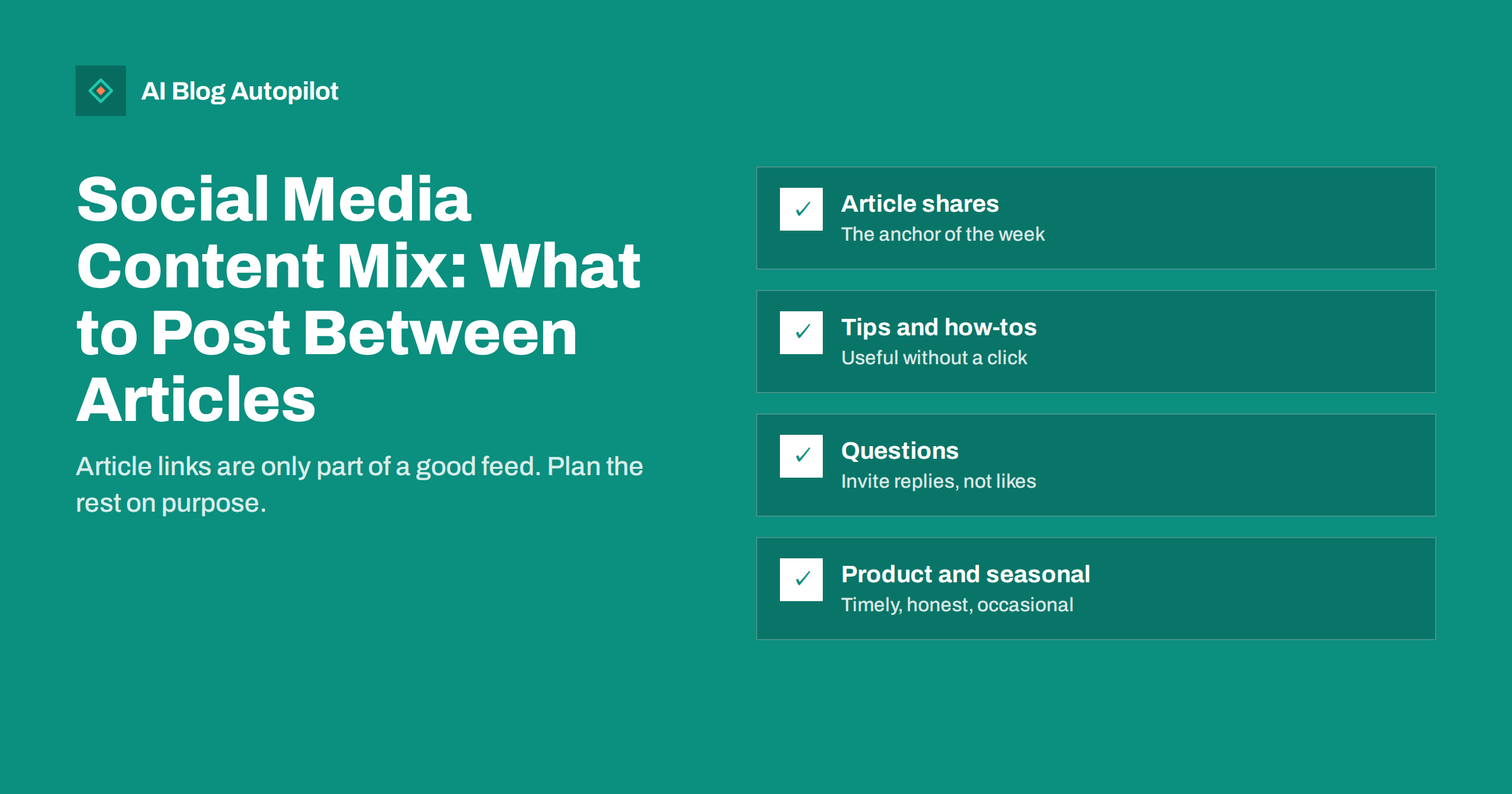
Short answer: a good social media content mix combines shares of your blog articles with posts that are useful on their own: quick tips, short how-tos, questions for your audience, behind-the-scenes or product posts, and timely seasonal content. A simple starting point is to make most posts helpful or conversational and keep direct promotion to a small share. Vary formats and keep each network’s style in mind, so the feed never looks like a list of links.
Many businesses treat social media as a place to announce new blog posts. That is a fine start, but a feed made only of article links gets repetitive quickly, and followers learn to scroll past it. The posts between articles are what make people notice the account, reply to it and, eventually, click through when a new article appears. This guide explains what to post, how to balance it and how to plan the mix without spending every day on it.
Why article links alone are not enough
A link post asks for something: leave the platform and read elsewhere. Most social networks prefer content that keeps people engaged where they are, and many users scroll without clicking anything. If every post is a link, the account offers little value to the majority who never click.
Posts that deliver value directly in the feed work differently. A practical tip, a short checklist or a question that people want to answer builds attention and goodwill. When the next article is shared, followers who have found the account useful are more likely to engage with it.
There is also a practical issue. Most blogs publish a few articles per week at most, while a social account can usefully post more often. The mix fills the gaps without inventing reasons to post.
The building blocks of a content mix
Most useful business accounts draw on the same handful of post types. Not every account needs all of them, but each serves a clear purpose:
- Article shares. The new blog post, introduced with a sentence that explains who it is for and what they will learn. This is the anchor of the week.
- Tips and how-tos. One practical idea that someone can use straight away, written fully in the post. Many of these can come from your own articles.
- Questions and polls. A genuine question about your audience’s work or habits. Replies tell you what people care about and give you topics for future articles.
- Product posts. A feature, a new offer or a use case, explained in plain terms. Useful when it solves a real problem, tiresome when it is every other post.
- Seasonal and timely posts. Holidays, industry events, the start of a quarter, seasonal problems your customers face. They show the account is run by people paying attention.
- Behind the scenes. How you work, who is on the team, what you learned from a project. These posts make a business recognisable.
- Older articles. Evergreen posts that are still accurate deserve to be shared again, with a new angle each time.
A simple ratio to start with
There is no scientific formula, and you will see many rules of thumb online. The point of a ratio is to stop promotion from taking over, not to follow a number exactly. A reasonable starting mix for a small business looks like this:
| Post type | Rough share of posts | Main purpose |
|---|---|---|
| Tips, how-tos, short educational posts | About a third | Value in the feed |
| New and older article shares | About a quarter | Traffic to the blog |
| Questions, polls, conversation | Around 15% | Replies and feedback |
| Product and offer posts | Around 15% | Sales and sign-ups |
| Seasonal, behind the scenes, team | The rest | Personality and timeliness |
Treat this as a first draft. After a month or two, look at which types got replies, saves or clicks, and shift the mix towards them. An account for a consultancy might lean towards educational posts; a shop might post more product and seasonal content.
Turning one article into several posts
The easiest way to fill the mix is to mine your own articles. A single well-researched post usually contains material for a week of social content:
- The share itself. Introduce the article with the problem it solves.
- A key tip. Pick the most useful step and write it out as a standalone post, with no link required.
- A common mistake. Most guides mention what people get wrong. That makes a strong short post.
- A question. Ask followers how they handle the topic today.
- A quote or summary graphic. One sentence from the article on a branded image.
- A FAQ answer. Questions from the article’s FAQ section are often exactly what people search for and ask.
Spread these across several days and networks rather than posting them all at once. Each one stands on its own, and together they point people back to the article.
Adapting the mix to each network
The same mix does not look the same everywhere. Each network has its own habits, and copying one post to all of them unchanged rarely works well:
- LinkedIn rewards thoughtful text posts, lessons from experience and professional questions. Article shares work best with a few lines of real insight.
- Facebook suits community questions, local and seasonal posts, photos and events.
- Instagram is visual first: carousels of tips, photos, short videos, with links handled differently.
- X, Threads, Bluesky and Mastodon favour short, conversational posts and threads, and replies matter.
- Pinterest works for evergreen how-to content and visual guides that people save.
- Telegram and similar channels suit concise updates for people who chose to follow you closely.
Write each post for the place it appears: length, tone, hashtags and the position of the link all vary. This takes more effort than one copy for everywhere, but it is what makes an account feel native rather than automated.
Planning the mix without living on social media
A content mix needs planning, but not daily improvisation. A weekly routine is enough for most small teams:
- Start from the blog calendar. Each new article sets the theme for its week.
- Add fixed slots. For example, a tip on Monday, a question on Wednesday and a product or seasonal post on Friday.
- Keep a list of evergreen ideas. Tips, recurring questions and older articles you can use when the week is quiet.
- Look ahead at the season. Note holidays, events and seasonal problems a month in advance.
- Schedule in batches. Write a week of posts in one sitting and schedule them, then spend a few minutes a day on replies.
Replies are the part you should not automate away. A question post with no answer from the account looks abandoned; a short, human response turns it into a conversation.
Common mistakes in a content mix
- All promotion. If most posts ask people to buy or click, followers stop paying attention.
- Posting for the sake of it. A weak post to fill a slot is worse than skipping the slot.
- Identical posts everywhere. The same text, the same hashtags and the same image on every network looks careless.
- Ignoring what works. Check which posts get replies and saves at least monthly and adjust.
- Forgetting old content. Evergreen articles published a year ago can still help new followers who have never seen them.
- Overusing trends. Jumping on every trend or meme that has nothing to do with your business confuses people about what the account is for.
Checking whether the mix works
A content mix is a hypothesis about what your audience values, so test it. Once a month, export or review the posts from the past four weeks and group them by type. For each group, look at a few simple signals rather than every metric the platform offers:
- Replies and comments show whether a post started a conversation. Questions and opinion posts should lead here.
- Saves and shares show whether people found a post useful enough to keep or pass on. Tips and checklists often do well.
- Link clicks show whether article shares bring readers to the blog. Tag links with UTM parameters so you can see the visits in your analytics.
- Follower changes over the month give a rough sense of whether the account is becoming more interesting to new people.
Compare types against each other on the same network, not across networks, because each platform counts and displays engagement differently. If questions on LinkedIn get thoughtful replies while the same questions on Facebook get none, shift Facebook towards local or seasonal posts instead. Small changes, made monthly and based on what your own audience does, beat any generic ratio.
How AI Blog Autopilot helps
AI Blog Autopilot shares every article it writes to your social networks, with separate text, length and timing for each network. It also works without a website: in social-only mode it creates native posts such as tips, how-tos, product posts, questions and seasonal moments, and plans with evergreen reshares bring older articles back into the feed. Plans are on the pricing page.
Related reading
- Turning an Article Into Social Posts That Get Read
- Resharing Old Blog Posts on Social Media Without Spamming
- Automated Social Posting Mistakes That Make Accounts Look Robotic
- Quote Graphics From Blog Posts
The bottom line
A healthy social feed is more than a list of article links. Mix shares of new and older articles with tips, questions, honest product posts and timely seasonal content, and keep promotion to a modest share. Build most of the mix from your own articles, write each post for its network, schedule in weekly batches and spend your daily time on replies. Review what works every month and let the results shape the next month’s mix.
الأسئلة الشائعة
What is a social media content mix?
It is the balance of post types an account publishes, such as article shares, tips, questions, product posts and seasonal content. Planning the mix keeps a feed varied and useful instead of repetitive or overly promotional.
How much of my social media should be promotional?
There is no fixed rule, but keeping direct promotion to a modest share, often around one post in five or six, is a sensible start. Adjust based on how your audience responds.
What should I post on social media between blog articles?
Post standalone tips from your articles, questions for your audience, honest product or offer posts, seasonal and behind-the-scenes content, and shares of older evergreen articles that are still accurate.
Should I post the same content on every network?
You can share the same idea, but write each post for its network. Length, tone, hashtags and how links are handled differ, and native-looking posts usually perform better than identical copies.
How do I find ideas for social posts?
Start with your own articles: key tips, common mistakes, FAQ answers and quotes all make good posts. Customer questions, seasonal events and replies to earlier posts are other reliable sources.