ENEnglish
 LTLietuviškai
 DEDeutsch
 FRFrançais
 RUРусский
 ESEspañol
 PLPolski
 ITItaliano
 UKУкраїнська
 CSČeština
 PTPortuguês
 JA日本語
JA日本語 LVLatviešu valoda
 ETEesti
 HUMagyar
 IDBahasa Indonesia
 TRTürkçe
 HIहिन्दी
 ELΕλληνικά
 ARالعربية
 THไทย
THไทย VITiếng Việt
 RORomână
 MSBahasa Melayu
 BNবাংলা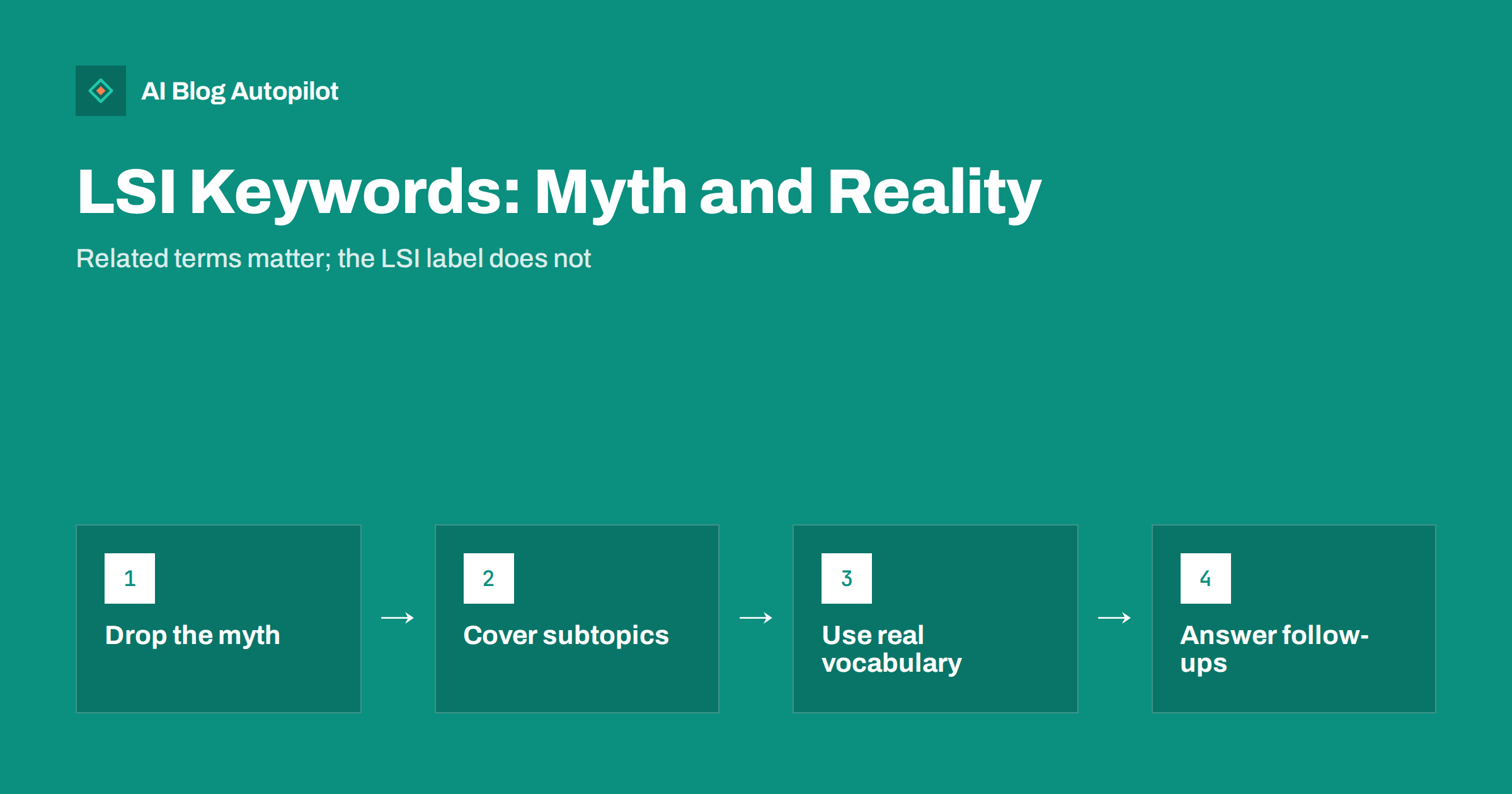
Short answer: “LSI keywords” is an SEO myth. Latent semantic indexing is an information retrieval technique from the late 1980s, and Google representatives have said publicly that Google does not use LSI keywords. What is true is that modern search engines understand topics, synonyms and context, so a page that covers a subject thoroughly, using the vocabulary experts and searchers naturally use, is easier to understand and match to more queries. Focus on covering subtopics and follow-up questions, not on sprinkling lists of “LSI” terms.
Few SEO terms are as widespread and as misunderstood as “LSI keywords”. Tools generate lists of them, plugins score articles on them, and guides tell writers to include a set number per article. The name suggests a precise technical mechanism behind it. There is not one.
Yet the advice attached to the term is not entirely wrong. This article separates the myth from the useful idea underneath it and shows how to use related language in a way that actually helps.
What latent semantic indexing actually is
Latent semantic indexing, also called latent semantic analysis, is a mathematical technique developed in the late 1980s for retrieving documents. It analyses which words tend to appear together across a collection of documents, and uses those patterns to find documents related to a query even when they do not contain the exact query words.
It was designed for relatively small, fixed collections of documents, such as a library catalogue or a set of research papers. It does not scale naturally to a web of billions of constantly changing pages, and search technology has moved through many generations of methods since then, including far more sophisticated language models.
So the technique is real. The idea that modern search engines use it to rank web pages, and that there is a special category of “LSI keywords” you must include, is not supported by anything the search engines have said.
Where the myth came from
The term spread through SEO writing in the 2000s and 2010s, at a time when search engines were visibly getting better at understanding synonyms and related concepts. “LSI” offered a technical-sounding explanation for that improvement, and it stuck.
Tools then began offering “LSI keyword” lists, usually generated from autocomplete suggestions, related searches or words that commonly appear on top-ranking pages. Those lists can be useful, but they have nothing to do with latent semantic indexing. The label is marketing.
Google representatives have stated publicly that there is no such thing as LSI keywords in how Google works. That settles the terminology, though not the underlying question of how to use related language well.
What search engines actually do with language
Modern search engines use a range of methods to understand queries and pages, including machine learning systems that model the meaning of words and passages in context. In practical terms, they can:
- recognise synonyms and close variants, so “car” and “vehicle” or “cost” and “price” are understood as related;
- understand that a page discussing boilers, radiators and thermostats is about home heating, even if it never uses that exact phrase;
- interpret ambiguous words from context, telling apart the different meanings of the same word;
- match specific passages within a page to specific questions.
None of this requires you to include a particular list of terms. It rewards pages that discuss a topic the way a knowledgeable person would, naturally using the relevant concepts, entities and vocabulary.
The useful idea behind the myth
Strip away the label, and the advice that survives is sound: a thorough article on a topic naturally contains the related terms, subtopics and entities that belong to that topic. An article about starting a vegetable garden that never mentions soil, sunlight, watering, seeds or pests is probably thin, and both readers and search engines can tell.
So related terms are best seen as a symptom of good coverage, not a cause of it. Checking for them can reveal gaps. Adding them without adding substance fixes nothing.
| Myth-based approach | Coverage-based approach |
|---|---|
| Get a list of “LSI keywords” from a tool | List the questions and subtopics readers need covered |
| Insert each term a set number of times | Write sections that answer each question properly |
| Score the article by term coverage | Check the article against top results and reader needs |
| Result: awkward text with the right words | Result: useful text that naturally contains the right words |
How to cover a topic’s language naturally
These methods produce the benefits people hope to get from “LSI keywords”, without the awkwardness:
- Map the subtopics. Before writing, list what someone needs to understand about the topic: definitions, steps, options, costs, risks, mistakes, examples. Each becomes a section or paragraph.
- Read the top results. Note the subtopics that appear across several of them. Those are expected. Reading the search results before writing explains how.
- Collect real questions. Related-question boxes, autocomplete and your customers’ questions show the words people actually use.
- Use the vocabulary of practitioners. Name the tools, methods, standards and components involved, the way a professional would. Specific terms signal expertise far better than generic ones.
- Answer follow-up questions. An FAQ section or short sections for the questions readers ask next naturally bring in related terms.
- Use synonyms as you would in speech. Varying words avoids repetition and helps match different phrasings of the same query.
Using term tools without falling for the myth
Content optimisation tools that suggest related terms can still be helpful, if you treat their output as a checklist of possible gaps rather than a quota.
- Scan the suggestions for missing subtopics. If a tool suggests “warranty” for an article about buying equipment and you never discussed warranties, that may be a real gap worth a paragraph.
- Ignore terms that do not belong. Tools pick up words that appear on competing pages for incidental reasons, such as navigation, brand names or unrelated sidebars.
- Never insert a term without adding meaning. If you cannot write a useful sentence containing it, leave it out.
- Do not chase scores. A perfect content score achieved by inserting words is worth less than a lower score on an article that answers the question clearly.
Over-optimisation covers what happens when scores become the goal.
Entities: the more useful modern concept
If you want a modern concept to replace “LSI”, entities are a better candidate. An entity is a distinct, identifiable thing: a person, organisation, place, product, concept or event. Search engines maintain knowledge about entities and the relationships between them.
For a writer, thinking in entities means naming things clearly and specifically. Instead of “a popular content management system”, say which one. Instead of “the relevant regulation”, name it. Instead of “a common metric”, name the metric and explain it. Clear entity references help search engines connect your content to the right topics and help readers trust that you know the subject.
Topical authority builds on the same idea at the level of a whole site: covering the entities and subtopics of a field consistently across many articles.
An illustration: two ways to plan the same article
Imagine an article targeting “how to choose a standing desk”. The myth-based plan starts from a tool’s term list: adjustable, ergonomic, height, office, posture, desk converter, and so on, each to be used a set number of times. The writer ends up producing sentences like “an ergonomic adjustable standing desk supports good posture in your office”, which contain the terms and say very little.
The coverage-based plan starts from what a buyer needs to decide:
- the height range needed for the user’s height, sitting and standing;
- manual crank versus electric motors, and single versus dual motors;
- desktop size and weight capacity for monitors and equipment;
- stability at standing height, and why it varies;
- desk converters as a cheaper alternative, and their trade-offs;
- common mistakes, such as standing all day or ignoring monitor height.
Writing those sections properly brings in every term on the tool’s list and many it missed, such as weight capacity, wobble, crossbars and anti-fatigue mats, because they are what the topic actually involves. The article is more useful, more specific and more likely to match the long-tail questions buyers type. Nobody had to count anything.
That is the whole argument in miniature: plan the substance and the vocabulary follows.
A quick self-check for any article
- Would an expert reading it notice an obvious missing subtopic?
- Does it name specific tools, methods, places or standards where relevant, rather than speaking in generalities?
- Does it answer the questions a reader would ask next?
- Does it read naturally aloud, without repeated phrases?
- Does it use varied wording for the main concept?
An article that passes these questions will contain the related language search engines look for, without anyone having to count it.
How AI Blog Autopilot approaches topic coverage
AI Blog Autopilot plans each article around a real search query from the topics, keywords, audience and tone you set, and writes long-form articles of 2,000 to 3,000 words with FAQ, tags and SEO meta. Length gives room to cover subtopics and follow-up questions properly, and the automatic quality check reviews structure and keyword use before publishing. See the AI Blog Autopilot home page for how it works.
Related reading
- Topical Authority: What It Means in Practice
- How Many Keywords Should One Article Target?
- Content Clusters and Pillar Pages, Explained Simply
The bottom line
“LSI keywords” is a misnomer: latent semantic indexing is an old retrieval technique, and search engines have said they do not use LSI keywords. The useful truth underneath is that thorough coverage naturally includes related terms, subtopics and specific entities. Plan articles around the questions readers need answered, use the vocabulary of people who know the field, answer follow-up questions and let related language appear because the content is complete, not because a list told you to add it.
الأسئلة الشائعة
Are LSI keywords real?
Not in the way SEO tools suggest. Latent semantic indexing is a real technique from the late 1980s, but Google has said it does not use LSI keywords. Lists sold under that name are simply related terms gathered from other sources.
Do related keywords still matter for SEO?
Related terms matter as a sign of thorough coverage. A complete article naturally uses the concepts and vocabulary of its topic, which helps search engines understand it. Inserting terms without adding substance does not help.
How do search engines understand synonyms?
Modern search engines use language models and other methods that interpret words in context, so they recognise synonyms, related concepts and different phrasings of the same question without needing exact matches.
Should I use tools that suggest LSI keywords?
They can help as a checklist for spotting missing subtopics. Ignore terms that do not belong, never insert a word without adding meaning, and do not chase a content score at the expense of readability.
What should I focus on instead of LSI keywords?
Cover the subtopics and follow-up questions readers need, name specific tools, methods and entities, and write naturally with varied wording. That produces the related language search engines look for.