ENEnglish
 LTLietuviškai
 DEDeutsch
 FRFrançais
 RUРусский
 ESEspañol
 PLPolski
 ITItaliano
 UKУкраїнська
 CSČeština
 PTPortuguês
 JA日本語
JA日本語 LVLatviešu valoda
 ETEesti
 HUMagyar
 IDBahasa Indonesia
 TRTürkçe
 HIहिन्दी
 ELΕλληνικά
 ARالعربية
 THไทย
THไทย VITiếng Việt
 RORomână
 MSBahasa Melayu
 BNবাংলা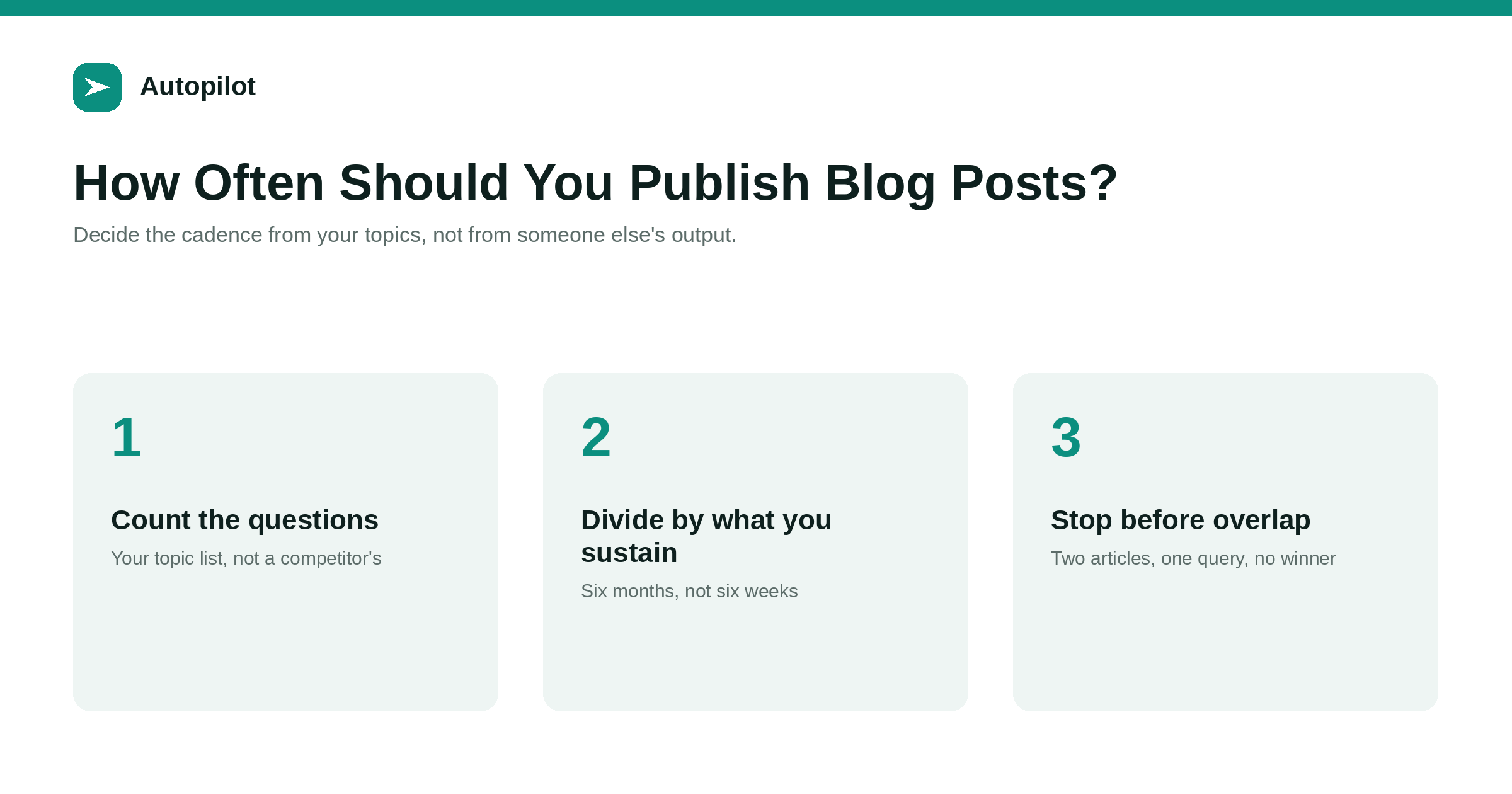
Short answer: publish as often as you can cover genuinely different questions, and no more often. For most small businesses that is one to four articles a month; for a site whose topic has hundreds of real sub-questions it can be far higher. Consistency matters more than volume, because a blog that stops for three months loses the compounding it paid for. The number that matters is not articles per month but distinct questions answered per month — and when two pieces answer the same question, you have added cost rather than reach.
Every answer to this question that begins with a number is wrong, including the popular ones. "Four times a week" is correct for a news site and ruinous for a two-person consultancy with eleven things worth saying.
The useful answer comes from your own topic list, from what you can sustain, and from the point at which your articles start competing with each other. All three are measurable without guessing at anyone else’s data.
Start from the questions, not the calendar
Write down every question a customer has actually asked you, plus every question someone would type before becoming a customer. Not keywords — questions. Most businesses reach somewhere between twenty and eighty before running out.
That list is your ceiling. If there are forty genuine questions, then forty articles is the size of the useful blog, and the only decision left is how fast you want to get there. Four a month finishes in ten months; twelve a month finishes in under four and then has nothing left.
This is why blogs run out of ideas and start repeating themselves. They set a cadence first and then went looking for things to fill it.
Consistency beats volume, and here is why
Search visibility compounds slowly. An article published today is rarely at its best for months, because it takes time to be found, linked and refined.
A blog that publishes two articles a month for a year has twenty-four pieces at various stages of that curve, continuously. A blog that publishes twelve in January and nothing afterwards has the same twenty-four pieces’ worth of effort concentrated into one cohort, all ageing together, with eleven months of silence behind it.
The second pattern also breaks the habit. Stopping for a quarter is the most common way a blog dies, and the reason is almost always an unsustainable schedule set with enthusiasm in month one.
The overlap ceiling
There is a point at which more articles subtract. It arrives when two pieces answer the same question, because search engines must choose between them and readers get whichever the algorithm picked rather than your best one.
Symptoms, in order of appearance: two of your pages trading places for the same query; internal links that could reasonably point to either; an author who cannot remember whether a subject is already covered.
The fix is not to publish less. It is to merge the overlapping pieces into one stronger article and redirect the weaker URL — and to check the existing list before commissioning anything new.
What cadence suits which situation
These are starting points to adjust, not rules.
| Situation | Sensible cadence | Why |
|---|---|---|
| New blog, small topic list | 2–4 a month | Enough to build a base without exhausting the list |
| New blog, large topic list | 8–12 a month for six months | Coverage compounds; slow down once the core is covered |
| Established blog, steady business | 2–4 a month | Maintenance plus a few new questions |
| Fast-moving field | Weekly or more | The questions change faster than the articles age |
| Local service business | 1–2 a month | The useful question list is genuinely short |
Notice that the high-frequency rows are justified by the size of the question list, not by ambition. When automation makes twelve articles a month affordable, that is a reason to cover more questions properly, not a reason to answer the same one twelve ways.
Quality does not have to fall as volume rises
The assumption behind "publish less, but better" is that the two trade off against each other. They do when one person is writing everything, because attention is the scarce resource. They do not when the constraint is removed.
What actually degrades at higher volume is not the prose — it is the thinking that comes before it. Nobody chooses forty overlapping topics on purpose; they choose them because the schedule demanded a subject and the list was empty. Keep the list full and honest, and the twentieth article of the month is as considered as the second.
So the discipline that matters at higher cadence is not writing discipline. It is list discipline: no topic enters the queue unless it answers a question no existing article answers.
Making a cadence survive contact with reality
Three habits separate blogs that keep going from blogs that stop.
Decide the cadence for the worst month, not the best one. If December is chaos every year, set the schedule December can survive.
Keep the list ahead of the schedule. Always have more approved topics than the next two months need, so nobody is inventing a subject under deadline.
Separate writing from publishing. The month writing stalls should not be the month the blog goes quiet; that is precisely what a queue is for. Autopilot works from a topic list with monthly article credits — and because those credits do not roll over, the plan you pick should match the cadence you will actually keep rather than the one you hope for. Current limits are on the pricing page, and automating a blog without losing quality covers the review step that keeps quality steady as volume rises.
The bottom line
Count the real questions, divide by what you can sustain through your worst month, and stop adding articles once new ones start overlapping old ones. That produces a cadence you can defend, a blog that keeps compounding, and a list you finish rather than a treadmill you abandon. Volume is cheap now; distinct, useful coverage is not, and that is the number worth tracking.
الأسئلة الشائعة
Is publishing daily better for SEO?
Only if you have enough distinct questions to fill each day usefully. Daily publishing with overlapping topics produces pages that compete with each other.
Does Google reward a regular schedule?
There is no schedule bonus. What regularity produces is a steady supply of pages entering the slow compounding curve, and a habit that survives busy months.
What happens if I stop for three months?
Existing articles keep working; they do not vanish. What you lose is momentum, the habit, and the three months of new questions you did not answer.
Should I republish old articles instead of writing new ones?
Often, yes. Updating a page that already ranks is usually a better use of an hour than adding a page that starts from nothing.
How many articles before I see results?
Honestly, it varies too much to promise. What is predictable is the shape: very little for months, then gradual compounding. Anyone quoting a specific number of articles is guessing.
Can I publish more if the articles are automated?
You can publish more of what you have decided to cover. Automation raises the ceiling on production, not on the number of genuinely different questions your audience asks.