ENEnglish
 LTLietuviškai
 DEDeutsch
 FRFrançais
 RUРусский
 ESEspañol
 PLPolski
 ITItaliano
 UKУкраїнська
 CSČeština
 PTPortuguês
 JA日本語
JA日本語 LVLatviešu valoda
 ETEesti
 HUMagyar
 IDBahasa Indonesia
 TRTürkçe
 HIहिन्दी
 ELΕλληνικά
 ARالعربية
 THไทย
THไทย VITiếng Việt
 RORomână
 MSBahasa Melayu
 BNবাংলা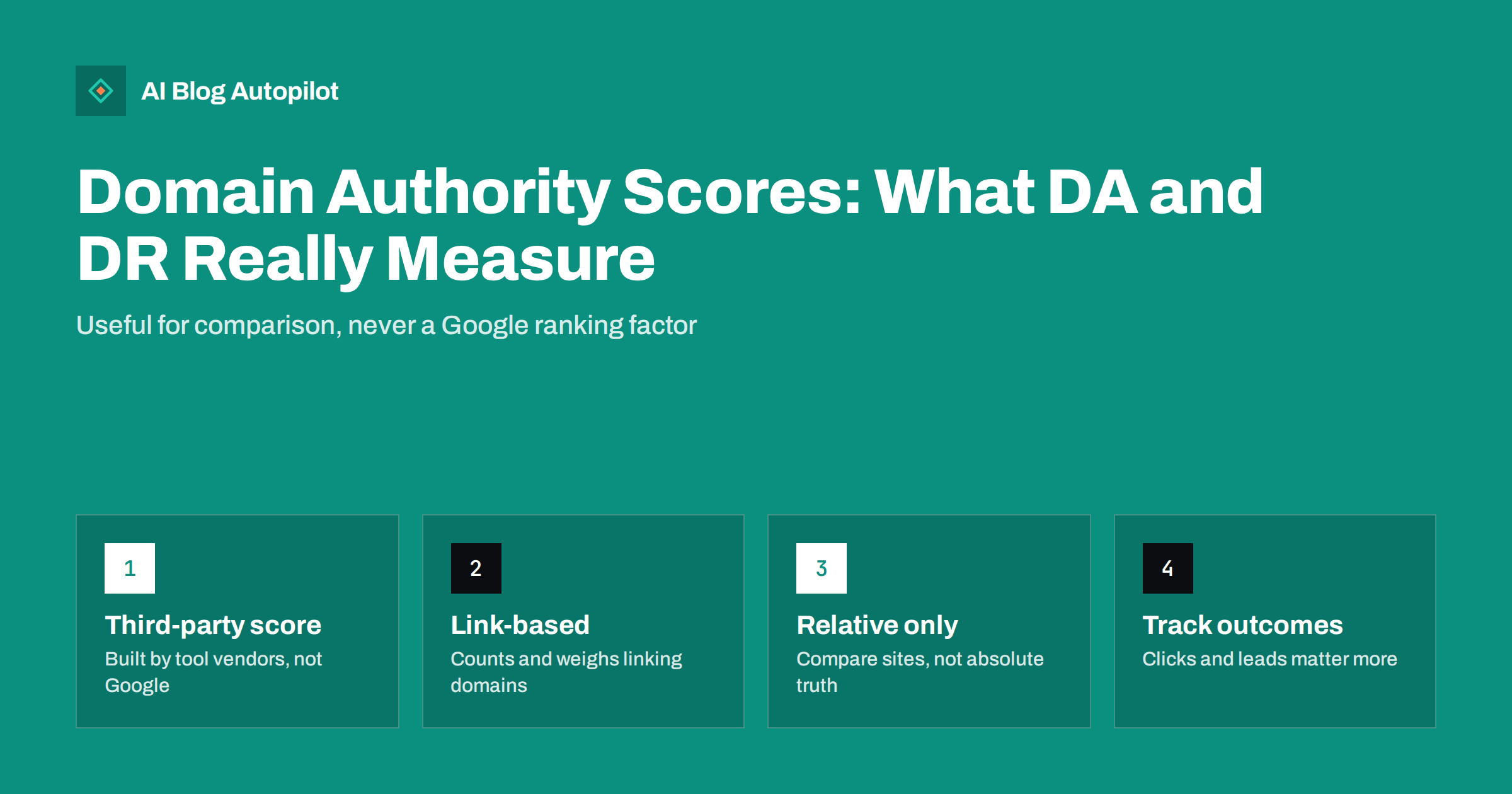
Short answer: Domain Authority (DA) and Domain Rating (DR) are scores invented by SEO tool companies to estimate how strong a website’s backlink profile is compared with other sites. Google does not use them, and a higher number does not by itself cause better rankings. They are useful as a rough, relative way to compare sites, judge link opportunities and track link growth over time, but they should never replace real outcomes such as impressions, clicks and enquiries.
Almost every blog owner eventually meets these numbers. A guest post offer arrives promising “a DA 50 link”, a competitor analysis tool shows a big red score next to your domain, or an agency report celebrates a two-point rise. It is easy to treat the score as an official grade. It is not, and understanding what sits behind it helps you use it sensibly.
What DA, DR and similar scores are
Several SEO tool vendors publish their own domain-level score. The names differ, and so do the formulas, but the idea is the same: summarise the strength of all links pointing to a domain in one number, usually on a scale from 0 to 100.
- Domain Authority (DA) is the score popularised by one of the oldest SEO software companies. It is presented as a prediction of how likely a domain is to rank compared with others.
- Domain Rating (DR) is a similar score from another large backlink tool. It focuses on the size and strength of a site’s backlink profile.
- Other “authority” scores exist in most all-in-one SEO suites. Each is calculated from that vendor’s own crawl of the web.
The important point is that each tool can only see the links its own crawler has found. Two tools can give the same site very different numbers, and neither of them is wrong in its own terms. They are measuring slightly different things with different data.
How the scores are calculated
Vendors do not publish every detail, but the broad inputs are well known and fairly consistent across tools:
- Number of linking domains. Links from many different websites count for more than many links from the same site.
- Strength of those linking domains. A link from a site that itself has many good links counts more than one from a brand-new site.
- How the link equity is shared. A site that links out to thousands of other domains passes less value to each one.
- Adjustments for scale. The scales are usually logarithmic, so moving from 10 to 20 is far easier than moving from 60 to 70.
Some tools also try to filter out obvious spam or use machine learning to fit the score to observed rankings. None of this involves your content quality, your topic relevance or how well a page answers a query, which are exactly the things that decide most rankings for a blog post.
What Google says about authority scores
Google has stated publicly on many occasions that it does not use a “domain authority” metric of this kind, and certainly not any third-party score. Search engines do evaluate links, and links remain one of many signals. But they are evaluated page by page and in context, not through a single number that a tool company can see.
This has two practical consequences. First, you cannot “raise your DA” as a ranking tactic: if you gain better links, rankings and the score may both move, but the score is a side effect, not a cause. Second, a site with a modest score can outrank a site with a much higher one when its page is the better answer. Many small, specialist blogs rank well for long-tail queries against much larger domains for exactly this reason.
Where these scores are genuinely useful
None of this means the scores are worthless. Used as a rough comparison tool, they save time.
- Comparing yourself with competitors. If every site ranking for a topic has a much stronger link profile than yours, that tells you the query may be hard to win without better links or a more specific angle. The existing guide on competitor content analysis shows how to combine this with content comparisons.
- Screening link opportunities. When you consider a guest post or a partnership, a very low score combined with no real traffic is a warning sign. It is a quick filter, not a verdict.
- Tracking your own trend. Over months, a slowly rising score usually reflects that more sites are linking to you. That is useful as a lagging indicator of digital PR and outreach work.
- Spotting sudden changes. A sharp drop can mean the tool lost a batch of your links from its index, or that some links were removed. It is a prompt to look closer.
Where they mislead
The same scores cause poor decisions when people treat them as absolute truths.
- Scores can be inflated. Because the formulas lean heavily on links, networks of sites can link to each other to push a number up. A high score on a site with no real readers is a classic sign of a link seller.
- Scores ignore relevance. A link from a respected site in your own niche can be worth far more to you than a link from a high-scoring general site that has nothing to do with your topic.
- Scores ignore pages. Rankings happen for pages. A strong domain can host a weak article that never ranks, and a modest domain can host an excellent one that does.
- Scores move for reasons unrelated to you. When a vendor updates its model or expands its index, scores across the web can shift. Your “drop” may simply be a recalibration.
- Different tools disagree. Reporting DA to one client and DR to another, or mixing them in one report, creates confusion. Pick one tool if you track the metric at all.
Reading a score correctly: three typical situations
Numbers only mean something in context. These are situations blog owners run into regularly, and how to interpret each one.
- “Our score is lower than our competitor’s, but we outrank them.” This is common and not a contradiction. Your page may match the search intent better, be more complete or be more specific. Keep improving the page and do not chase the competitor’s number.
- “Our score went up, but traffic did not.” New links may point to pages that do not target valuable queries, or the links may be weak in relevance. Check which pages gained links and whether those pages are the ones you want to rank.
- “A site with a high score offers us a link for a fee.” Look at the site’s actual traffic, the topics it covers and whether it publishes posts on everything from casinos to gardening. Sites that sell links widely are exactly the kind search engines learn to discount.
In each case the score is a starting question, not an answer. The follow-up is always the same: look at the pages, the links themselves and the real search data.
A sensible way to use authority scores on a blog
For most business blogs, the score deserves a small role in a larger process. Here is a practical approach.
- Choose one tool and stick with it. Consistency matters more than which vendor you use.
- Check the score monthly or quarterly, not daily. It changes slowly and daily checks only create anxiety.
- Record it alongside real outcomes. Put the score next to impressions, clicks and conversions from your own analytics and Search Console. If the score rises and nothing else does, it is not telling you much.
- Use it as one filter among several. When judging a linking site, also look at whether it has real content, real readers, a relevant topic and an editorial standard.
- Never buy links based on the score. Paid links intended to manipulate rankings break search engine spam policies, and a high score does not make them safe.
What actually builds a stronger site
If you want the underlying thing that the scores try to estimate, a stronger and more trusted site, the work is familiar and slow:
- Publish articles that answer real questions better than what already ranks.
- Create things people want to reference: original data, clear explanations, useful templates and honest comparisons.
- Build relationships in your industry so that other sites mention and link to you naturally.
- Keep your own site well linked internally, so that the value you earn flows to the pages that need it.
- Cover your topic consistently over time, which builds the kind of topical authority that no single score captures.
Links earned this way tend to raise third-party scores as a by-product. More importantly, they bring readers and help the right pages rank.
How AI Blog Autopilot fits in
AI Blog Autopilot does not measure or report third-party authority scores, and it does not build links. Its job is the part of the work that creates reasons to link to you: it plans articles around real search queries, writes long-form posts of 2,000 to 3,000 words with FAQ sections, tags and SEO meta, runs an automatic quality check before publishing, and shares each article to your social networks. A steady stream of useful articles gives outreach and PR something worth pointing to. You can see how Autopilot works on the home page.
Related reading
- Earning Backlinks Honestly: What Works for a Small Site
- Digital PR on a Small Budget
- Guest Posting: What Still Works and What Does Not
The bottom line
DA, DR and similar scores are vendor estimates of backlink strength. They are handy for comparing sites and screening link opportunities, but Google does not use them and they say nothing about the quality of a specific article. Track them lightly if you find them useful, and judge your blog by what matters: whether the right pages appear in search and whether readers become customers.
الأسئلة الشائعة
Does Google use Domain Authority or Domain Rating?
No. Both are scores created by SEO tool companies from their own link data. Google evaluates links and many other signals in its own way and does not use any third-party authority score.
What is a good Domain Authority score for a blog?
There is no universal good score, because the scale is relative and logarithmic. Compare your score with the sites that rank for your target topics rather than with an absolute number, and focus on the trend over months.
Why do DA and DR give different numbers for the same site?
Each tool crawls the web separately and uses its own formula. They find different sets of links and weigh them differently, so the scores are not interchangeable. Use one tool consistently if you track the metric.
Can I increase my Domain Authority quickly?
Only by gaining links, which takes time when done properly. Schemes that inflate scores quickly usually rely on low-quality or paid links, which can break search engine spam policies and do not bring real readers.
Should I refuse a guest post because the site has a low score?
Not automatically. A small, relevant site with real readers can be a better place for your content than a high-scoring general site. Look at relevance, editorial quality and actual audience as well as the score.