ENEnglish
 LTLietuviškai
 DEDeutsch
 FRFrançais
 RUРусский
 ESEspañol
 PLPolski
 ITItaliano
 UKУкраїнська
 CSČeština
 PTPortuguês
 JA日本語
JA日本語 LVLatviešu valoda
 ETEesti
 HUMagyar
 IDBahasa Indonesia
 TRTürkçe
 HIहिन्दी
 ELΕλληνικά
 ARالعربية
 THไทย
THไทย VITiếng Việt
 RORomână
 MSBahasa Melayu
 BNবাংলা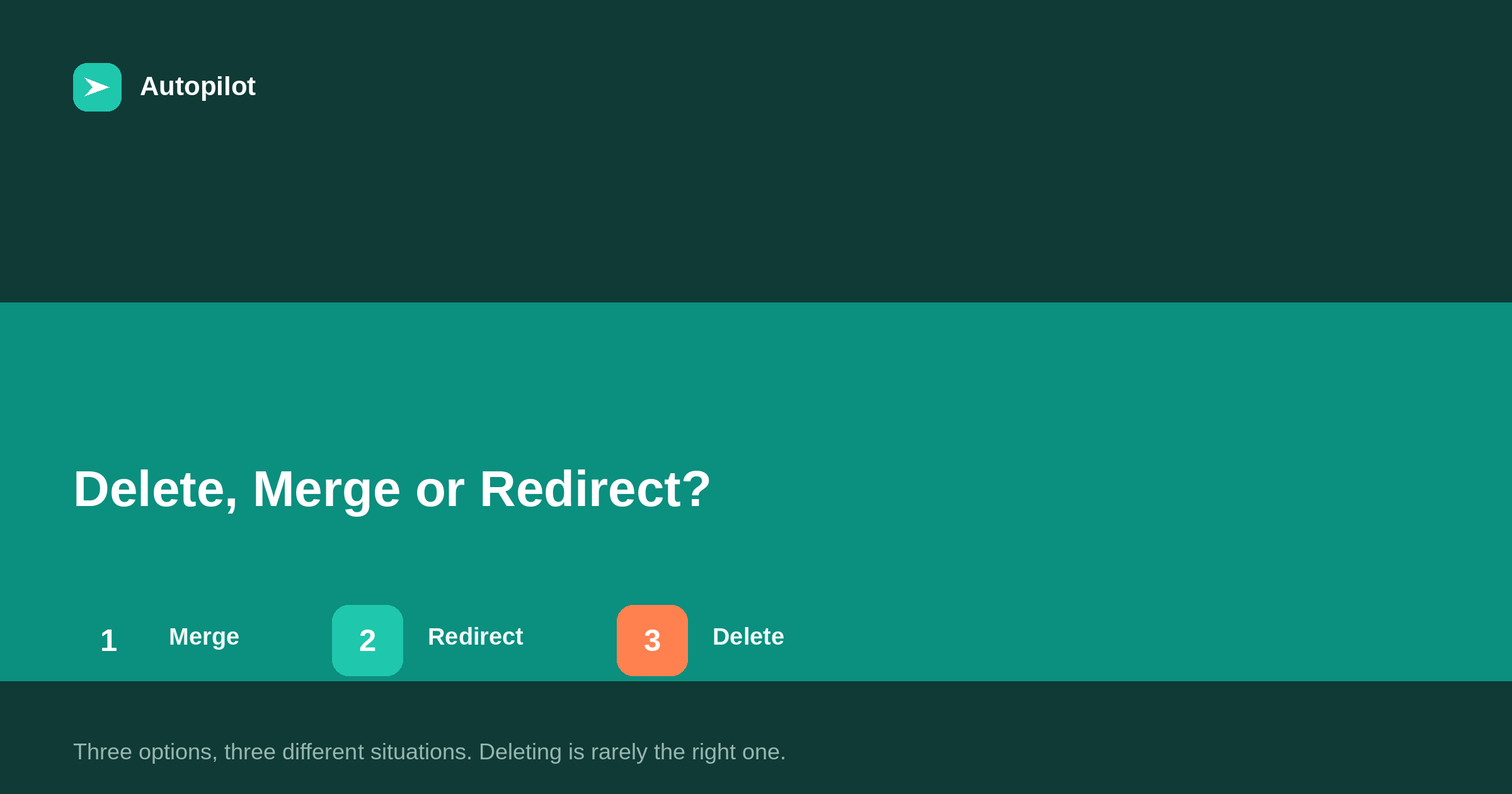
Short answer: merge overlapping articles into one stronger page and redirect the weaker URL; redirect pages that are obsolete but had traffic or links; delete only pages that have neither and never will. Pruning is not about the number of articles — a large blog is not a problem in itself. It is about pages that compete with each other, contradict each other, or mislead readers, and the usual answer is consolidation rather than removal.
Advice to "prune your content" is often taken as advice to delete, which is the option that destroys value fastest. A page with few visitors may still hold links, still answer a question occasionally, and still cost nothing to keep.
Pruning is really consolidation: fewer, stronger pages covering the same ground, with the history of the old URLs preserved.
What pruning fixes
Three genuine problems, none of which is "too many articles".
Self-competition. Two or more of your pages answering the same query. Search engines pick one, usually not your best, and both stay weaker than a single merged page would be.
Contradiction. An old article saying something you no longer believe or that is no longer true. This damages trust in a way no ranking report shows.
Dead weight with a cost. Pages that mislead, describe discontinued things or point everywhere at broken links.
A page that simply gets little traffic is not on that list. Low traffic is not a problem; confusion is.
The three options
| Situation | Action | What happens to the URL |
|---|---|---|
| Two pages, one query, both thin | Merge | Weaker URL redirects to the survivor |
| Page obsolete, had traffic or links | Redirect | To the closest current page |
| Page obsolete, never had either | Delete | Returns 404 or 410 |
| Page thin but unique and true | Expand | Unchanged |
| Page fine, just old | Refresh | Unchanged |
The fourth and fifth rows cover more cases than people expect. Much of what looks like a pruning candidate is actually a candidate for the treatment in the refresh guide.
Merging, done properly
Merging is the most valuable and the most often botched.
- Choose the survivor — usually the page with more history, not necessarily the better text.
- Move what is worth keeping from the other pages into it, properly integrated rather than appended.
- Redirect the retired URLs to the survivor with a permanent redirect.
- Fix internal links that pointed at the retired URLs, so they point at the survivor directly rather than through the redirect — the problem described in internal linking as you publish.
- Check the survivor still reads as one article, not as three stitched together.
Step four is the one that gets skipped, and skipping it leaves every internal link on the site travelling through a redirect for years.
When deleting is actually right
Deletion is correct in a narrow set of cases: duplicate pages created by accident, test posts, pages about something that no longer exists and has no successor, and content that is wrong in a way that cannot be corrected.
Even then, check first whether anything links to the page from outside. If something does, redirect instead — a 404 throws that away permanently, and it costs nothing to keep.
Never bulk-delete by traffic threshold. That rule deletes seasonal pages in their quiet month and pages that serve a small but valuable audience.
Deliberate drafts, and why they must survive
One warning worth stating plainly, because it is how a careful pruning project gets undone.
If you merge articles by turning the retired ones into drafts, any process that automatically republishes drafts will bring them back. We have seen exactly this: nine posts deliberately converted to drafts during a consolidation, and an automated routine that blindly republished drafts would have restored all nine overnight and re-created every duplicate.
The safe pattern is to retire URLs with redirects rather than drafts, and to make sure anything automated leaves deliberate drafts alone.
Pruning a blog that is still publishing
Pruning and automated publishing coexist without difficulty if two things are true.
First, the topic queue is checked against what already exists, so new articles do not re-create the overlaps you just removed. That is the list discipline described in picking topics worth writing.
Second, nothing automated touches existing posts. Publishing new articles is safe; a process that edits or republishes old ones can undo a consolidation without anyone noticing. Autopilot publishes new articles and does not modify or republish what is already there, which is the property that matters here.
Practically, a quarterly review is enough: find overlaps, merge, redirect, fix the internal links, and add the merged topic to the list of things already covered.
Keeping a record of what you merged
Write down every merge: which URLs were retired, what they covered, and which page absorbed them. Without that record, the same topics get proposed again six months later by someone who was not in the room, and the overlap rebuilds itself. A single shared list of retired topics, checked when new topics are added, prevents the whole cycle and takes a minute per merge to maintain.
Related reading
If this was useful, these cover the questions that usually come next.
- Refreshing old posts — the option to try before consolidating
- Internal linking as you publish — the step people skip after a merge
- Picking topics worth writing — keeping overlaps from growing back
The bottom line
Prune for overlap and contradiction, not for page count. Merge competing articles into one stronger page, redirect anything obsolete that had traffic or links, and delete only what has neither. Fix the internal links afterwards, keep deliberate drafts safe from anything automated, and check new topics against what you already published so the overlaps do not grow back. Work through it once a quarter and the archive stays something a reader can navigate, rather than a list you have quietly stopped looking at yourself.
الأسئلة الشائعة
Does deleting old posts improve SEO?
Not by itself. What helps is removing self-competition and contradictions, which merging usually achieves better than deleting, because merging keeps what the old pages had.
Should I delete pages with no traffic?
No, not on that basis alone. Low traffic is not a problem; pages that compete with each other or mislead readers are. Check for external links before removing anything.
What redirect should I use?
A permanent one, to the closest equivalent page. Redirecting everything to the homepage is treated as a soft 404 and helps nobody.
How do I find overlapping articles?
Look for queries where two of your pages appear, and compare titles by the question they answer rather than by wording. Two different titles asking one question is the usual form.
Is a large blog a problem?
No. Size is not the issue; overlap and contradiction are. A thousand pages that each answer something distinct is a healthy site.
Can I prune while still publishing automatically?
Yes, provided new topics are checked against what exists and nothing automated edits or republishes old posts. Those two conditions keep the two activities from fighting.