ENEnglish
 LTLietuviškai
 DEDeutsch
 FRFrançais
 RUРусский
 ESEspañol
 PLPolski
 ITItaliano
 UKУкраїнська
 CSČeština
 PTPortuguês
 JA日本語
 LVLatviešu valoda
 ETEesti
 HUMagyar
 IDBahasa Indonesia
 TRTürkçe
 HIहिन्दी
 ELΕλληνικά
 ARالعربية
 THไทย
 VITiếng Việt
 RORomână
 MSBahasa Melayu
 BNবাংলা
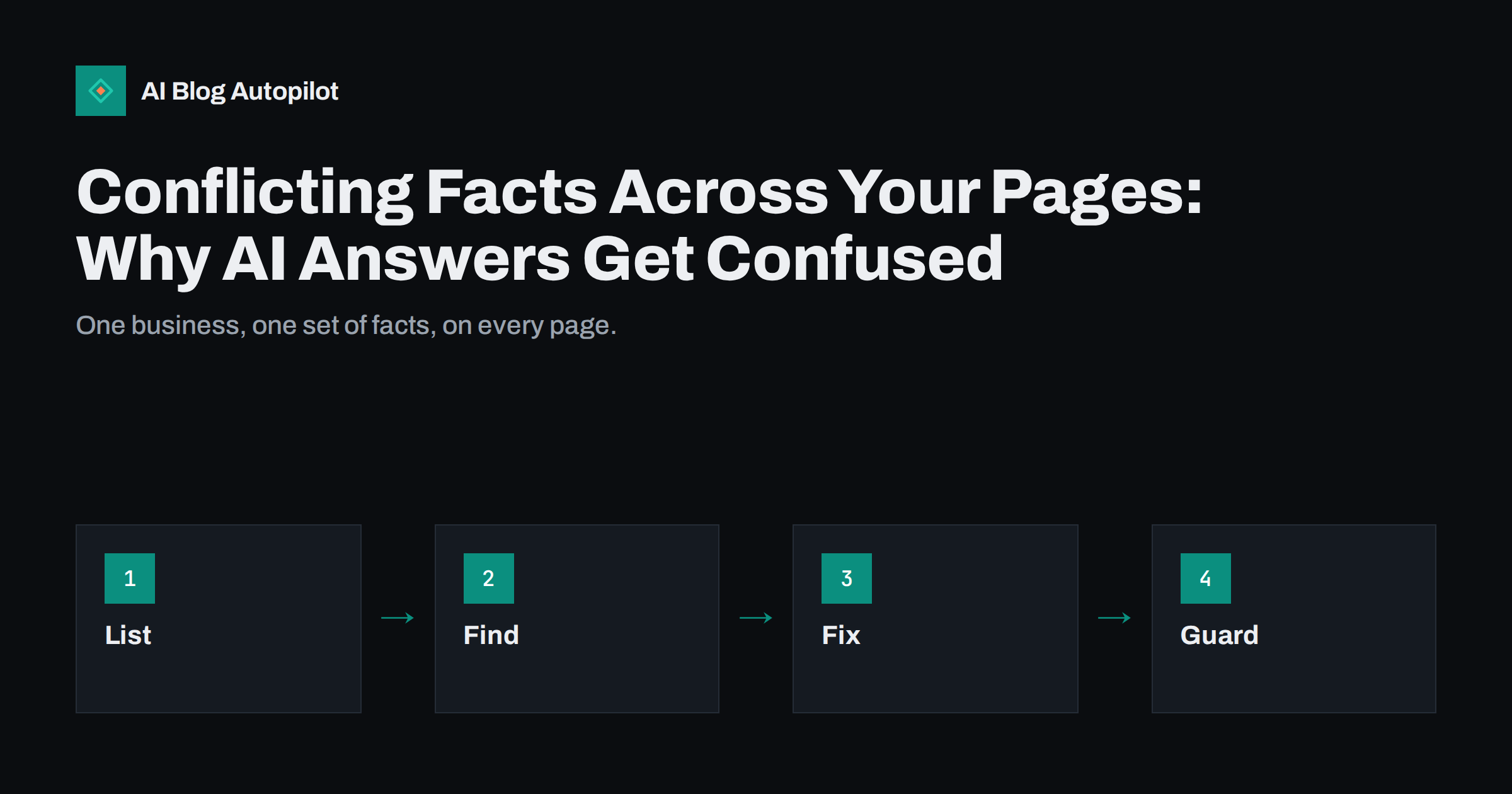
Short answer: AI assistants build their answers about your business from several of your pages at once, plus whatever third parties say about you. When those pages disagree, about the founding year, the number of staff, the price of a plan, the location, the product name or what is included, the assistant either picks one version, often the oldest or most repeated, or hedges with “sources vary”. The fix is a short list of the facts that must agree, a crawl of your site for every place each fact appears, one authoritative page per fact, and a habit of updating every copy when the fact changes. Consistency is cheap to maintain and expensive to lack, because a wrong fact in an AI answer is hard to correct after the event.
Inconsistency creeps in slowly. The about page was written at launch, the footer was copied from an old template, the pricing page was updated last month, a blog post from three years ago still quotes the old plan names and the press page lists a city you moved away from. Each page is individually plausible, and no human reader sees them all at once. Assistants and search engines do. They retrieve passages from across the site, compare them with each other and with external sources, and resolve the differences as best they can, which usually means not in your favour. This article explains which facts matter, how conflicts arise, how to find them and how to keep one set of facts in place as the site grows.
How assistants combine your pages
When someone asks an assistant about your company, it typically retrieves several passages: the home page description, the about page, the pricing page, a few blog posts and perhaps a directory entry or a review site. It then writes an answer that reconciles them. If three pages say the business was founded in 2014 and one says 2016, the answer may say 2014, may say 2016 if that page looks newer or more authoritative, or may say “founded around 2014–2016”. If the pricing page says a plan costs 49 and a blog post says 39, the assistant has no way to know which is current unless the pages say so. Assistants also weigh outside sources; a wrong fact in a directory can outvote a right fact on your site if your site itself is inconsistent. Our article on how AI assistants know your business explains the mix of training data and live retrieval behind this.
The facts that must agree
Not every sentence needs policing. A small set of facts is quoted again and again, and those are the ones to keep consistent.
- Identity: legal name, trading name, product names and how each is spelled and capitalised.
- Origins: founding year, founders, ownership and any parent company.
- Location: registered address, office locations, countries served and languages supported.
- Size: number of staff, customers, sites or users, if you publish any of them.
- Offer: plan names, prices, what each includes, limits, free tiers and trial terms.
- Contact: email addresses, phone numbers, support hours and response times.
- Policies: refund terms, cancellation, data location and compliance claims.
- Numbers you promote: integrations, networks, languages, years of operation and any statistic in your marketing.
Write these down as a one-page fact sheet with a date, an owner and the URL of the page that is the authoritative source for each. That sheet becomes the reference for everyone who writes about the business, including any automated writer.
Where conflicts come from
Knowing the usual sources makes them easier to find.
- Old blog posts that quote prices, plan names, features or team sizes as they were at the time.
- Templates and footers copied between sites or pages years ago and never revisited.
- The about page, which tends to be written once and forgotten.
- Press and media pages with stale boilerplate and old logos.
- Help centre articles describing a previous version of the product.
- Translated pages updated later than the original, or not at all.
- Structured data with an old address, name or founding date that nobody looks at because it is invisible.
- Social profiles, directories and review sites that were filled in once and drifted from the site.
- Marketing pages written with round numbers (“over 50 integrations”) while the product page states an exact number that has since changed.
Rounded, approximate or “over” figures are a frequent cause. If one page says “60 networks” and another says “more than 50”, both may be true, but an assistant may present them as a disagreement or quote the smaller one. Decide on one figure and one wording, and use it everywhere.
Finding the conflicts
You do not need to read the whole site. Search for each fact instead.
- Crawl the site with a tool that exports page text, then search the export for each fact’s key terms: the old and new prices, every plan name you have ever used, each year you might have stated as the founding year, old addresses and old product names.
- Use the site search operator in a search engine for the same terms, which also shows what the search index currently holds.
- Check structured data on the home page, about page and product pages with a validator, and read the values rather than only checking for errors.
- Read the translations of key pages, or at least the figures in them, if you publish in several languages.
- Check external profiles: business listings, social bios, app store pages, directories and review sites, which assistants also read.
- Ask assistants directly what they know about your business and note every fact that is wrong or hedged; each one points to a conflict somewhere. Our article on checking your visibility in AI answers describes a simple routine.
Record each conflict in the fact sheet: the fact, the correct value, every URL with a wrong or outdated value and who will fix it.
Fixing them without rewriting everything
The aim is one authoritative page per fact, with every other mention either matching it or clearly dated.
- Correct the authoritative page first: the pricing page for prices, the about page for origins and size, the contact page for contact details.
- Update the copies that still matter: footers, templates, structured data, help articles and the home page.
- For old blog posts, either update the figure with a note of the change, or add a short dated line at the top saying that prices and features described were current at publication and linking to the current page. Do not leave an old price with no context.
- Remove figures from pages that do not need them. A footer does not need a staff count; a blog post about writing does not need the plan price.
- Align external profiles with the site, and keep a list of them.
- Use exact, consistent wording for each fact so that it is recognised as the same fact everywhere, including in other languages.
Where a fact has genuinely changed, say so once in a visible place, for example a short note on the pricing page that prices were updated on a given date. Assistants and readers both treat a dated change more kindly than a silent contradiction. Our article on product and pricing facts covers how to present them so that they are easy to quote.
Keeping facts consistent as you publish
Consistency breaks again every time something changes, so it needs a process rather than a one-off audit.
- Keep the fact sheet current and give it one owner. Any change to a listed fact starts with the sheet.
- Add a “which facts does this change” step to product, pricing and company announcements, with the list of pages to update.
- Give writers and automated tools the fact sheet, and instruct them to take figures only from it. A brief that says “do not state prices or counts; link to the pricing page” prevents most new conflicts.
- Prefer links over figures in articles. “See the current plans on the pricing page” never goes stale; “the Growth plan costs 49” does.
- Review published articles that contain facts on a schedule, in the same pass as your other content refreshes.
- Re-ask assistants every few months and compare their answers with the sheet.
When the wrong fact is already out there
If an assistant is already repeating an outdated or wrong fact, consistency on your own site is the first and most effective step, because retrieval-based answers change as soon as the pages they read change. Correct external listings next, since they are often the source. Where an assistant relies on older training data, the correction takes longer to appear, and the best you can do is to make the current fact unambiguous and widely repeated on pages that are crawled often, such as the home page and the pricing page. Our article on what to do when AI answers get your business wrong goes through the options in order.
How AI Blog Autopilot helps
AI Blog Autopilot writes articles from the topics, keywords, audience and tone you set, and its writer is instructed not to invent statistics, quotes or sources, so you can tell it which facts to use and which to leave to a link. Use approval mode if you want to check every figure before an article goes live, and keep your fact sheet in the topic notes so that new articles repeat the current facts rather than old ones. Plans are on the pricing page.
Related reading
- Product and Pricing Facts: Making Them Easy for AI Answers
- Entities and AI Search: Making Your Business Easy to Understand
- When AI Answers Get Your Business Wrong: What to Do
- Checking Whether AI Assistants Mention Your Blog
The bottom line
AI assistants read your site as a whole and resolve disagreements between pages in ways you do not control. Keep a dated fact sheet of the figures that must agree, search the site and your external profiles for every mention, make one page authoritative for each fact, fix or date every other copy, and give the sheet to everyone and everything that writes for you. Prefer links to figures in articles, and re-check what assistants say about you a few times a year.
الأسئلة الشائعة
Why does an AI assistant quote an old price for our product?
Because an old page, blog post or external listing still states it, and the assistant found that version. Update or date every copy and make the pricing page the single authoritative source.
Which facts should we keep consistent across the site?
Names, founding year, locations, size figures, plan names and prices, what is included, contact details, policies and any number you use in marketing.
Do old blog posts with outdated facts need rewriting?
Not fully. Update the figure with a note, or add a dated line at the top saying the details were current at publication and linking to the current page.
Do external listings matter for AI answers?
Yes. Directories, social bios, app store pages and review sites are read alongside your site, and a wrong fact there can outweigh a right one if your own pages are inconsistent.
How often should we check what assistants say about us?
Every few months, and after any change to prices, names, locations or products. Compare the answers with your fact sheet and trace each error to a page.