ENEnglish
 LTLietuviškai
 DEDeutsch
 FRFrançais
 RUРусский
 ESEspañol
 PLPolski
 ITItaliano
 UKУкраїнська
 CSČeština
 PTPortuguês
 JA日本語
JA日本語 LVLatviešu valoda
 ETEesti
 HUMagyar
 IDBahasa Indonesia
 TRTürkçe
 HIहिन्दी
 ELΕλληνικά
 ARالعربية
 THไทย
THไทย VITiếng Việt
 RORomână
 MSBahasa Melayu
 BNবাংলা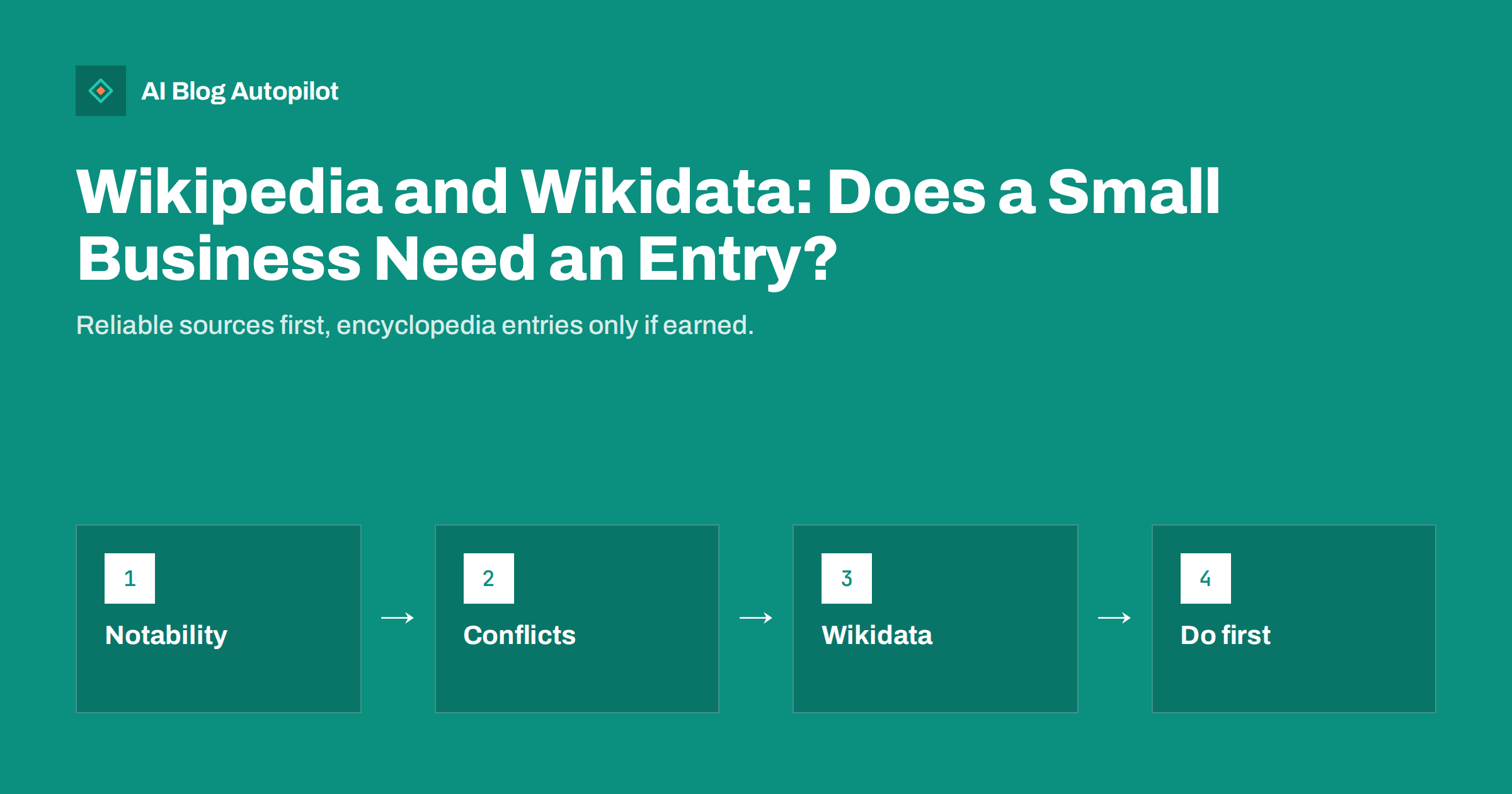
Short answer: most small businesses do not need a Wikipedia page, and many cannot have one, because the encyclopedia only covers organisations that independent, reliable sources have written about in depth. Writing a page about your own company is discouraged and often removed. Wikidata, its structured sister project, has a lower bar but still expects references. A better use of your time is to make your own site clear, keep facts consistent across the places you control, and earn real coverage. If an entry becomes justified, let independent editors create it.
Business owners often hear that AI assistants “learn from Wikipedia” and conclude that they need a page. The reasoning is understandable, but it skips several steps. This article explains what these projects are, why a self-written page backfires, how an entry might arise honestly, and what to do in the meantime so that people and machines can understand who you are.
Why the question comes up
Encyclopedia pages and structured knowledge bases are well-known sources of general facts, and many systems that answer questions use them in some way. When an assistant is asked about a company, a result that includes a short, neutral summary with a founding date, a location and an industry looks more confident than one that does not. So owners ask: if we had an entry, would we be described correctly?
It may help, but nobody outside the systems involved can say how much weight any single source receives, and the weights change. Treat any claim of a guaranteed effect with suspicion. What is certain is that an entry is neither required nor sufficient for being understood. Plenty of businesses are described accurately from their own sites, directories and news coverage, and a page with outdated facts can do harm.
What Wikipedia expects
Wikipedia is an encyclopedia, not a directory. It applies a notability standard: a topic needs significant coverage in multiple independent, reliable sources, such as national or regional news outlets, trade publications and books. Your own website, press releases, social media accounts, interviews where you are the only voice, paid placements and routine listings do not count as independent coverage.
- Size alone does not decide it. A small company with solid independent coverage may qualify, while a larger one with only promotional material may not.
- Neutral tone is required. Marketing language is removed, and claims need citations.
- Anyone can edit, and anyone can challenge. Pages that look promotional are tagged, trimmed or deleted.
For most local shops, agencies, consultancies and early-stage software companies, the honest answer is that they do not meet the standard yet. That is not a failure, it simply means the encyclopedia is not the right place to spend effort.
Why writing your own page backfires
The community strongly discourages editing a page about yourself or your employer because of the conflict of interest. Even when disclosed, a draft written by the subject tends to be read with suspicion. Typical outcomes are a rejected draft, a deletion discussion, or a page that survives with warning banners that look worse than having no page at all.
Paying someone to create or edit a page without disclosure is a serious breach of the rules and can lead to accounts being blocked and pages removed. Several companies have also been publicly embarrassed after attempts to polish their entries were noticed. If you believe your business meets the standard, the accepted route is to propose the topic or request changes on the relevant talk page, disclose your connection and let independent editors decide.
What Wikidata is, and how it differs
Wikidata is a free, structured database. Instead of articles, it stores items with properties, such as an organisation with a name, an official website, an industry, a country and a founding date. Its structured format makes it easy for software to read, which is why it appears in discussions of AI search and entities.
The bar for an item is different from the encyclopedia’s, but it is not absent. Items are expected to describe something that can be identified from serious, publicly available references, or that fulfils a structural need. A business with a registered company record, a website and independent mentions is more likely to remain than one that exists only in its own promotion. The same cautions on conflict of interest apply, so read the project’s guidance on notability and edit disclosure before you add anything about your own organisation, and be ready for the item to be edited or removed by others.
Whatever you do, never enter claims you cannot support with a reference, and never use the project as a place to advertise. Accurate, referenced, minimal data is the only kind that tends to last.
How an entry arises honestly
If you work on becoming a subject worth covering, an entry may follow without any effort of your own. The path is the same as the path to being understood generally.
- Do something worth reporting. A published study, a notable project, an award from a recognised body, or a product that people write about.
- Earn independent coverage. Journalists, researchers and industry writers who describe you in their own words, in sources with editorial standards.
- Keep the facts public and consistent. An about page, a company registry entry and clear contact details help others to describe you correctly.
- Let others decide. If an independent editor creates a page, you may suggest corrections on the talk page, with sources, and disclose your link.
This route takes time, and it benefits you even when no entry appears, because the coverage itself brings readers, links and trust.
What to do instead for AI answers
Most of what helps assistants describe a business accurately is under your own control. Start with the basics and keep them tidy.
- A clear about page that states in plain sentences what you do, where you operate, when you started and who runs the business.
- Consistent names and facts across your site, social profiles, directories and any company registry entries. Mismatched names or old addresses create confusion.
- Organisation structured data on your site, with the official name, website and links to your official profiles, as covered in our guides on entities and structured data.
- Dated, sourced articles that state your key facts in the plain text of the page.
- Genuine mentions elsewhere, such as trade directories, partner pages and interviews, that describe you in the same terms.
A quick audit shows how much there is to fix. Search for your business name and list every place that describes it: your site, your social profiles, map listings, trade directories, partner pages, old press items and any company registry entry. Put the name, address, phone number, website, founding year and one-line description for each in a table. Differences stand out at once, such as an old address in a directory, a former name in a profile, or two different founding years. Correct the ones you control, and ask the owners of the others to update them. This small task often does more for clarity than any attempt to create a new page.
These steps cost little and work whether or not any encyclopedia mentions you. They also help human readers who simply want to check that you are real.
Warning signs of bad offers
Because the topic is poorly understood, it attracts sellers. Be cautious about anyone who promises a guaranteed page, offers to “get you on Wikipedia” for a fee, or claims that an entry will make AI assistants recommend you. Ask how they will handle the conflict-of-interest rules, whether they will disclose payment and what happens if the page is deleted. If the answers are vague, walk away. A deleted page leaves a public record, and a promotional one can harm your reputation more than silence.
Another useful habit is to keep a short, public “facts” paragraph on your about page and update it when something changes. State the legal name, what you do, where you are based, the year you started and the main products or services. Journalists, researchers and assistants that need a quick description can then take it from a source that you keep correct, and anyone who later writes about you has an accurate starting point. Date the paragraph so that readers know it is current.
A realistic checklist
Here is a short test you can run once a year. If you answer no to the first two questions, an entry is not realistic yet and effort is better spent elsewhere.
- Have at least three independent, reliable sources written about us in some depth, beyond a name mention?
- Can we point to that coverage with links and dates?
- Are our name, address, website and key facts the same everywhere we control?
- Does our own site state the basic facts in plain text, with structured data that matches?
- If a page existed, could every claim on it be backed by a source that is not ours?
How AI Blog Autopilot helps
AI Blog Autopilot asks for your topics, keywords, audience and tone, and writes full SEO articles with FAQ, tags and meta for your WordPress blog. Regular, factual articles that state who you are and what you do give assistants and readers more of your own clear material to work from. See the pricing page for plans.
Related reading
- Entities and AI Search: Making a Business Understandable
- Brand Mentions: Why AI Answers Recommend Some Businesses
- Citing Sources in Blog Posts: Why AI Answers Reward It
- The About Page a Business Blog Needs
The bottom line
An encyclopedia entry is a result of notability, not a marketing tool. Do not write one about your own business, avoid anyone who sells them, and treat Wikidata with the same care. Put your effort into a clear about page, consistent facts everywhere you control, structured data that matches and independent coverage that you earn. If an entry ever becomes justified, it will come from independent editors, and you will have done the groundwork already.
FAQ
Will a Wikipedia page make AI assistants recommend my business?
Nobody can promise that. Assistants use many sources, and weights change. A page is neither required nor enough, and an inaccurate one can do harm.
Can I edit the page if one exists about my company?
You should disclose your connection and suggest changes on the talk page with independent sources, instead of editing the article directly.
Is Wikidata easier than Wikipedia?
Its bar differs, but it still expects references and has rules on conflicts of interest. Read its guidance before adding anything about your own organisation.
What should I do if my facts are wrong in an AI answer?
Fix your own site and profiles first so they agree, then earn or request corrections in the sources the answer relies on.
Is it worth paying a service to create a page?
Be very cautious. Undisclosed paid editing breaks the rules, and deleted or promotional pages can damage your reputation.