ENEnglish
 LTLietuviškai
 DEDeutsch
 FRFrançais
 RUРусский
 ESEspañol
 PLPolski
 ITItaliano
 UKУкраїнська
 CSČeština
 PTPortuguês
 JA日本語
JA日本語 LVLatviešu valoda
 ETEesti
 HUMagyar
 IDBahasa Indonesia
 TRTürkçe
 HIहिन्दी
 ELΕλληνικά
 ARالعربية
 THไทย
THไทย VITiếng Việt
 RORomână
 MSBahasa Melayu
 BNবাংলা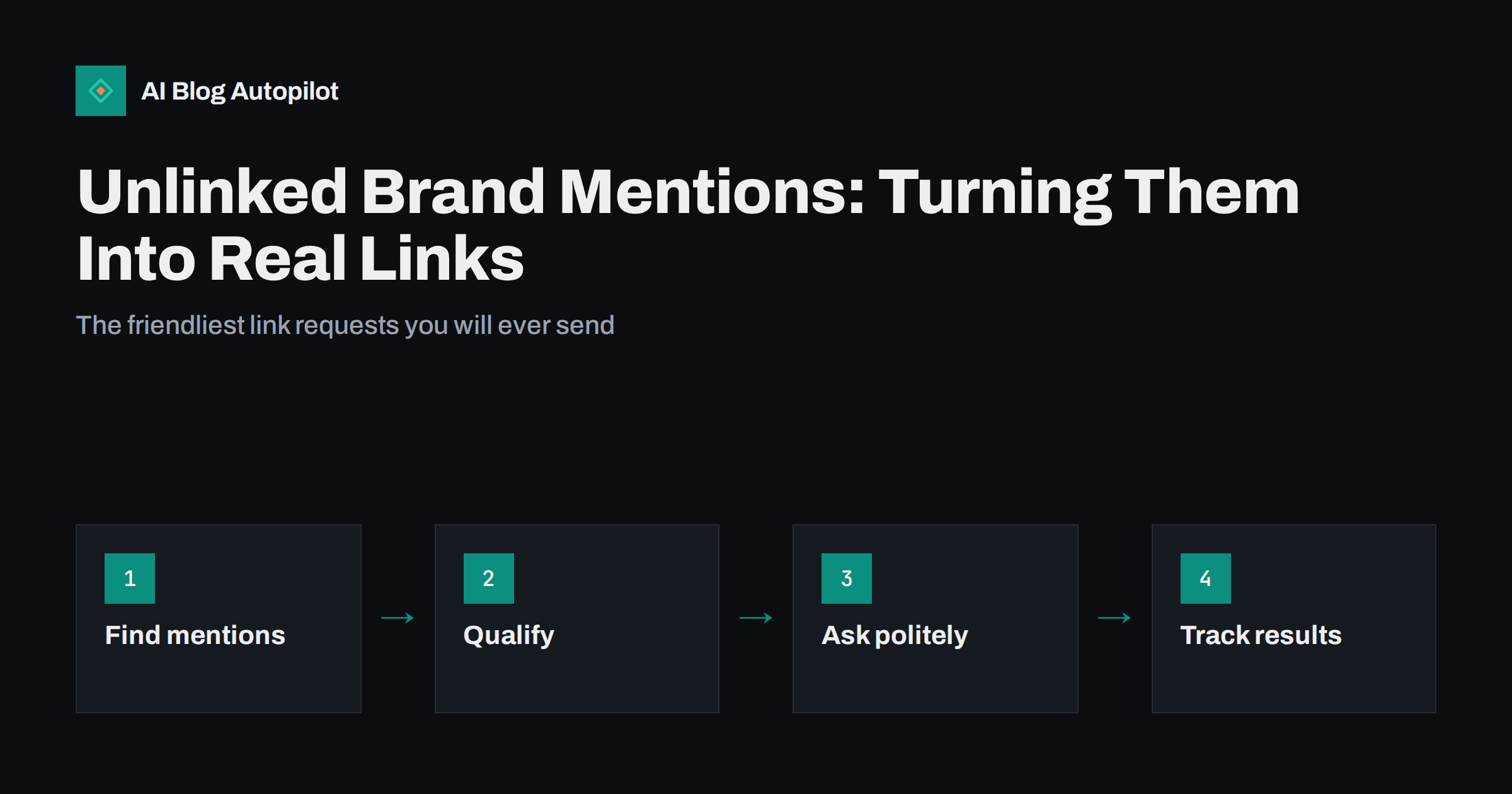
Short answer: an unlinked brand mention is a page that names your business, product or people without linking to your website. Because the writer already knows and chose to mention you, a short, polite request to add a link succeeds more often than cold link outreach. Find mentions with search operators, alerts and backlink tools, keep only relevant editorial pages, and send a brief message suggesting the specific page to link to. Accept that some will say no, and never pay for the link.
Most link building is hard because you are asking strangers to care about you. Unlinked mentions are the exception. Someone has already written about your business, reviewed your product, quoted your founder or listed you as a resource. The only thing missing is the link that would let readers find you, and that search engines use to understand the connection. Reclaiming those links is one of the few link building tasks that is both effective and pleasant for everyone involved. This guide explains how to do it well.
Why unlinked mentions are worth pursuing
- High success rate. The writer already considers you relevant. You are asking for a small edit that helps their readers, not for a favour from scratch.
- Genuine editorial links. These links come from pages written about you by choice, which is exactly the kind of link search engines value.
- Useful for readers. A reader who sees your name in an article and wants to learn more should be able to click through.
- Brand clarity. A link connects the name on the page to your official website, which reduces confusion with similarly named businesses.
- A signal of what earns attention. Mentions show which of your products, people or content get talked about, which informs future PR and content.
Where to find unlinked mentions
You can find most mentions with free or inexpensive methods:
- Search operators. Search for your brand name in quotes and exclude your own site, for example
"Your Brand" -site:yourdomain.com. Repeat with product names and the names of key people. - Alerts. Set up web alerts for your brand, products and founder so new mentions arrive by email as they are published.
- Backlink and mention tools. Many SEO suites have a mentions feature that lists pages naming your brand and shows whether they link.
- Your own records. Interviews you gave, podcasts you appeared on, events you spoke at, awards and supplier or partner listings often mention you without linking.
- Images. Your logo, charts or photos used on other sites are mentions too. Reverse image search can find them.
Search for variations too. People misspell brand names, drop words from them or write them with and without spaces. A business called “Green Leaf Studio” may appear as “Greenleaf”, “Green Leaf” or “GL Studio”. Product names and the names of well-known staff members often appear more frequently than the company name itself.
Collect results in a simple spreadsheet with the URL, the site, what was mentioned, whether a link exists and the contact details you find.
Which mentions to pursue
Not every mention is worth a request. Filter before you write:
- Relevance. Pages in your industry or covering your topic are worth more than random listings.
- Real sites. Skip scraper sites, auto-generated pages and obvious spam, even if they mention you.
- Editorial context. A mention inside an article or review is better than one in a comment or a user profile.
- Sentiment. If a mention is critical, a link request is unlikely to be welcome. Consider responding to the criticism instead, if appropriate.
- Existing links elsewhere on the page. If the article already links to you in another paragraph, there is nothing to ask for.
- Freshness. Recent articles are easier to edit, and their authors remember writing them.
Writing the request
A good request is short, specific and easy to act on. It should take the recipient less than a minute to read and understand. Include:
- A genuine thank-you for the mention, with the article title so they know which one.
- The exact place where you were mentioned, for example “in the section on accounting tools”.
- The suggested link: the most useful page for their readers. That might be your home page, a product page or an article that expands on what they wrote.
- A reason that helps their readers, such as “so readers can find the tool you described”.
- No pressure. A friendly sign-off without follow-up threats or demands.
A message in this spirit works well: “Hi Anna, thanks for including us in your guide to invoicing tools, it was great to see. If it would be useful for your readers, you could link our name in the comparison section to our invoicing page at [URL]. Either way, thanks again for the mention.” That is the whole message.
Finding the right person matters as much as the wording. For a news or magazine site, the article’s author is usually best; for a company blog, the marketing or content contact; for a directory or association listing, whoever maintains the listings. A contact form on a large site often goes nowhere, so look for the author’s professional profile or a named editor instead. If you cannot find anyone reasonable, skip the mention rather than sending a message to a generic address that nobody reads.
What not to do
- Do not offer payment or gifts in exchange for a link. Paid links intended to influence rankings break search engine spam policies, and the offer can damage the relationship.
- Do not insist on exact-match keyword anchor text. Your brand name as the anchor is natural and appropriate.
- Do not send templates that obviously go to hundreds of people. Personalise at least the article title and the place of the mention.
- Do not follow up more than once. One polite reminder after a week or two is acceptable; more is spam.
- Do not ask for links from pages that criticise you unless you have resolved the issue and the author is open to it.
- Do not ask for “dofollow” specifically. If a site uses
nofollowor other attributes by policy, respect it. Such links still bring readers and brand visibility.
Beyond brand names: related opportunities
Once you have a process for brand mentions, a few related opportunities use the same approach:
- Broken links to your site. Pages linking to URLs you moved or deleted. Ask for an update to the current URL, or set up a redirect on your side, which is often faster.
- Wrong links. Mentions linking to a social profile, an old domain or a competitor with a similar name.
- Uncredited content. Sites using your data, charts or images without credit. A polite request for attribution with a link is reasonable.
- Staff mentions. Articles quoting your experts often link to their social profiles only; a link to their bio page on your site can be suggested.
The guide on earning backlinks honestly covers other methods that fit alongside these.
Making it a routine
Link reclamation works best as a small, regular task rather than a one-off project:
- Once a month, review new alerts and mention reports.
- Add qualifying mentions to the spreadsheet.
- Send requests for the best few, personalised.
- Record replies and whether the link was added.
- Send one follow-up where there was no reply after a couple of weeks.
Note which kinds of sites respond best. Over time a pattern appears, for example that industry associations and small specialist blogs reply far more often than large news sites, and you can focus your effort accordingly.
Keep realistic expectations. Many requests will get no reply, some writers cannot edit published articles, and some sites have a strict policy on outgoing links. A minority of positive answers is normal and still worthwhile, because each link gained this way is a genuine editorial one that would be hard to earn otherwise.
Half an hour a month is usually enough for a small business. Over a year, the links add up, and so does your understanding of where you are being talked about.
Creating more mentions in the first place
Reclamation only works if people mention you. Mentions come from being useful and visible: publishing original data or clear explanations that others want to cite, commenting as an expert when journalists ask for sources, speaking at industry events and producing resources worth referencing. The guide to digital PR on a small budget describes practical ways to earn mentions without an agency.
How AI Blog Autopilot fits in
AI Blog Autopilot does not do outreach and does not request or buy links. What it provides is the content that makes mentions and links more likely: long-form articles planned around real search queries, written with FAQs and SEO meta, published regularly and shared to your social networks so people see them. It also gives you relevant pages to suggest when someone mentions you. See how Autopilot works.
Related reading
- Guest Posting: What Still Works and What Does Not
- Domain Authority Scores: What DA and DR Really Measure
- How to Put Something Original in an Article You Automated
The bottom line
Unlinked mentions are link opportunities from people who already chose to write about you. Find them with searches, alerts and tools, keep the relevant editorial ones, and send a short, specific, friendly request suggesting the most useful page. Never pay, follow up once at most, and make it a monthly habit.
FAQ
What is an unlinked brand mention?
It is a page that names your business, product or staff without linking to your website. Because the author already knows about you, asking them to add a link is usually easier than asking a stranger for one.
How do I find unlinked mentions of my brand?
Search for your brand name in quotes while excluding your own domain, set up web alerts for your brand and products, and use the mentions feature in SEO tools. Check interviews, events and partner listings you know about as well.
Is it acceptable to ask for a link?
Yes, when it is polite, specific and helps the site’s readers. It becomes a problem only if you offer payment or pressure, which can break search engine spam policies and harm the relationship.
What page should the link point to?
The page most useful to the site’s readers in that context. It might be your home page, a product page or an article that expands on the topic they wrote about.
What if the site adds a nofollow link?
Accept it. Sites decide their own link policies, and a nofollow link still sends readers and connects your name to your website. Do not argue about link attributes.
How many follow-ups should I send?
One polite follow-up after a week or two is reasonable. If there is still no reply, move on. Many writers are busy, and repeated messages turn a friendly request into spam.