ENEnglish
 LTLietuviškai
 DEDeutsch
 FRFrançais
 RUРусский
 ESEspañol
 PLPolski
 ITItaliano
 UKУкраїнська
 CSČeština
 PTPortuguês
 JA日本語
JA日本語 LVLatviešu valoda
 ETEesti
 HUMagyar
 IDBahasa Indonesia
 TRTürkçe
 HIहिन्दी
 ELΕλληνικά
 ARالعربية
 THไทย
THไทย VITiếng Việt
 RORomână
 MSBahasa Melayu
 BNবাংলা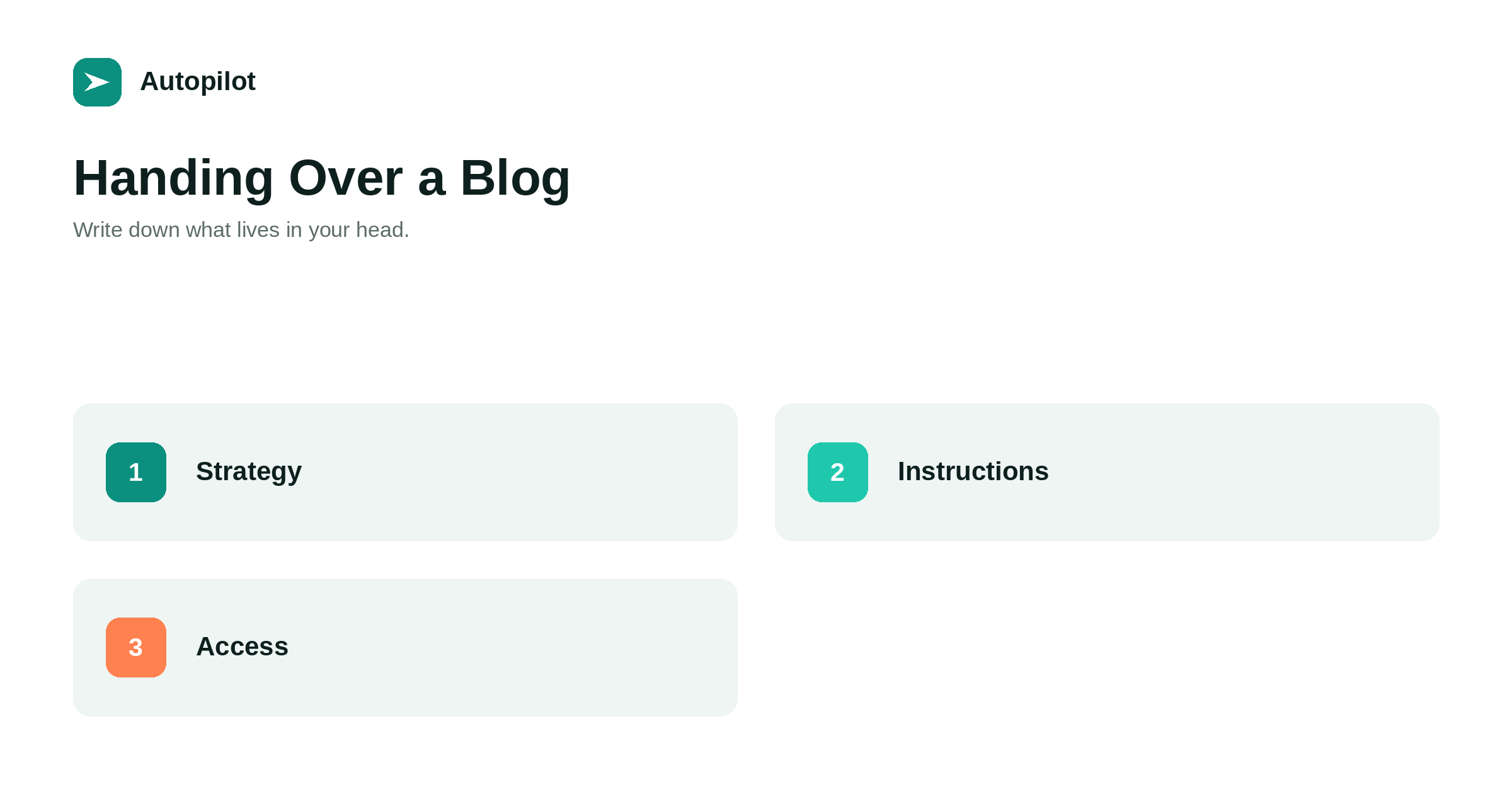
Short answer: before handing a blog to a new person, agency or tool, write down what currently lives in someone’s head: the strategy (purpose, reader, subjects, measure), the standing instructions (voice, style, forbidden claims, approved facts), the content inventory, the review process, the publishing and distribution routine, and every account and tool with its owner. Transfer access properly, revoke old access, review the first month’s articles closely, and keep the previous owner available for questions for a few weeks.
Blogs change hands: an employee leaves, an agency is replaced, the owner delegates, a tool takes over drafting. Each time, knowledge that was never written down disappears, and quality slips in ways nobody notices for months.
A good handover captures that knowledge before it walks out of the door.
What to hand over
A complete handover package covers six areas.
| Area | Contents |
|---|---|
| Strategy | Purpose, reader, subjects, measure |
| Instructions | Voice guide, style guide, forbidden claims, approved facts |
| Inventory | Every article, its question, status, next action |
| Process | Planning, review, publishing, distribution routine |
| Access | Accounts, tools, connections, who owns each |
| History | What has been tried, what worked, what did not |
If some of these do not exist yet, creating them is the most valuable part of the handover.
The unwritten rules
The most easily lost knowledge is informal: the claim the business never makes, the competitor never mentioned, the customer who asked not to be named, the subject the owner dislikes. Ask the outgoing person to list these explicitly.
They belong in the forbidden claims and voice guide — writing down your brand voice.
The inventory
A content inventory lets the new owner see what exists, which articles matter most, which facts expire, and what was planned — a content inventory. Without it, they will duplicate topics and miss updates.
Access, properly
List every account and connection: the website, analytics, Search Console, social profiles, email tools, publishing tools. Transfer ownership where needed, create new access for the new owner with the right roles, and revoke access for anyone leaving.
For publishing tools, create a new connection with its own application password rather than reusing the old one — connecting WordPress safely.
Handing over to a tool
When automation takes over drafting, the handover is to standing instructions. Everything a human writer knew implicitly must be written down, because a tool will follow only what it is told — writing a brief an AI can use.
Review closely for the first month, as described in the first 90 days.
Handing over to an agency
Give the agency the full package, agree the review and approval process in writing, and set the measure they will report against. Ask them to review the first articles with you and adjust the instructions together — running blogs for clients.
The first month after
Quality often dips after a handover as the new owner learns. Review the first month’s articles closely, compare them with earlier ones, and feed corrections into the instructions.
Keep the previous owner available for questions for a few weeks where possible.
A handover checklist
A practical checklist for the day of handover: the strategy page shared and discussed; voice guide, style guide and forbidden claims shared; approved facts list current; content inventory up to date with next actions; review and approval process written down; publishing schedule and queue explained; distribution routine explained; a list of every account with its owner; new access created for the new owner; old access revoked; and a date set for a check-in a month later.
Working through the list together, rather than sending documents, surfaces questions that neither side knew to ask.
History worth passing on
Record what has been tried and what happened: subjects that attracted readers but no enquiries, formats that worked, experiments that failed, changes made after traffic drops. Without this, a new owner repeats old mistakes.
A short page of notes, a year’s worth of quarterly plans and results, and the corrections log together give a new owner most of what they need to avoid starting from scratch — handling corrections covers the log.
Handing over relationships
A blog has relationships as well as documents: colleagues who contribute examples, customers who have given quotes, experts who have been interviewed, partners who link to articles. Introduce the new owner to the important ones, so those relationships continue rather than quietly ending.
Handing over across languages
For multilingual blogs, make sure the handover covers each language: reviewers, terminology lists, local instructions and any market-specific rules. Language versions are often maintained by different people, and one of them may hold knowledge nobody else has.
When the old owner is unavailable
Sometimes there is no handover: someone leaves suddenly. Reconstruct what you can from the site itself, the tools’ settings and past communications. Build an inventory from the sitemap, derive the strategy from the most successful articles, and treat the first month as an audit rather than business as usual.
A month after
Meet a month after the handover to review the first articles together, answer questions that have arisen, and update any documents that turned out to be incomplete. That single meeting catches most of what the initial handover missed.
Update the handover package with whatever was learned, so the next handover, whenever it comes, starts from a better place.
Protecting the business
Make sure the business, not an individual or agency, owns the domain, hosting, analytics, Search Console and social accounts. When ownership sits with a person who leaves or an agency that is replaced, recovering it can take weeks and sometimes fails.
Signs a handover went wrong
Watch for articles that contradict earlier ones, claims the business never used to make, topics that duplicate existing articles, and a sudden change in tone. Any of these in the first months suggests something important was not handed over. Trace it back, write it down, and add it to the instructions.
Preventing the problem
The best handover is one that was prepared all along: a blog whose strategy, instructions and inventory are always written down and current. That also makes day-to-day work easier and protects the blog against sudden departures.
Related reading
If this was useful, these cover the questions that usually come next.
- A content strategy on one page — the first document to hand over
- A content inventory — the record of what exists
- Running blogs for clients — the receiving side
The bottom line
Before handing over, write down the strategy, instructions, unwritten rules, inventory, process, access and history. Transfer access properly and revoke the old, create new publishing connections, review the first month closely, and keep the previous owner available for questions. Better still, keep these documents current all along.
FAQ
What should I hand over when someone takes over a blog?
Strategy, standing instructions, the content inventory, the process, all access, and history of what worked.
What knowledge is most often lost?
Unwritten rules: claims never made, subjects avoided, customer sensitivities.
How should access be transferred?
Create new access for the new owner with appropriate roles, transfer ownership where needed, and revoke access for anyone leaving.
What changes when a tool takes over drafting?
Everything a writer knew implicitly must be written into standing instructions.
Does quality drop after a handover?
Often briefly. Review the first month closely and adjust instructions.
How do I avoid difficult handovers?
Keep strategy, instructions and inventory written down and current all the time.