ENEnglish
 LTLietuviškai
 DEDeutsch
 FRFrançais
 RUРусский
 ESEspañol
 PLPolski
 ITItaliano
 UKУкраїнська
 CSČeština
 PTPortuguês
 JA日本語
JA日本語 LVLatviešu valoda
 ETEesti
 HUMagyar
 IDBahasa Indonesia
 TRTürkçe
 HIहिन्दी
 ELΕλληνικά
 ARالعربية
 THไทย
THไทย VITiếng Việt
 RORomână
 MSBahasa Melayu
 BNবাংলা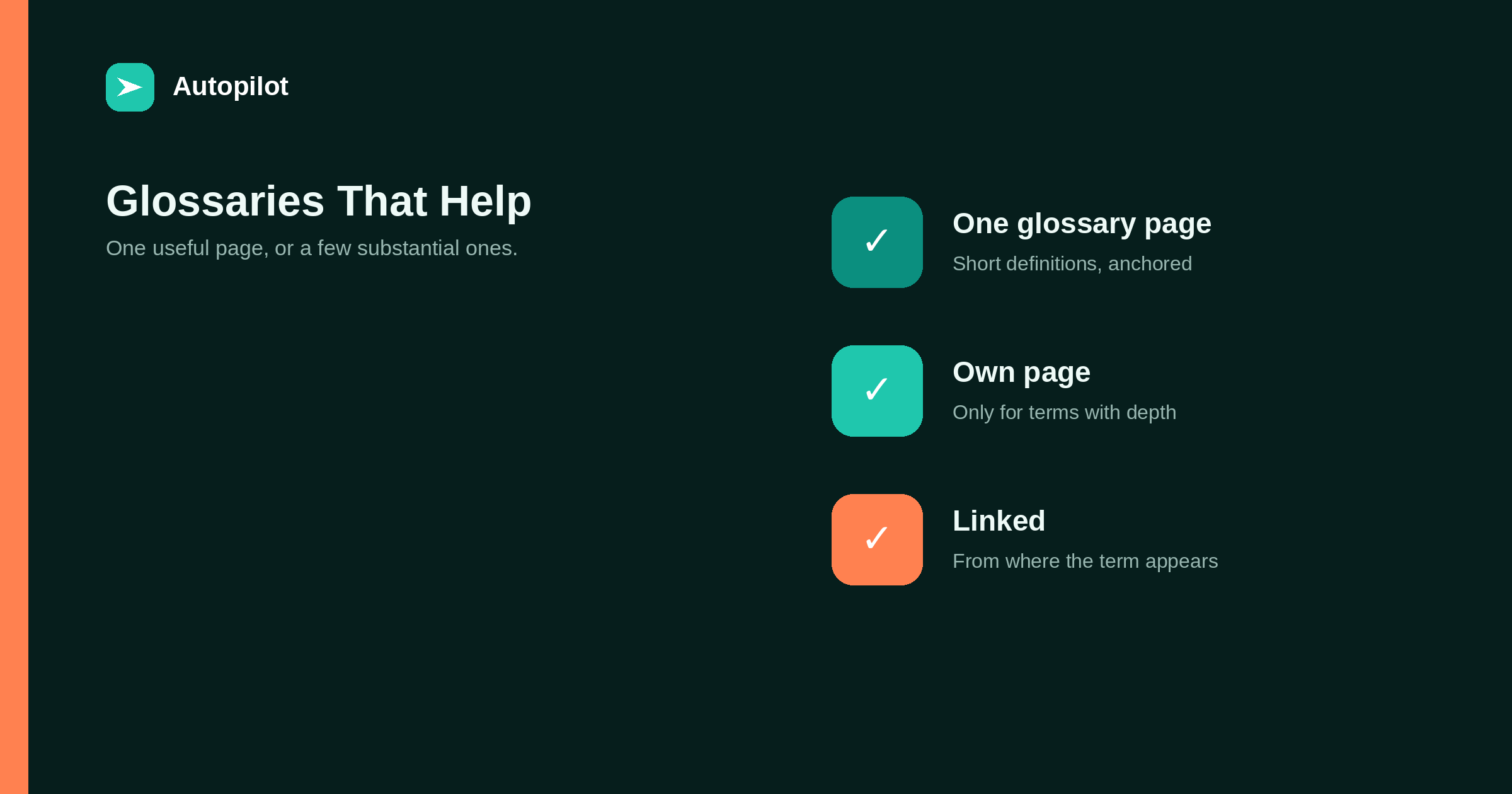
Short answer: for most business sites, one glossary page with short, clear definitions of the terms your readers meet, each with an anchor so articles can link to it, works best. Give a term its own page only if there is genuinely more to say — how it works, why it matters, examples, common confusions — enough for a useful article. Hundreds of separate one-paragraph definition pages tend to be thin and add little. Write definitions in plain language first, then add the precise version, and link terms from the articles where readers encounter them.
Glossaries are a common content idea: define every term in your field, one page each, and collect search traffic from people looking up definitions. Done that way, they often produce hundreds of thin pages that neither rank nor help.
Done with restraint, a glossary is genuinely useful: it helps readers who meet unfamiliar terms and ties a site’s articles together.
One page or many
The main decision is whether definitions live on one page or on separate pages.
| Approach | Suits | Risk |
|---|---|---|
| One glossary page, anchored entries | Most business sites | Low |
| Separate pages for major terms only | Terms with real depth | Low if substantial |
| Separate page for every term | Rarely justified | Many thin, similar pages |
A reasonable default: one glossary page for all terms, plus full articles for the handful of terms that deserve explanation at length.
When a term deserves its own page
Give a term its own page when there is enough to say for a useful article: how it works, why it matters to your readers, examples, common misunderstandings, related concepts.
On this site, canonical tags get a full article — canonical tags — because there is real depth and practical consequence. A term that needs one sentence belongs in the glossary.
The test is simple: could you write a few hundred useful words without padding? If not, it is a glossary entry.
Writing definitions
Lead with plain language, then add precision.
A canonical tag is a line in a page’s code that tells search engines which address is the original when the same content appears at several. That sentence is understandable to a newcomer; the technical detail can follow for readers who need it.
Avoid defining a term with other undefined terms, and avoid circular definitions. Where a related term is needed, link to its entry.
Structure of a glossary page
A usable glossary page is alphabetical, with each term as a heading and an anchor, so articles can link directly to the entry: glossary#canonical-tag.
- A short introduction saying what the glossary covers.
- An alphabetical index at the top for long glossaries.
- Each entry: the term, a plain definition, one line of context, and a link to a full article if one exists.
Keep entries short. The glossary is a reference, not a set of articles.
Linking terms from articles
The glossary’s value comes from links. When an article uses a term a reader might not know, link its first appearance to the glossary entry or full article.
Do this with restraint: the first appearance in an article, not every mention. internal linking as you publish covers how many links an article can carry before they stop helping.
The thin-page risk
Hundreds of one-paragraph pages, each defining one term, often share most of their text — the same template, the same related-terms list — and each says very little. Search engines may treat them as low value, and they add crawling burden without adding much for readers.
If you already have such pages, consolidating them into one glossary page with redirects is often an improvement — the approach in deleting, merging or redirecting.
Definitions and answer engines
Clear, self-contained definitions are the kind of passage that answer engines quote. A glossary entry or the opening sentence of a full article that defines a term plainly gives them something usable.
That is a reason to write definitions well, not a reason to multiply definition pages. being cited by AI search covers what makes passages quotable; nobody can guarantee being cited.
Glossaries across languages
If you publish in several languages, the glossary is one of the most useful pages to produce natively in each, because terms often do not translate directly and readers look up the local term.
Write each language’s glossary from the terms that language’s readers actually use, rather than translating the English entries one by one. Some terms will be borrowed from English; others will have established local equivalents. Link each version to its counterparts with hreflang, as described in publishing in several languages, so search engines show the right one.
A multilingual glossary also helps your own team keep terminology consistent across languages, which matters more as volume grows.
Who the glossary is for
Decide who the glossary serves before writing it. A glossary for customers new to your field needs plain definitions of basic terms; one for specialists can skip those and focus on terms that are genuinely contested or confused. Mixing the two produces entries that are too basic for experts and too dense for newcomers.
For most business blogs, the newcomer is the right reader, because they are the ones who meet unfamiliar terms in your articles and need a quick answer before reading on.
Keeping it current
Terms change meaning, new ones appear, and some fall out of use. Review the glossary when you review your main articles, add terms that new articles introduce, and update definitions that have drifted.
An automated blog introduces new terms steadily; adding them to the glossary during review keeps it complete without a separate project.
Related reading
If this was useful, these cover the questions that usually come next.
- Clusters and pillar pages — where definitions fit in a structure
- Duplicate content — the thin-page risk
- Internal linking as you publish — linking terms to definitions
The bottom line
Start with one glossary page of short, plain definitions, each with an anchor. Give a term its own page only when there is enough to say for a useful article. Link terms from articles at their first appearance, avoid hundreds of thin definition pages, and keep the glossary current as new articles introduce new terms.
FAQ
Should my website have a glossary?
If your readers meet specialised terms, a single glossary page with short definitions is useful and helps connect your articles.
Should each glossary term have its own page?
Only terms with enough depth for a useful article. Most terms work better as entries on one glossary page.
Are glossary pages good for SEO?
A useful glossary can help readers and internal linking. Hundreds of thin definition pages usually add little and may be treated as low value.
How should I write a definition?
Plain language first, then precise detail, without circular definitions or undefined jargon.
How do I link articles to the glossary?
Link the first appearance of an unfamiliar term in each article to its glossary entry using an anchor, or to the full article if one exists.
What should I do with many thin definition pages?
Consider consolidating them into one glossary page and redirecting the old URLs to the matching entries.