ENEnglish
 LTLietuviškai
 DEDeutsch
 FRFrançais
 RUРусский
 ESEspañol
 PLPolski
 ITItaliano
 UKУкраїнська
 CSČeština
 PTPortuguês
 JA日本語
 LVLatviešu valoda
 ETEesti
 HUMagyar
 IDBahasa Indonesia
 TRTürkçe
 HIहिन्दी
 ELΕλληνικά
 ARالعربية
 THไทย
 VITiếng Việt
 RORomână
 MSBahasa Melayu
 BNবাংলা
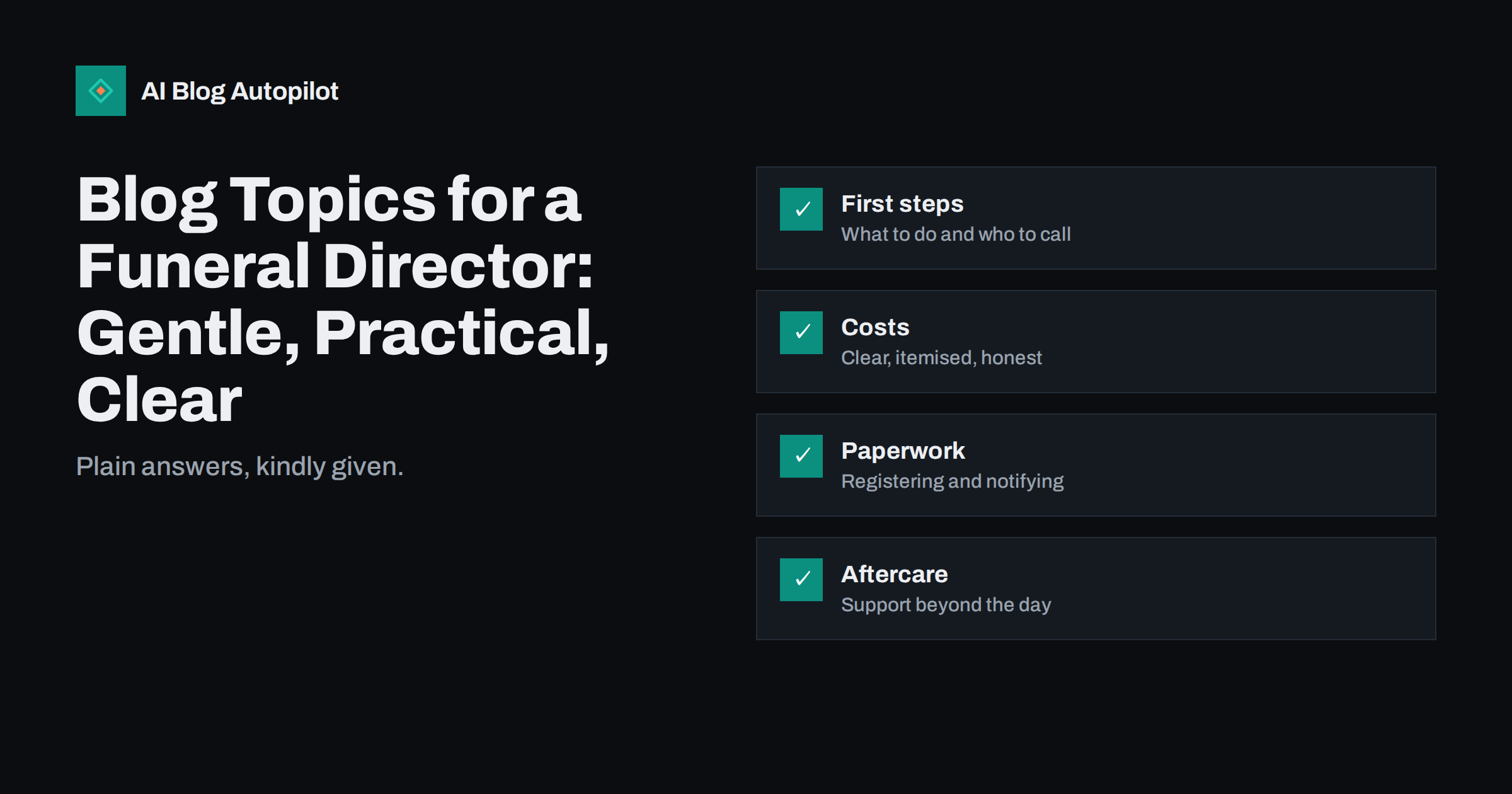
Short answer: a funeral director blog works best when it answers the practical questions families ask in the first days of a loss: what to do first, how arrangements work, what things cost, which paperwork is needed and where to find support afterwards. Use calm, plain language, avoid pressure, state prices clearly and keep every page accurate for your country.
Few businesses are visited at a more difficult moment. People who search for a funeral director are often tired, upset and unsure of the basic steps. They are not browsing for entertainment; they need clear information and a sense that someone steady is on the other side of the page.
This guide offers topic ideas for independent funeral directors, small family firms and memorial services. It also explains how to set the tone, what to check before publishing and how to keep a blog useful without ever sounding like an advertisement.
Set the right tone first
Tone matters more here than in almost any other trade. Write as you would speak to a family in your office: unhurried, warm and direct. Avoid euphemisms that confuse, such as vague phrases for what happens to the person who has died, and avoid heavy sales language. Short sentences and everyday words are kinder than long, formal ones.
Never use a loss as a hook, a trend or a seasonal promotion. Do not ask for clicks, and do not put urgent offers or countdown timers near any page about bereavement. A reader should feel that the page exists to help, not to sell.
Agree a short tone guide with your staff and keep it beside the editor. It might list words you use and words you avoid, how you refer to families, and how you treat different faiths and customs. The advice on brand voice guidelines shows how to write one down.
What to do first when someone dies
The most useful page on the site is often the simplest: a numbered list of what to do in the first hours and days. Explain who to call when a death happens at home, in hospital or in a care home, what a doctor or authority must confirm, and when a funeral director can be contacted. Keep the steps short and put the most urgent ones first.
Because rules differ by country and region, state clearly where your guidance applies, and link to the official government page for the legal steps. Do not give legal advice you are not qualified to give. A sentence such as “check the current rules with your local registrar” is both honest and helpful.
Add a line that people can call at any hour if you offer that service, and say what happens when they do. Knowing that a real person will answer calms readers more than any design could.
Explaining arrangements step by step
Many families have never organised a funeral. Write a plain guide to the process from first call to the day itself: meeting the director, choosing between burial and cremation, deciding the date and place, choosing a service style, notifying family and handling flowers or donations. Explain each stage in a short paragraph with what you do and what the family decides.
Write separate articles for the choices that raise the most questions, such as direct cremation, a simple service, a religious service, a woodland or natural burial and a memorial held later. Describe what is included in each, who may attend and what it typically involves, without judging any choice.
Use headings that match the questions people type, such as “How long does it take to arrange a funeral?” The guide to question headings explains why this helps both readers and AI assistants find the answer.
Think about who is reading. Often it is not the person closest to the loss but a relative or friend who has been asked to find information, perhaps from another town or country, perhaps late at night. Pages that load quickly on a phone, have clear headings and avoid pop-ups serve these readers best. Put your phone number and address in plain text at the top of key pages, not in an image.
Write for different beliefs and customs too. Families may follow religious traditions, humanist or secular approaches, or a mixture. Describe what you can arrange for each without assuming. A short page on how you work with different faith communities, written with their guidance, shows respect and answers a question many families are afraid to ask.
Costs, explained without pressure
Cost is the question people are most reluctant to ask, so answer it openly. Explain what a funeral typically consists of, which costs are yours and which belong to third parties such as the crematorium, cemetery, clergy, doctors’ fees or flowers. Many families are surprised by the second group, and explaining it prevents shock later.
If you can, publish your price list or a clear range. If not, explain what affects the price and how to obtain a written estimate. Avoid hidden extras and say plainly what is optional. Consumer or regulatory rules in many countries require price information, so check what applies to you.
Add a calm article on ways to manage costs: simpler services, payment options, funeral plans and where help with costs may be available. Keep it factual and link to official sources for benefits and rules, since these change. The article on writing honest articles about what things cost has a useful structure.
Paperwork, legal steps and what comes after
After the funeral, families face forms, letters and calls. An article that lists them in order is a gift. Cover registering the death, obtaining certificates, notifying banks, insurers and pension providers, cancelling subscriptions and understanding the basics of a will and probate, with a clear note that you are not a law firm and that a solicitor can advise on the estate.
Offer a printable checklist that families can tick off. Keep the wording neutral across countries or write a separate version for each place you serve. Date the page and review it at least once a year, because administrative rules change more often than people expect.
Add an article for people who are arranging a funeral abroad or bringing someone home, if you handle repatriation. Describe the steps, the usual timescale and the documents needed. Even a short, honest explanation draws a trusting audience from far away.
Tributes, readings and personal touches
Many families want to make a service personal and do not know how. Write about writing and delivering a eulogy, choosing music, picking readings from different traditions, asking children to take part and creating a slideshow or memory table. These pages are evergreen, widely searched and useful whether or not the reader chooses your firm.
Offer examples carefully. Short, original sample paragraphs for a eulogy are helpful if they are written by you and clearly general. Never publish a real family’s story or photographs without written permission. The article on notices and disclaimers explains the basics.
Include practical details for those attending: what to wear, what happens at a graveside or crematorium, how long a service lasts and how to behave around grieving relatives. Guests often feel anxious, and a short guide eases that.
Grief support and aftercare
Your relationship with a family does not end on the day. A section on aftercare shows that you remain there. Write about what grief can feel like, how to support a child or a colleague who is grieving, how to cope with anniversaries and holidays and where to find professional help. Be careful not to give medical or psychological advice; point to qualified services and local support groups.
Share information about memorial options, such as plaques, tree planting, memorial books and annual services, if you offer them. Explain the costs, the timing and how to take part. A yearly remembrance event can be announced on the blog with a lasting page that you update each year.
Be mindful of reader sensitivity when you share on social media. Posts about aftercare should be gentle and unprompted by trends, and comments should be moderated with care. See handling negative comments for a routine you can adapt.
Plan a small set of evergreen pages rather than a flood of posts. Funeral searches do not follow news cycles, so ten excellent, well-linked guides will serve better than a daily feed. Link them to each other: the first-steps page leads to arrangements, which lead to costs, which lead to paperwork. Review each one twice a year and note the date of the last check at the bottom.
Add a page about pre-planning for people who want to organise their own funeral in advance. Explain what can be decided now, how to record wishes, how plans differ from insurance and what to tell family. Many readers arrive curious and anxious, and a gentle, unpushy guide is likely to be remembered when the time comes.
Local trust and accuracy
Funeral searches are overwhelmingly local. Keep your business profile accurate, with opening hours, any out-of-hours contact and the areas you cover, and match these details on your website. The guide to Google Business Profile updates covers the routine. A page for each area or chapel can help, if every page contains real, specific information.
Have a senior member of staff read every article before publishing. Check facts, dates, legal references and wording, and avoid claims you cannot support. If you use automated tools to help with drafts, treat the result as a first version and review it with extra care, since a single mistake on this subject can hurt a reader.
How AI Blog Autopilot helps
AI Blog Autopilot can plan topics like these and hold weak articles for review, so nothing goes live without passing a quality check. For a subject this sensitive, approval mode is worth considering, so you see each article first. Read the plans and try the three free articles to see how it writes.
Related reading
- A Blog Strategy for a Local Business
- Compliance Review for Blog Posts
- Handling Corrections on a Blog
The bottom line
Write for families in a hard moment: calm tone, clear steps, honest prices, accurate paperwork and gentle aftercare, all reviewed by a person before it goes live.
FAQ
What should a funeral director blog write about first?
Start with what to do when someone dies, then explain the arrangements process, costs and paperwork in plain language.
Should a funeral director publish prices?
Publishing prices or a clear range builds trust. At the least, explain what affects the cost and how to get a written estimate.
What tone suits this subject?
A warm, unhurried and direct tone, with no sales pressure, urgent offers or euphemisms that confuse readers.
Can a funeral blog give legal advice?
No. Explain the general steps, link to official sources and suggest a qualified adviser for legal or estate questions.
Should automated drafts be reviewed?
Yes. For sensitive subjects a person should check every fact, date and phrase before the article goes live.