ENEnglish
 LTLietuviškai
 DEDeutsch
 FRFrançais
 RUРусский
 ESEspañol
 PLPolski
 ITItaliano
 UKУкраїнська
 CSČeština
 PTPortuguês
 JA日本語
JA日本語 LVLatviešu valoda
 ETEesti
 HUMagyar
 IDBahasa Indonesia
 TRTürkçe
 HIहिन्दी
 ELΕλληνικά
 ARالعربية
 THไทย
THไทย VITiếng Việt
 RORomână
 MSBahasa Melayu
 BNবাংলা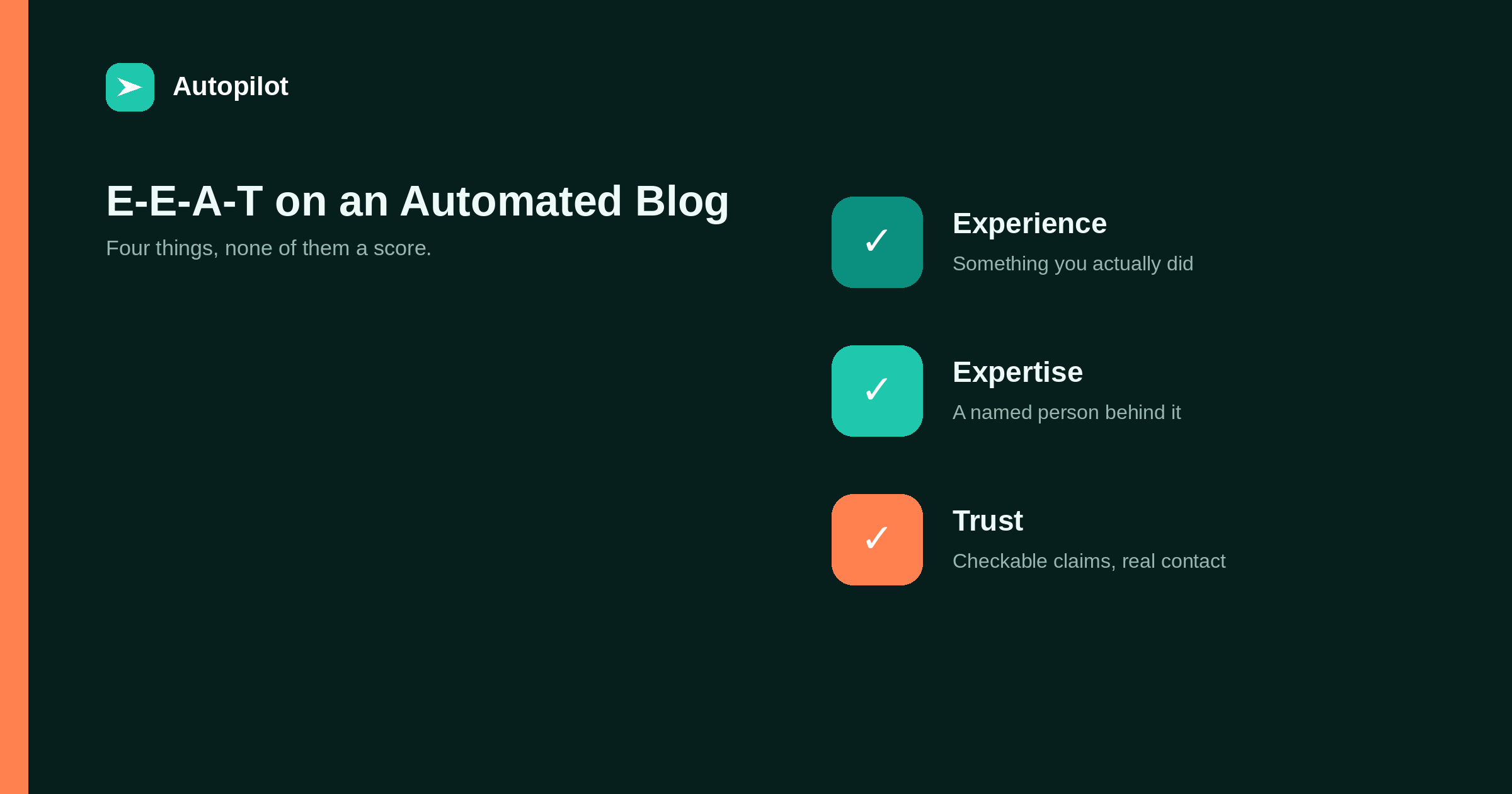
Short answer: treat it as four separate jobs rather than a score. Experience is the hard one and the only fix is adding something you actually did — your own numbers, a client situation, a screenshot of your own tooling. Expertise means a real named person or organisation is accountable for the page, with a bio that says why. Authoritativeness accumulates from other people referencing you and cannot be manufactured quickly. Trust is the most actionable: checkable claims, sources, visible contact details, honest pricing and no promises nobody can keep. None of this is a number you can see, and nobody can grant it to you.
E-E-A-T appears in search quality guidance as a description of what human raters are asked to assess. It is not a ranking factor with a dial, and there is no report anywhere that shows your score.
That makes it easy to dismiss and easy to overthink. The useful move is to take the four words apart, because they demand quite different work — and one of them is genuinely harder for a blog that publishes on a schedule.
Experience is the one automation cannot supply
Experience means first-hand involvement: you used the product, ran the process, made the mistake, saw the outcome. No amount of research produces it, and no generated draft contains it unless somebody puts it there.
This is the honest limitation of automated content, and pretending otherwise is how sites end up with archives that read like summaries of each other. The answer is not to write less but to add deliberately.
Concretely, in every article: a number from your own operations, a situation a client was actually in, a screenshot of your own screen, a thing you tried that did not work, or a place where you disagree with the standard advice and can say why. Two of those per article is enough to change the character of the page, and adding them is the part of editing a draft worth real time.
Expertise means somebody is accountable
Expertise is about whether the person or organisation behind the page is in a position to be right.
The mechanics are unglamorous. Posts carry an author, the author has a page, and that page says what they do and why they can speak to this subject. For a company blog the author can reasonably be the organisation, provided the organisation is real and identifiable.
What does not work is an invented persona with a stock photograph. It adds nothing a rater would credit and it is a straightforward misrepresentation if anyone checks. If the company stands behind the page, say so plainly — that is honest and sufficient.
Authoritativeness accumulates and cannot be rushed
Authoritativeness is the part that is largely out of your hands: whether other people treat you as a source.
It comes from being cited, linked, quoted and recommended, over years. There is no version of this you can install in a quarter, and the shortcuts — bought links, reciprocal schemes, syndicated guest posts at volume — are the things the guidelines explicitly warn about.
What does move it: publishing something worth citing, which usually means original data, a genuinely clear explanation of something people find confusing, or a strong position argued well. One of those a quarter is more valuable than thirty articles that summarise the field, which is also the argument for not letting volume become the only goal.
Trust is where most of the work actually is
Trust is the most concrete of the four and the easiest to improve this week.
| Signal | What it means in practice |
|---|---|
| Checkable claims | Sources for numbers, dates on statistics |
| Honest pricing | Current prices, or a link to the live page |
| No guarantees nobody can make | Never promise a position or a result |
| Real contact details | A company name, address and a way to reach a person |
| Corrections | Fix errors visibly rather than quietly |
| Working pages | No broken links, no pages that contradict each other |
Half of that list is fact-checking before you publish. The other half is site hygiene, which nobody is excited about and which is exactly why doing it is worth something.
The trap of contradicting yourself at volume
A blog that publishes often develops a specific trust problem: two pages that disagree.
One article says a plan includes a feature, another says it does not. One quotes a price from March, another from September. One recommends doing something the next recommends against, with no acknowledgement.
Readers notice and raters would too. The defences are boring and effective: a single source of truth for facts about your own business, prices written as a reference to the pricing page rather than copied, and a habit of reviewing overlapping articles — which is most of what deleting, merging or redirecting is for.
What to do about the money and health pages
Guidance is stricter for pages that can affect somebody’s finances, health, safety or legal position. That distinction should change how you publish, not just what you write.
For those subjects, unattended publishing is the wrong setting. Route them through a named reviewer with relevant standing, state qualifications where they exist, cite primary sources rather than summaries, and include the limitations honestly — including, where appropriate, that the reader should get professional advice.
This is the clearest case for the middle setting in draft, approve or full auto: most categories run unattended, and a defined list never does.
What none of this can promise
Doing all of the above does not guarantee a ranking, and anyone telling you otherwise is selling something. Search results move for reasons that include competitors, query changes and algorithm updates you will never see documented.
What it does do is make each page defensible: accurate, attributable, contactable and containing something that is actually yours. That is worth having whether or not it moves a position, because it is also what makes a reader trust the next article.
Related reading
If this was useful, these cover the questions that usually come next.
- What search engines actually say — where this framework comes from
- Editing a draft — the pass where experience gets added
- Fact-checking before you publish — the most concrete part of trust
The bottom line
Split the four words apart. Add real experience to every article because nothing else can supply it, put a real name behind the page, earn authority slowly by publishing something worth citing, and treat trust as a checklist you can work through this week. Keep the money and health subjects out of unattended publishing, and do not let anyone tell you this guarantees a position.
FAQ
Is E-E-A-T a ranking factor?
No. It is a framework in the search quality guidance used by human raters to describe what a good page looks like. There is no score to read and no setting to change, but the things it describes — accuracy, accountability, usefulness — are real properties of a page.
Can an automated blog have experience?
Only what you put into it. Generated drafts contain research, not first-hand involvement, so the review step is where your own numbers, client situations and screenshots get added. Two such additions per article changes the page materially.
Should I invent an author persona with a photo?
No. It adds nothing a rater would credit and it is a misrepresentation that is easy to discover. Name a real person or say the organisation is the author; both are honest.
What is the fastest part of E-E-A-T to improve?
Trust. Add sources to claims, date your statistics, publish real contact details, keep prices current or link to the live pricing page, fix broken links, and remove any promise of a ranking or a result.
Do finance and health articles need different handling?
Yes. Guidance is stricter where a page can affect money, health, safety or legal standing. Route those through a named reviewer with relevant standing, cite primary sources, and do not publish them unattended.
Will improving these things raise my rankings?
They may help, and nobody can promise it. Positions move for reasons including competitors and algorithm changes. What this work reliably produces is pages you can defend and readers who come back, which is worth having regardless.