ENEnglish
 LTLietuviškai
 DEDeutsch
 FRFrançais
 RUРусский
 ESEspañol
 PLPolski
 ITItaliano
 UKУкраїнська
 CSČeština
 PTPortuguês
 JA日本語
JA日本語 LVLatviešu valoda
 ETEesti
 HUMagyar
 IDBahasa Indonesia
 TRTürkçe
 HIहिन्दी
 ELΕλληνικά
 ARالعربية
 THไทย
THไทย VITiếng Việt
 RORomână
 MSBahasa Melayu
 BNবাংলা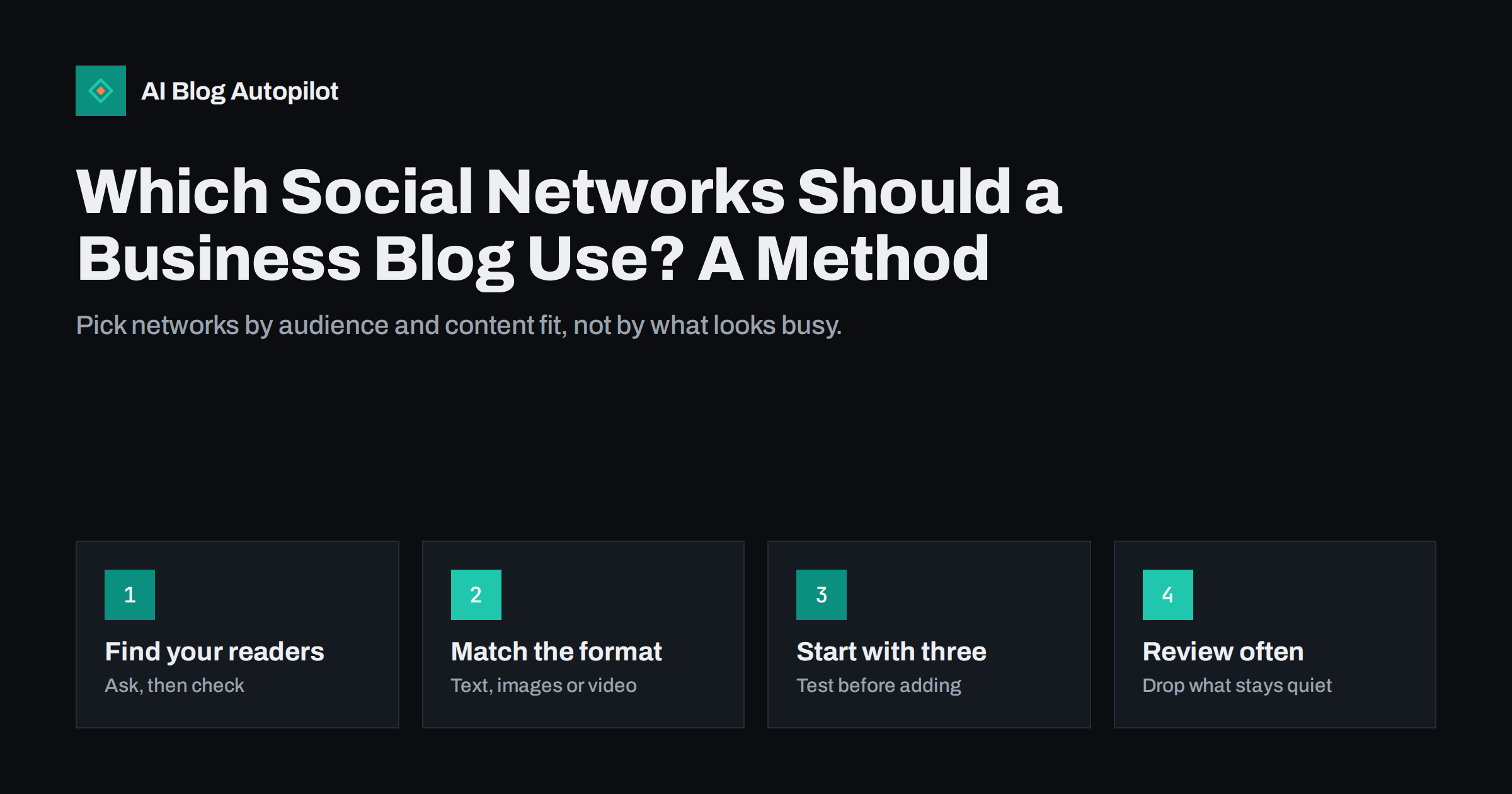
Short answer: choose social networks for a business blog by starting with where your readers already spend time, then matching each network to the kind of content you publish. Begin with two or three networks, share every article there for a couple of months, and compare the results. Keep the ones that bring readers, conversations or leads, and drop the ones that do not. You do not need to be everywhere, and being present on a network you cannot keep up with is worse than not being there at all.
It is tempting to treat every network as an opportunity. New ones appear, old ones change, and advice often says to be on all of them. For a small business with limited time, that approach leads to half-finished profiles and posts that nobody sees. A simple, repeatable method for choosing networks keeps the effort focused and makes it easier to decide later when something new comes along.
Start with your readers, not the networks
The first question is not “which network is best” but “where do the people I want to reach already spend time”. The answer depends on who they are. A business buying software from you probably reads professional networks. A local customer may look at a neighbourhood group or a visual network. A hobbyist community may live on a forum or a chat server.
Ways to find out without guessing:
- Ask directly. A short question to customers or newsletter readers, such as where they follow businesses like yours, gives better information than any general article.
- Look at your analytics. The referral report shows which networks already send visitors, even if you have never posted there on purpose.
- Look at competitors and peers. See where businesses similar to yours have an active audience, meaning replies and shares, not just a follower count.
- Search for your topic. Check which networks show lively discussion about the subjects you write about.
Write down two or three answers. They become your shortlist.
Match each network to your content
Networks favour different kinds of content. A long, practical article about tax rules may do well on a professional network and poorly on a network built around photos. A visual how-to may suit an image network better than a text-heavy one.
Consider three questions for each network on your shortlist:
- What format does it reward? Short text, longer text, images, carousels, video or links to outside pages.
- Can your articles be turned into that format? A guide can become a short summary, a list of tips or a few images. Some topics suit one format and not another.
- Will links to your blog work there? Some networks give links little reach, while others treat them normally. That affects whether the network can bring readers to your site or only awareness.
The goal is a good fit between what you already produce and what the network does well, not a new content line for every network.
Consider your capacity honestly
A network needs more than the first post. Someone has to check replies, answer questions and keep the profile accurate. If nobody will do that, a network will still collect messages that go unanswered, and unanswered messages look worse than silence.
Before adding a network, answer plainly:
- Who owns the profile, and what is their backup?
- How often will we post, and can we keep that up for six months?
- How quickly will we respond to comments and messages?
- What is the minimum we will do when the team is busy?
Automation can carry part of the posting work, but it does not replace a person who answers a customer. Decide which parts a tool does and which parts a person does.
Start with two or three and test
A sensible starting point is two or three networks: one where your readers clearly are, one where your content fits naturally and, if you wish, one experiment. Share every new article on each for at least two months, using the format the network favours, and keep the setup otherwise consistent so that you can compare results.
Avoid changing everything at once. If you alter posting times, formats, wording and networks all together, you will not know what made the difference. Change one thing at a time, and give a change a few weeks before judging it.
What to measure
Measure the outcome you care about, not just popularity:
- Visits to the blog from each network, in your analytics.
- Quality of those visits, such as pages per visit or sign-ups, not only the number.
- Engagement that matters, such as meaningful replies, questions from prospects or shares by relevant people.
- Time spent, so you can see which network gives the most return for the least effort.
Followers are a weak signal on their own. A small account with readers who click and reply is often worth more than a large one that does neither.
Decide when to drop a network
Dropping a network is a normal part of the process. Review every quarter and ask whether the network brought visits, conversations or leads that justify the effort. If a network has been quiet for several months despite reasonable attempts, pause it and spend the time elsewhere.
Pausing does not mean deleting. You can leave a clear profile with a link to your blog, a note on where to find you and a pinned post, so people who look you up still find your main site. Keep the account secure and keep the profile name consistent in case you return later.
The same review applies when a network changes its rules or reach. If something shifts and your posts stop working, treat it as new information and adjust, without feeling that earlier effort was wasted.
Keep a consistent presence on the ones you keep
For each network you keep, build a small standard setup: the same name and short description as your other profiles, a link to your blog, a clear picture and a pinned post or highlighted link that explains what you offer. This makes it easy for new visitors to understand who you are within a few seconds.
Then settle on a rhythm. Sharing each new article is the baseline. On top of that, you can reshare older articles that are still useful, add short tips drawn from your posts and answer questions your audience asks. Mixing these keeps the profile active without writing new material for every post.
Common mistakes when choosing networks
A few patterns come up again and again, and knowing them saves months of effort.
- Copying a competitor’s list. A competitor may be on a network because of a different audience, a larger team or a past decision. Their presence tells you little about whether it suits you.
- Chasing the newest network. A new network can be interesting, but early reach rarely lasts, and the rules often change. Try it as a small experiment, not as a core channel.
- Posting the same text everywhere. Each network has its own habits, lengths and tone. A post written for one network often reads badly on another. Adapt the wording, even lightly.
- Ignoring the profile. A weak profile, with no description, no link or an old picture, wastes the attention a good post earns.
- Measuring only likes. Likes feel good, but they do not show whether anyone reads your articles or contacts your business.
A simple scoring method
If you are torn between several networks, a short scoring table makes the decision easier. For each candidate, give a score from one to five on four points:
- Audience fit: are your readers and customers active there?
- Content fit: can your articles be shown there in a way the network rewards?
- Effort: how much time will it take to keep the profile active and answer people?
- Business value: can you see a route from the network to visits, enquiries or sales?
Add the scores, keep the top two or three and park the rest. The numbers are not scientific, but writing them down forces you to give reasons, and you can revisit them after a quarter with real results beside them.
When a network is not worth it
Some businesses find that only one network matters, and that is a perfectly good outcome. If your customers are mostly found in one place, put the effort there, share every article and answer every comment. Depth on one network often produces more than a thin presence on six.
How AI Blog Autopilot helps
AI Blog Autopilot shares each article to your connected social networks. It supports 58+ of them, and each network gets its own text, length and timing, so you can pick the ones that fit your readers and leave the rest off. Its content map shows every article and every post per network, so after a couple of months you can see which networks were posted to and whether anything failed. The plans differ in how many networks they include; see the pricing page for the current details.
Related reading
- Social Media Content Mix: What to Post Between Articles
- Best Time to Share a Blog Post on Social Media
- Social Media Metrics for Bloggers: What Is Worth Measuring
- Using LinkedIn to Distribute a Business Blog
The bottom line
Choose social networks by starting with where your readers are, matching each network to the format of your content and being honest about the time you have. Begin with two or three, share every article there for a couple of months and compare visits, replies and leads. Keep what works, pause what does not and keep the profiles you keep consistent and secure. A small number of active networks beats a long list of neglected ones.
FAQ
How many social networks should a small business blog use?
Two or three is a good start. Pick the ones where your readers are and where your content fits, share every article there for a couple of months, and add another only when you can keep up.
Do I need to be on every social network?
No. Being on many networks without the time to maintain them spreads effort thin and leaves unanswered messages. Focus on a few where your audience is active.
How do I find out where my readers spend time?
Ask customers directly, check the referral report in your analytics, look at where similar businesses get replies and shares, and see where your topics are discussed.
When should I stop using a social network?
When it has brought no meaningful visits, conversations or leads for several months despite reasonable attempts. Pause it, leave a clear profile with a link to your blog and spend the time elsewhere.
Is follower count the best way to judge a network?
No. Visits to your blog, the quality of those visits and meaningful replies say more about whether a network is working for you than a follower number does.