ENEnglish
 LTLietuviškai
 DEDeutsch
 FRFrançais
 RUРусский
 ESEspañol
 PLPolski
 ITItaliano
 UKУкраїнська
 CSČeština
 PTPortuguês
 JA日本語
JA日本語 LVLatviešu valoda
 ETEesti
 HUMagyar
 IDBahasa Indonesia
 TRTürkçe
 HIहिन्दी
 ELΕλληνικά
 ARالعربية
 THไทย
THไทย VITiếng Việt
 RORomână
 MSBahasa Melayu
 BNবাংলা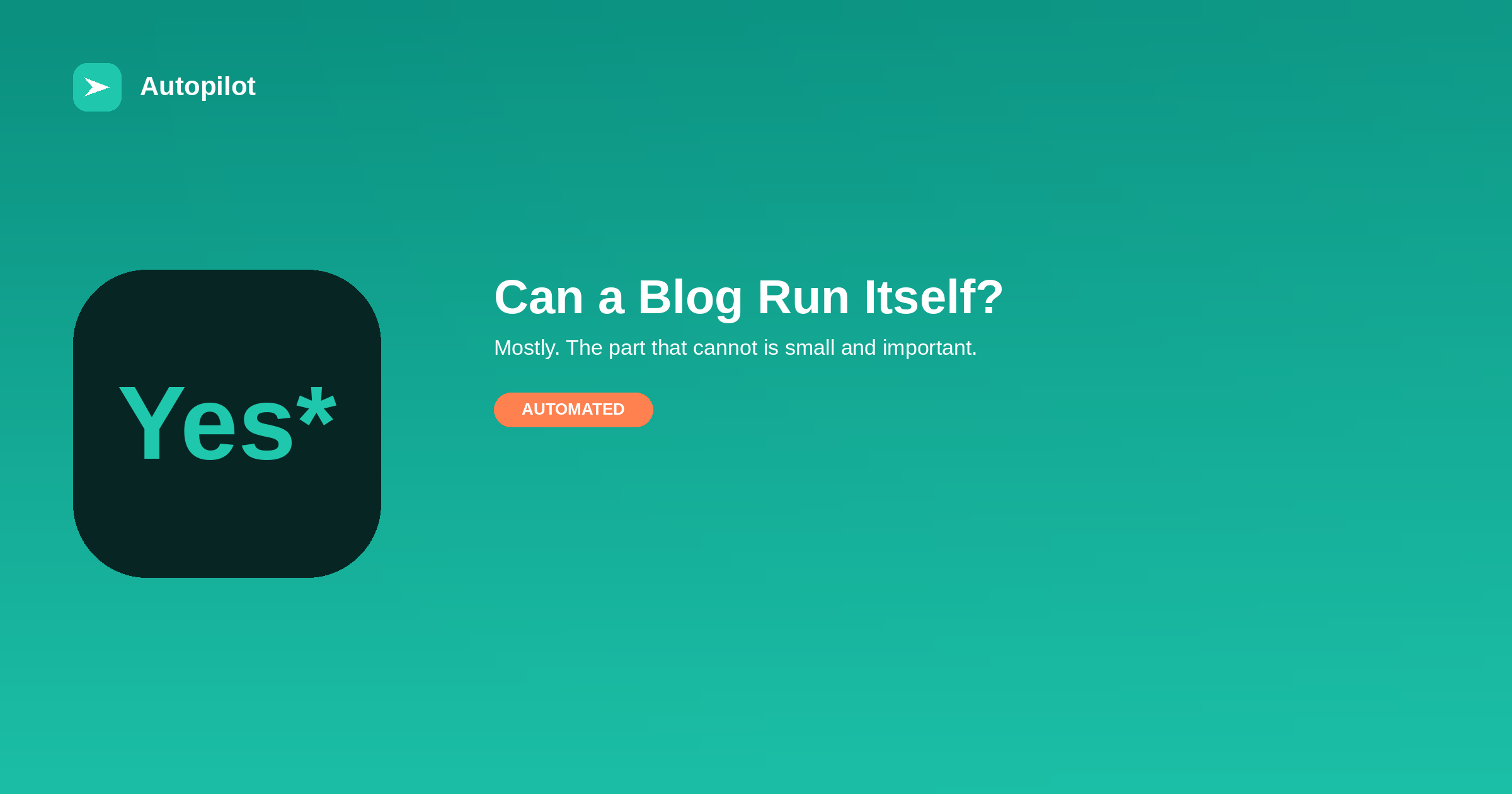
Short answer: mostly, yes. Topic suggestions, drafting, titles, descriptions, FAQ, structured data, images, publishing, social sharing and search engine notification can all run without anyone touching them. What cannot be automated is deciding what the business should say, adding first-hand experience, and being accountable for accuracy. For most businesses that remaining part is small — standing instructions written once, plus a short review and a couple of additions per article — but skipping it is what makes automated blogs fail. And nobody can automate a guaranteed result.
The question usually comes with one of two expectations: that an automated blog is a gimmick producing spam, or that it is a way to have a thriving blog with no effort at all. Neither is right.
The honest answer sits between them, and it is more useful than either, because it tells you exactly where your effort should go.
What runs without you
A great deal of what a blog requires is mechanical or close to it, and software now handles it well.
- Suggesting topics from search data and your existing content.
- Drafting structured articles with a short answer, sections and FAQ.
- Writing titles, descriptions and structured data.
- Producing a featured image for each article.
- Publishing on a schedule, in the right category, with tags.
- Sharing each new article to social networks.
- Notifying search engines that something new exists.
Done by hand, that list is most of a working week per month for a regular blog. Automated, it is close to zero.
What still needs a person
Three things, and none of them are large in time.
Direction. What the blog is for, who it is written for, what the business never claims. Written once as standing instructions, revisited occasionally — writing a brief an AI can use.
Review. Reading articles before or shortly after they publish, checking the claims that could be wrong. Twenty minutes an article at first, less once instructions are refined.
Additions. A number, a customer situation or a screenshot only you have. Five minutes, and the thing that makes the article worth reading — adding something original.
The time it actually takes
Putting rough numbers on it, for a blog publishing eight to twelve articles a month:
| Task | By hand | Automated with review |
|---|---|---|
| Topic planning | 2–3 hours | 30 minutes approving |
| Writing | 3–5 hours per article | Minutes |
| Review and additions | Included above | 15–25 minutes per article |
| Images and formatting | 30 minutes per article | None |
| Publishing and sharing | 20 minutes per article | None |
These are illustrative ranges rather than measurements of any particular team, and your own will differ. The shape is what matters: the time moves from production to judgement, and shrinks overall by a large factor.
Is it allowed?
This is often the real question underneath. Published search guidance says content is assessed on whether it is helpful and made for people, not on how it was produced. Automation used mainly to manipulate rankings is against the rules; automation used to produce useful pages is not.
The practical consequence is that an automated blog is held to exactly the same standard as any other. Thin, duplicated or inaccurate pages fail whoever made them. Useful, accurate, specific pages can succeed whoever made them. what search engines actually say about AI content quotes the guidance in full.
Can it run with no review at all?
Technically, yes. Some businesses run certain categories fully unattended, with spot checks, once they have months of evidence that review rarely changes anything in those categories.
That is a reasonable end state for low-risk subjects. It is not a reasonable starting point, and it is never appropriate for subjects involving money, health, safety or legal matters. The failure mode of unreviewed automation is not dramatic; it is a slow accumulation of small errors under your name, which is worse — the mistakes people make when automating describes it.
What nobody can automate
Results. No tool, agency or writer can guarantee rankings, traffic or leads, because those depend on competitors, your market and search changes that nobody controls.
What automation reliably changes is cost and consistency: a blog that publishes every week instead of whenever someone has time, at a fraction of the effort. Consistency is one of the few things within your control that tends to help over time, which is why it is worth having — not because it guarantees anything.
How to try it sensibly
Start small and watch closely. Set up standing instructions, connect with a limited account, review every article for a month, add something of your own to each, and measure one outcome.
AI Blog Autopilot’s first three articles are free, which is enough to judge the output on your own site before paying for anything; plans are on the pricing page. Whatever tool you try, judge it on the published pages rather than the demo, and give it a full month before deciding, because the first week mostly tests your instructions rather than the tool.
Related reading
If this was useful, these cover the questions that usually come next.
- What content automation actually means — the steps, one by one
- The mistakes people make when automating — how it goes wrong
- What search engines actually say about AI content — the rules that apply
The bottom line
A blog can be mostly automated: drafting, images, publishing and sharing run without you. Direction, review and additions still need a person, and they take far less time than production used to. It is allowed when the pages are useful, it can eventually run with little review in low-risk areas, and nobody can automate a guaranteed result.
FAQ
Can a blog be fully automated?
Most of the work can: topics, drafting, images, publishing, sharing and search notification. Direction, review and first-hand additions still need a person, though they take far less time than writing did.
How much time does an automated blog take each week?
For a blog publishing two or three articles a week, commonly an hour or two of review and additions, plus occasional updates to instructions. It depends heavily on subject matter and how refined the instructions are.
Is an automated blog against Google’s rules?
No, provided the pages are helpful. Guidance targets automation used mainly to manipulate rankings, not automation used to produce useful content.
Can I skip reviewing articles?
For low-risk categories, after months of evidence that review changes little, some businesses do. It is a poor starting point and never appropriate for money, health, safety or legal subjects.
Will an automated blog bring customers?
It can contribute, but nobody can guarantee it. What automation reliably provides is consistent publishing at lower cost; results depend on the pages, your market and competition.
How should I test blog automation?
Start with a few articles on your own site, review every one, add something only you know, and judge the published pages rather than a demo.