ENEnglish
 LTLietuviškai
 DEDeutsch
 FRFrançais
 RUРусский
 ESEspañol
 PLPolski
 ITItaliano
 UKУкраїнська
 CSČeština
 PTPortuguês
 JA日本語
JA日本語 LVLatviešu valoda
 ETEesti
 HUMagyar
 IDBahasa Indonesia
 TRTürkçe
 HIहिन्दी
 ELΕλληνικά
 ARالعربية
 THไทย
THไทย VITiếng Việt
 RORomână
 MSBahasa Melayu
 BNবাংলা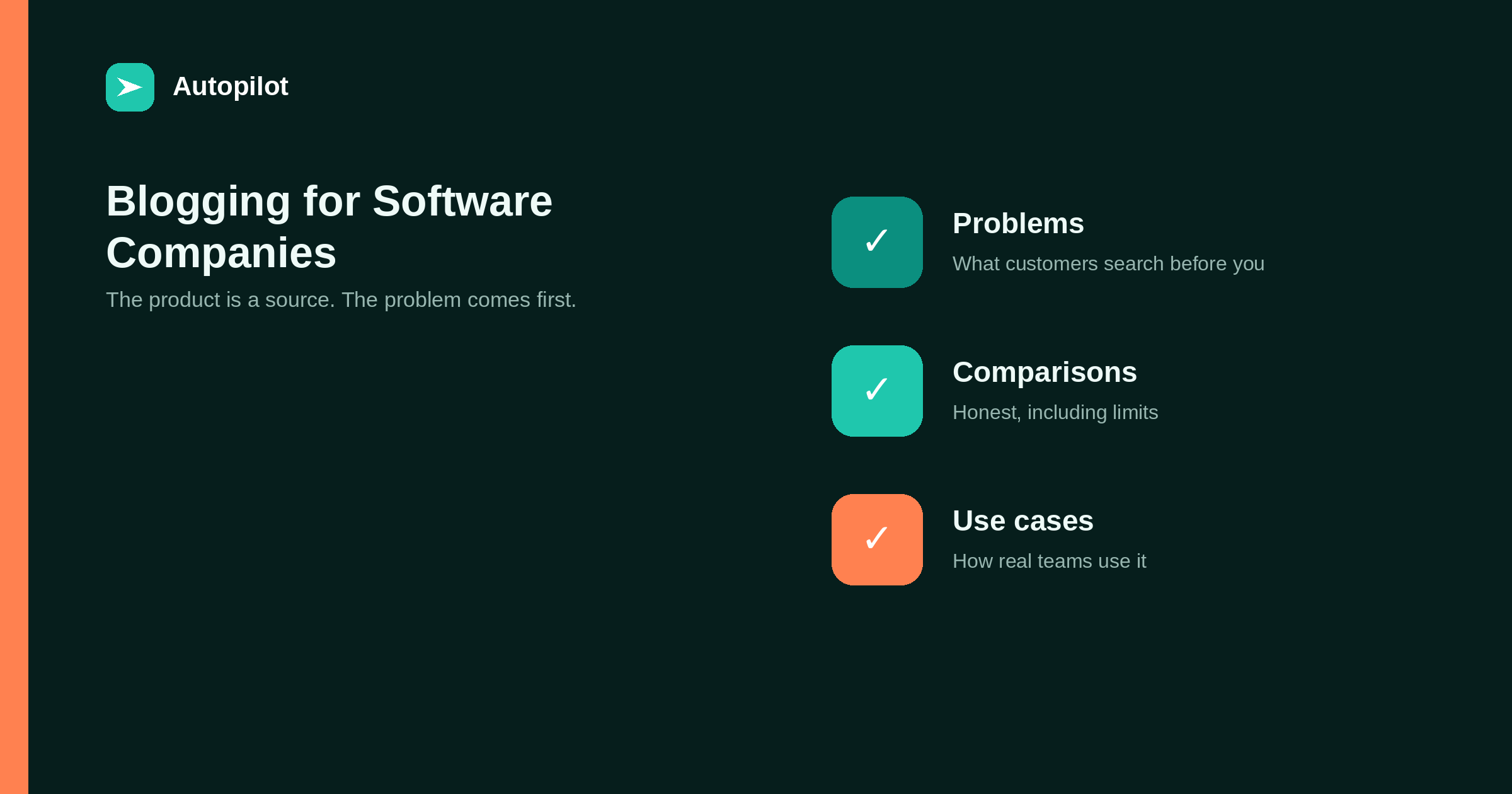
Short answer: plan around four kinds of article: the problems customers search for before they know your product exists, honest comparisons for people choosing between approaches or tools, use-case articles showing how real teams apply the product to specific jobs, and help content answering the questions support handles every day. Lead with the problem rather than the product, admit where the product is not the right fit, keep product details current, and link articles to the relevant feature or pricing page as the next step.
Software companies are in an unusual position for content. The product itself generates articles: every feature solves a problem people search for, every integration is a use case, every support ticket is a question someone else is also asking.
The trap is writing about the product instead of the problem. Nobody searches for your feature name before they have heard of you.
Start from problems, not features
Customers search for their problem long before they search for a solution, and much longer before they search for your product.
List the problems each part of the product solves, in the words customers use before they have found you: not configure deduplication, but why is my content posting twice. Each is a potential article that helps someone who has never heard of you and naturally introduces the product as one solution.
This is where the most valuable readers come from, because they have the problem the product solves.
The four kinds of article
Most software blogs benefit from a balance of four types.
| Loại | Reader | Example |
|---|---|---|
| Problem articles | Has the problem, does not know you | How to publish consistently with a small team |
| Comparisons | Choosing an approach or tool | Freelancer, agency or automation |
| Use cases | Evaluating fit | How an agency runs twenty client blogs |
| Help content | Customer or close to it | Connecting WordPress safely |
Problem articles bring new readers, comparisons serve people deciding, use cases show fit, and help content supports customers and reduces support load. A blog with only one type misses most of the journey.
Comparisons, honestly
People evaluating software search for comparisons, and many software blogs publish self-serving ones that conclude the author’s product wins every category. Readers recognise them immediately.
An honest comparison says who each option suits, including when yours is the wrong choice. That costs a few prospects who were never a good fit and earns trust from the ones who are. Avoid naming competitors in ways you cannot substantiate, and keep any factual claims about other products current and checkable — fact-checking before you publish applies with extra force here.
Use cases and customer stories
Use-case articles show how a specific kind of team applies the product to a specific job. They answer the question every evaluator has: would this work for us?
The strongest are built from real customer situations, with permission or properly anonymised, including what did not work at first. Invented or composite stories presented as real are worse than none. adding something original covers gathering this material.
Help content as a growth channel
Support teams answer the same questions repeatedly. Each answer, turned into a public article, helps current customers, reduces tickets, and is often searched by prospects evaluating whether the product does what they need.
Keep these articles accurate as the product changes. Outdated help content is worse than none, because it contradicts what users see — a yearly review of the most visited ones, as in refreshing old posts, keeps them honest.
Keeping product details current
Software changes constantly: features are renamed, screens redesigned, plans restructured. Articles that describe the product specifically go out of date faster than any other content.
Three habits help. Link to the pricing page rather than stating prices in articles. Describe what a feature does rather than exactly where the button is, unless the article is a step-by-step guide. And keep a list of articles that mention specific features, so a product change triggers a quick review rather than a slow discovery.
Connecting articles to the product
Each article should have a clear next step. Problem articles link to the relevant feature page or a trial; comparisons link to pricing; use cases link to a demo or trial; help articles link to related help.
The article should help first and mention the product where it genuinely fits, not in every paragraph. landing page or blog post covers keeping explanation and offer on separate, linked pages.
Automation for a software blog
Software companies are often well placed to automate drafting, because the subject matter is documented and the problems are well defined. The parts to keep human are the ones that depend on the product and customers: accuracy about features, real use cases, and honest comparisons.
A workable split is automated drafts for problem articles and general how-to content, reviewed by someone who knows the product, with use cases and comparisons written or heavily edited by the team.
Measuring it
Software companies can usually measure more precisely than most businesses: trials and sign-ups from blog visitors, activation of those accounts, and help articles that reduce specific ticket types.
Track each article type against the outcome it is meant to drive, as in measuring whether a blog is working. No content strategy guarantees growth; a balanced one makes it clear which kinds of article are contributing.
Related reading
If this was useful, these cover the questions that usually come next.
- Landing page or blog post — separating explanation from the offer
- LinkedIn for a business blog — distributing to business buyers
- The first ten posts — a starting mix that applies here too
The bottom line
Build around problems customers search for before they know you, honest comparisons, real use cases and public help content. Lead with the problem, admit where the product is not the right fit, keep product details current, and give each article a next step matched to its type.
FAQ
What should a software company blog about?
The problems customers search for before they know the product, honest comparisons, use cases showing how real teams use it, and help content answering common support questions.
Should a SaaS blog write about its own features?
Mainly through the problems those features solve. Few people search for a feature name before they know the product.
How should software companies write comparison articles?
Honestly: say who each option suits, including when your product is the wrong choice, and keep claims about other products current and substantiated.
Is help content worth publishing publicly?
Usually yes. It helps customers, reduces support load, and is searched by prospects checking whether the product does what they need.
How do I keep product articles up to date?
Link to pricing instead of stating prices, describe what features do rather than exact button locations where possible, and keep a list of articles to review when the product changes.
How should a SaaS blog be measured?
By trials and sign-ups from blog visitors, activation of those accounts, and reductions in specific support tickets from help articles.