ENEnglish
 LTLietuviškai
 DEDeutsch
 FRFrançais
 RUРусский
 ESEspañol
 PLPolski
 ITItaliano
 UKУкраїнська
 CSČeština
 PTPortuguês
 JA日本語
JA日本語 LVLatviešu valoda
 ETEesti
 HUMagyar
 IDBahasa Indonesia
 TRTürkçe
 HIहिन्दी
 ELΕλληνικά
 ARالعربية
 THไทย
THไทย VITiếng Việt
 RORomână
 MSBahasa Melayu
 BNবাংলা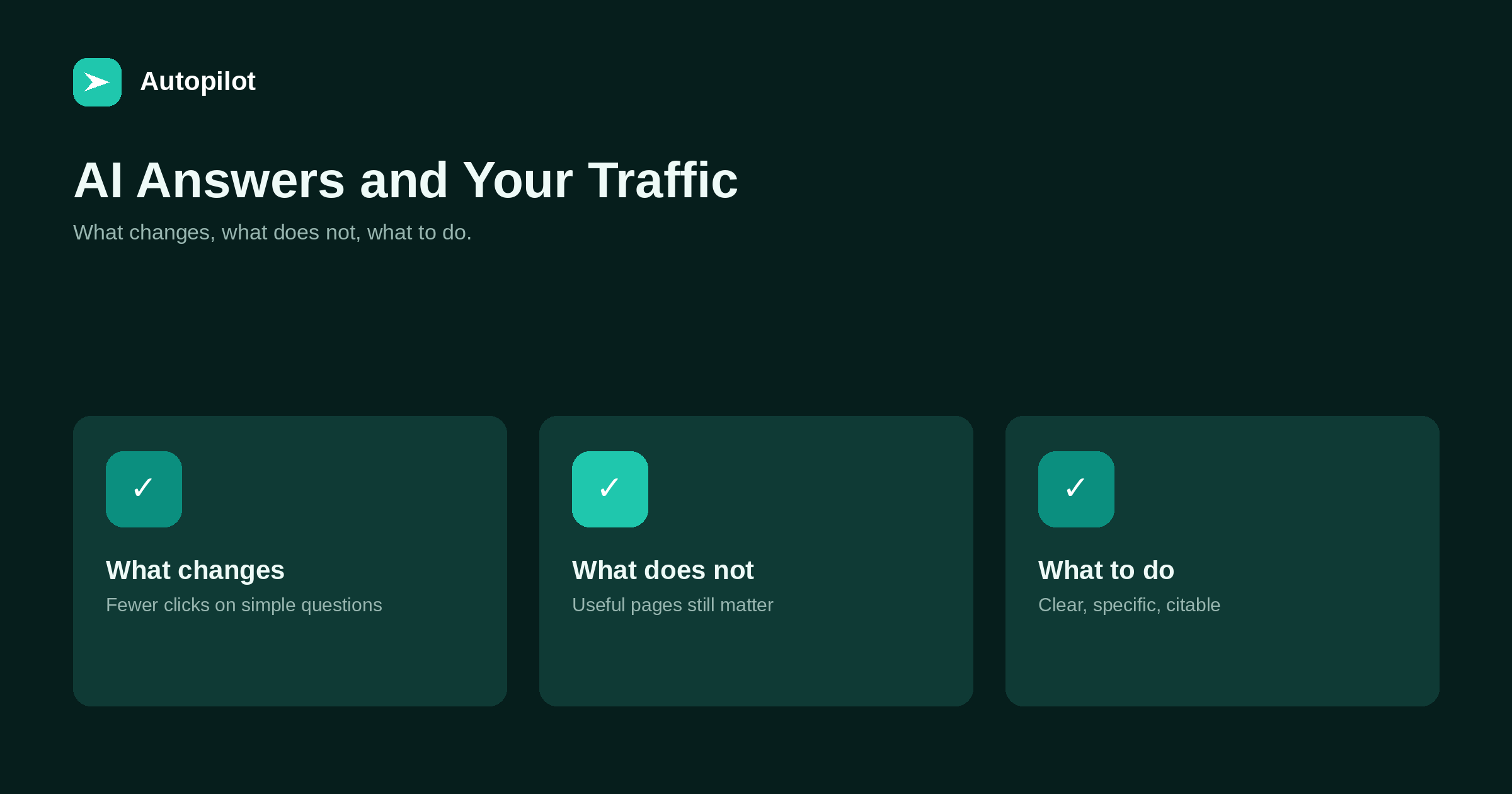
Short answer: AI-generated summaries at the top of search results answer many questions directly, which reduces clicks for simple informational queries. They also cite sources, so clearly written, specific pages can be linked from the summary. What has not changed: the summaries draw on pages that search engines already consider useful, so the fundamentals — accurate, well-structured, genuinely helpful content — still apply. Practical steps: answer clearly near the top, include specifics and experience, keep facts current, and measure outcomes as well as clicks.
Search results for many questions now begin with a generated summary that answers the query in a few sentences, often with links to the pages it drew on. For publishers, it is the most visible change to search in years.
It is also an area full of confident predictions. The honest position is that some effects are clear, others are still unfolding, and the sensible response is mostly what good publishing already required.
What seems clear
Some effects are fairly consistent across reports and experience.
- Simple informational questions are more often answered without a click.
- The summaries cite sources, which gives some pages prominent links.
- Queries needing detail, decisions or current specifics still send many searchers to pages.
The size of these effects varies widely by topic and query type, and published estimates differ. Treat any single figure you read with caution, including ones that sound precise.
What has not changed
The summaries are built from pages that search engines already find and judge useful. The guidance on helpful, reliable content still applies, and a page that is thin, inaccurate or unclear is no more likely to be cited than to rank.
what search engines actually say about AI content covers that guidance. None of it has been replaced; the summaries are another way the same judgements surface.
Writing pages that get cited
Pages cited in AI answers tend to share practical traits.
| Trait | Why it helps |
|---|---|
| A clear answer near the top | Easy to extract and attribute |
| Self-contained sections | Passages make sense out of context |
| Specific facts, dated | More useful than generalities |
| Descriptive headings | Show what each passage answers |
| Visible expertise and sources | Signals reliability |
being cited by AI search goes into each in detail. Nobody can guarantee a citation.
Specifics and experience matter more
A summary can restate general knowledge. It cannot contain your data, your customer situations or your tested process unless it cites your page.
That makes first-hand material — the subject of adding something original — more valuable, not less. Pages that say something specific and verifiable are the ones worth citing and the ones worth clicking through to.
Keeping facts current
AI summaries draw on what they find. An outdated page may be summarised with outdated information, attributed to you.
Keep prices, features, dates and rules current on the pages that matter most, and review them regularly — refreshing old posts covers the routine. Linking to live pages for details that change, such as pricing, reduces the risk.
Measuring the effect on your site
Compare Search Console data for your main pages over comparable periods: impressions, clicks and click-through rate. A page with stable impressions and falling click-through rate on informational queries may be affected by summaries.
Then look beyond clicks: branded searches, direct visits, enquiries. zero-click searches covers measuring in a world where visibility and visits separate.
Controlling use of your content
Site owners have some controls over how crawlers use their content, including robots.txt rules and specific directives. Blocking crawlers used for search generally also removes you from search results they power, so these choices involve trade-offs.
AI crawlers and llms.txt covers the technical options and what each actually does.
Questions worth asking about your own content
A useful exercise is to take your ten most visited articles and ask of each: could a two-sentence summary satisfy most people searching this? If yes, the article is exposed, and it may be worth expanding it with the process, the decision, or the experience that a summary cannot carry.
Then ask the opposite question: which of your articles contain something that could only come from your business? Those are your most resilient pages, and usually your most persuasive ones. Making more of them is the most direct response available.
Finally, check the facts on your highest-traffic pages. If a summary is going to quote you, it should quote something true and current.
Where AI answers help publishers
It is not all loss. A citation in a summary can put a small site above much larger ones for a specific question, if its page answers that question better. Specific, well-structured articles from businesses with genuine expertise can gain visibility they would not have had in a list of ten links dominated by large publishers.
Searchers who click through from a summary have usually already read the basic answer, so they arrive wanting depth. Pages that deliver it tend to keep those readers, and they are often further along in their thinking than a typical search visitor.
A sensible response
There is no special technique that guarantees visibility in AI summaries. The sensible response is the one that serves readers anyway: answer clearly, include what only you know, keep facts current, and build channels you own, such as a newsletter.
Search will keep changing. Content that is genuinely useful to a reader has been the most durable strategy through every previous change, and there is no strong reason to expect this one to be different.
Related reading
If this was useful, these cover the questions that usually come next.
- Being cited by AI search — the practical techniques
- Zero-click searches — the wider trend
- AI crawlers and llms.txt — the technical side
The bottom line
AI summaries reduce clicks on simple questions and cite sources for others. The fundamentals still apply: accurate, clear, specific, well-structured pages. Answer near the top, include your own experience and data, keep facts current, measure outcomes as well as clicks, and be cautious of anyone offering guaranteed placement in AI answers.
FAQ
What are AI answers in search results?
Generated summaries shown at the top of some search results, answering the question in a few sentences and usually linking to the pages they drew on.
Do AI answers reduce website traffic?
For simple informational questions they often reduce clicks. Queries needing detail, decisions or current specifics still send many searchers to pages. The effect varies widely.
How can my pages be cited in AI answers?
By being clear, specific and well-structured: an answer near the top, self-contained sections, dated facts and visible expertise. Nobody can guarantee citation.
Should I block AI crawlers?
It depends on your priorities. Blocking crawlers that power search features can remove you from those features. Understand what each control does before using it.
Is SEO still worth doing?
Yes. AI summaries draw on pages search engines already judge useful, so accurate, helpful, well-structured content remains the foundation.
How do I measure the impact on my site?
Compare impressions, clicks and click-through rate over comparable periods in Search Console, and track branded searches and enquiries alongside.