ENEnglish
 LTLietuviškai
 DEDeutsch
 FRFrançais
 RUРусский
 ESEspañol
 PLPolski
 ITItaliano
 UKУкраїнська
 CSČeština
 PTPortuguês
 JA日本語
 LVLatviešu valoda
 ETEesti
 HUMagyar
 IDBahasa Indonesia
 TRTürkçe
 HIहिन्दी
 ELΕλληνικά
 ARالعربية
 THไทย
 VITiếng Việt
 RORomână
 MSBahasa Melayu
 BNবাংলা
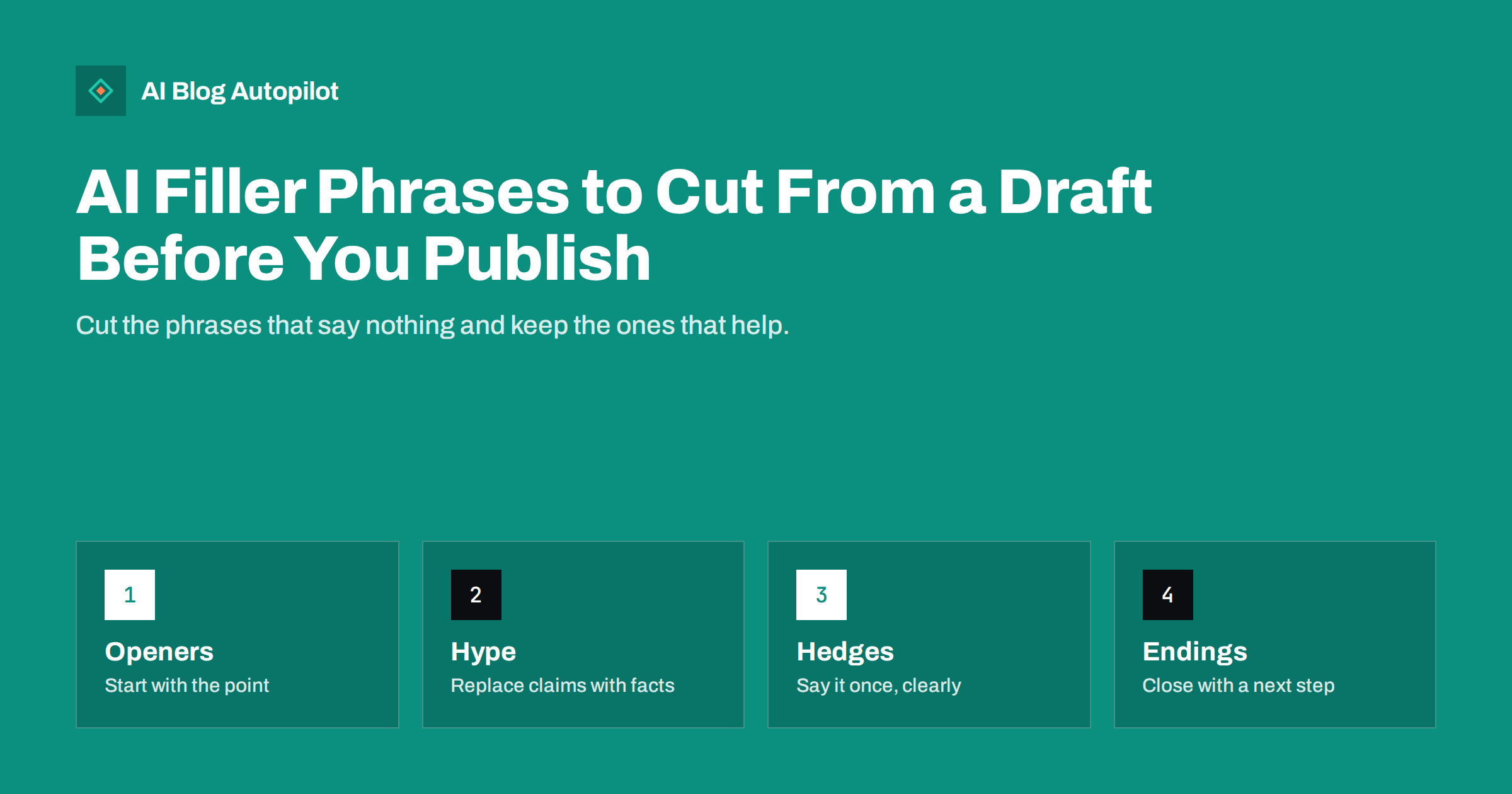
Short answer: filler phrases are words that take up space without telling the reader anything: generic openers about how fast the world moves, empty transitions, vague hype and summaries that repeat what was just said. They are common in drafts written by people and by AI tools alike, and cutting them makes an article shorter, clearer and more trustworthy. Search for the patterns, replace each one with a fact, an example or a direct statement, and delete what is left over. Do not hunt for single banned words, because the real problem is emptiness, not vocabulary.
Readers decide quickly whether an article is worth their time, and the first sentences carry most of that decision. A paragraph that opens with a sweeping statement about the digital age tells them nothing and suggests that the rest will be the same. This guide lists the most common filler patterns, explains why they weaken an article and shows how to edit them out without damaging your own voice.
What counts as filler
A phrase is filler if you can remove it and the reader loses nothing. That is the whole test. It is not about long words or formal style, and it is not about particular words that some people associate with machine-written text. A phrase that is useful in one sentence can be filler in another.
Filler tends to appear in the same places: at the start of an article, at the start of each section, between ideas and at the end. It also appears when a writer does not have a specific fact to give, so the sentence fills the gap with a general statement. That makes filler a useful warning sign. When you find a vague sentence, ask what specific thing you could say instead. Often the honest answer is that you have nothing to add, and the sentence should go.
A useful habit is to read a paragraph and underline the one sentence that carries the information. If everything else only repeats, introduces or praises it, the paragraph can shrink to that sentence plus an example. Doing this a few times trains the eye, and after a while you will see filler as you write, before it reaches the draft.
Generic openers
The most common filler is the opening that could introduce any article on any subject. Typical examples are sentences about how important a topic is today, how much the world has changed or how many businesses struggle with something. They delay the answer and add no information.
- “In today’s fast-moving digital world, businesses need…” can usually be deleted entirely.
- “Have you ever wondered how…?” delays the answer with a question the reader did not ask.
- “Whether you are a beginner or an expert…” tells nobody anything.
- “In this article, we will explore…” repeats the title.
Replace them with the answer. Begin with the main point, a specific problem or a concrete situation. An opening that says what the reader will be able to do after reading is almost always stronger than an opening that praises the topic. Our guide to introductions that do not waste time shows several patterns that work.
Empty transitions and signposts
Transitions help when they show a real relationship between ideas, such as a contrast or a consequence. They are filler when they only announce that something is coming or that the writer is moving on.
- “It is important to note that…” and “It goes without saying that…” can nearly always be cut, leaving the statement itself.
- “Let’s dive in” and “Without further ado” delay the content.
- “Now that we have covered X, let us turn to Y” can be replaced by a clear heading.
- “As mentioned earlier” is often a sign that a section repeats itself.
If a section needs a bridge, make it say something: “Because indexing takes time, plan changes a few weeks ahead.” That sentence connects two ideas and gives advice in one line.
Vague hype and unsupported claims
Words such as powerful, seamless, game-changing, revolutionary, cutting-edge and unlock are easy to write and impossible to check. A reader cannot tell what they mean, and many readers have learned to skip them. Compare “our seamless platform unlocks growth” with “you connect your WordPress site once, and articles appear on the schedule you set”. The second sentence is longer, but only the second one helps someone decide. In a factual article they can also cause harm, because a bold claim without evidence reduces trust in everything around it.
Replace each hype word with the fact behind it. Instead of “a powerful tool that transforms your workflow”, say what the tool does, for whom and under what conditions. If you cannot name a fact, a feature, a number you can source or a real example, remove the claim. Never invent statistics, quotes or sources to fill the gap, which is a bigger problem than filler. Our guide to fact-checking AI content explains how to verify claims in a draft.
Hedges and stacked qualifiers
Honest uncertainty is valuable, and some topics require careful wording. Stacked hedges are different: “it may potentially be possible that results could sometimes vary” says almost nothing. Readers want to know what you know, what depends on the situation and what you do not know.
- State the claim, then name the condition: “A new page usually appears in search within a few days, but a site with few links can wait longer.”
- Use one qualifier where you need it, not three.
- When you do not know, say so plainly and tell the reader how to find out.
- Drop reflexive disclaimers that appear in every paragraph.
The aim is not to sound more confident than the facts allow. It is to be precise, so that the reader can act on what you wrote.
Repetition and padding
Drafts often make the same point three times: in the heading, in the first sentence of the section and in a summary sentence at the end. Lists can be padded as well, with items that restate each other, such as “plan your content”, “create a content plan” and “think about your content strategy”.
Read each section and ask what it adds that the previous one did not. Merge items that mean the same thing, delete summary sentences that restate the paragraph and keep one clear statement of each idea. A shorter article that covers the same ground is not a lower-quality article. It is usually a better one, and readers finish it more often.
Also look at paragraph length and sentence rhythm. A draft in which every sentence has the same shape and length reads as mechanical. Mix short and long sentences, and vary how paragraphs begin, so that the text sounds like a person explaining something.
Endings that add nothing
The closing section is another favourite place for filler: “In conclusion, it is clear that…” followed by a paraphrase of the introduction, then a vague wish for the reader’s success. A good ending does a job. It sums up the main decision in a few sentences, names the next action or points to a related resource.
Write the conclusion as a short checklist of what to do first, or as the main answer restated in plain words for readers who skipped to the end. Then stop. You do not need to thank the reader, remind them that you are happy to help or promise a future article.
The same applies to the end of each section. Many drafts finish every section with a sentence that restates it, such as “By doing this, you will improve your results”. Delete it. The reader has just read the advice and does not need to be told that it is advice. Ending a section on its last useful sentence also makes the whole article feel faster and more confident.
A practical editing pass
You can clean a draft in one focused pass without rewriting it. Work in this order:
- Read the first two paragraphs. If the answer is not there, rewrite them so that it is.
- Delete every sentence that could appear unchanged in an article on another subject.
- Replace each hype word with a fact, an example or nothing.
- Cut stacked hedges to one qualifier, or none.
- Remove transitions that only announce what comes next.
- Merge repeated points and delete summary sentences inside the body.
- Rewrite the ending as a clear next step.
- Read the whole piece aloud, and mark every place where you stumble or feel bored.
Keep a small personal list of the filler you tend to write, because everyone has habits: a favourite opener, a pet transition, a word that appears too often. Checking for your own habits is quicker than checking for everyone’s. After a month, the list will be short, and your drafts will need less cleaning.
Do not run a find-and-replace on a list of banned words. A mechanical filter removes useful words, misses new patterns and encourages writers to swap one cliché for another. A human check against the question “does this tell the reader something?” works better and keeps your own style.
How AI Blog Autopilot helps
AI Blog Autopilot writes articles from the topics, keywords, audience and tone you set, and its writer is instructed never to make up statistics, quotes or sources. A quality check looks at length, structure, keyword and meta before anything goes live, and approval mode lets you read each article first. Giving clear topic notes and an audience description is the best way to keep drafts specific. See the pricing page for plans.
Related reading
- How to Edit an AI Draft: The Four Passes That Matter
- Introductions That Do Not Waste Time
- Fact-Checking AI Content
- How to Write Brand Voice Guidelines an AI Can Follow
The bottom line
Filler is any phrase the reader could lose without missing anything. Cut generic openers, empty transitions, vague hype, stacked hedges, repetition and padded endings, and replace them with facts, examples and direct statements. Edit in a single pass against the question of whether each sentence tells the reader something, and keep your own voice instead of banning single words.
FAQ
Are there words I should always avoid?
Not as a rule. The problem is emptiness, not vocabulary. Test each sentence by asking whether the reader would miss it if it were gone.
Is filler only a problem in AI-written text?
No. People write it too, especially when they lack a specific fact. AI drafts simply produce it faster, so a checking pass matters more.
Do filler phrases hurt SEO?
Not directly as a ranking penalty, but they make pages longer, vaguer and less useful, which affects readers and the quality signals that follow from them.
How long should an editing pass take?
For a typical article, ten to twenty minutes. Focus on the opening, the claims and the ending, where most filler gathers.
Should I remove all hedging?
No. Keep honest uncertainty, but state it once and precisely, with the conditions that matter.