ENEnglish
 LTLietuviškai
 DEDeutsch
 FRFrançais
 RUРусский
 ESEspañol
 PLPolski
 ITItaliano
 UKУкраїнська
 CSČeština
 PTPortuguês
 JA日本語
JA日本語 LVLatviešu valoda
 ETEesti
 HUMagyar
 IDBahasa Indonesia
 TRTürkçe
 HIहिन्दी
 ELΕλληνικά
 ARالعربية
 THไทย
THไทย VITiếng Việt
 RORomână
 MSBahasa Melayu
 BNবাংলা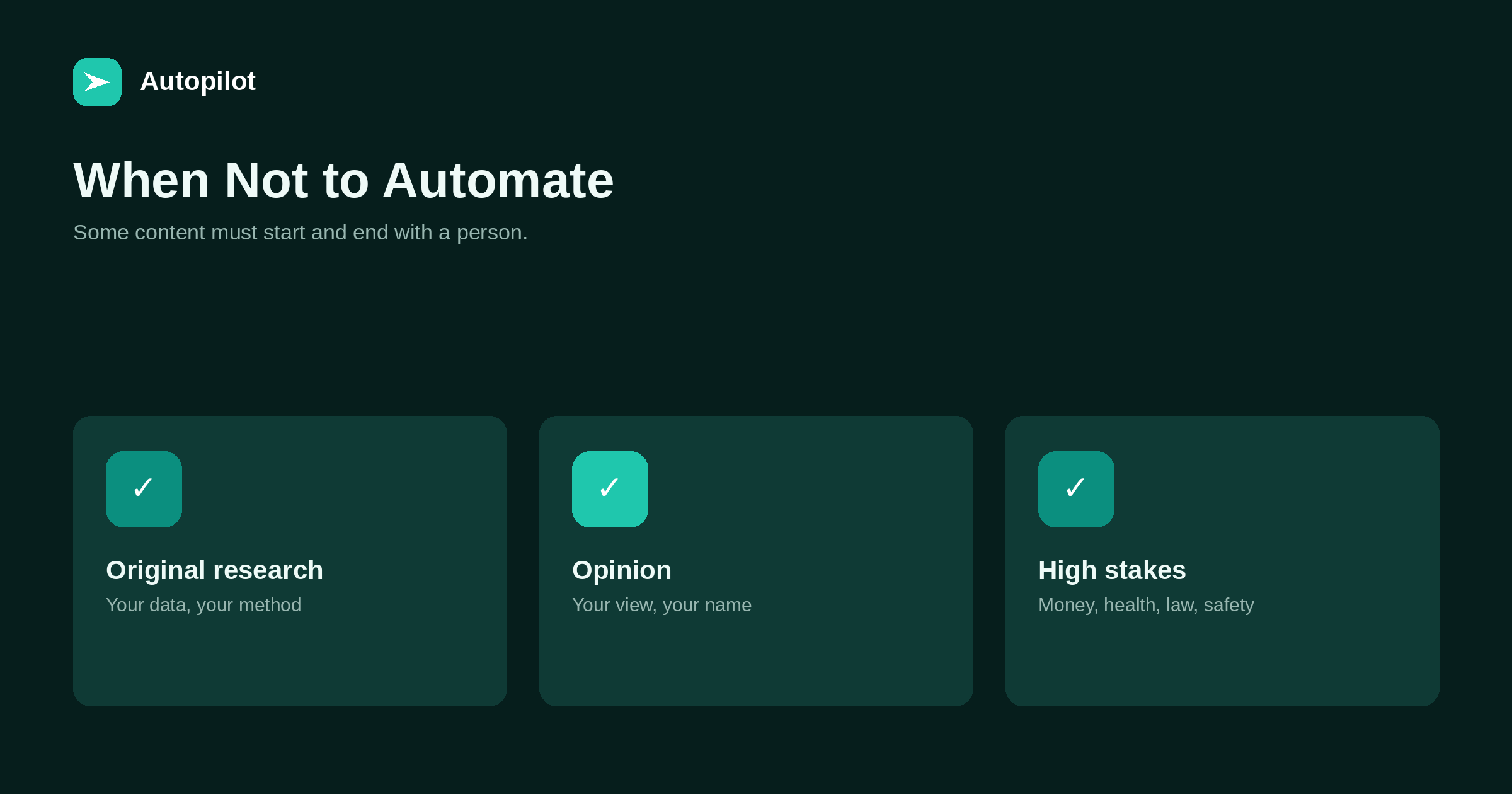
Short answer: do not automate content whose value is the author’s own view, experience or data: opinion pieces, original research, detailed case studies and personal accounts. Be very cautious with high-stakes subjects — money, health, law, safety — where drafts must be reviewed by someone qualified and sometimes written by them. Avoid automation for crisis communication, sensitive announcements and anything responding to a specific person. Use automation for well-documented, explanatory subjects, where it saves the most time with the least risk.
This blog argues that a great deal of content work can be automated. That argument is stronger, not weaker, for being clear about where automation does not belong.
Knowing the difference protects the content you do automate, because readers trust a blog more when its most important pieces are unmistakably written by people who know the subject.
Content whose value is your view
Opinion pieces, commentary and positions on industry questions are valuable because they show how the author thinks. A generated draft can structure an argument, but the position and the reasons must come from a person.
writing an opinion piece covers writing them. Automating the view itself defeats the purpose.
Original research and data
Surveys, analyses of your own data and research findings are original by definition. The method, the numbers and the interpretation need a person who understands them and can stand behind them.
Tools can help present the findings; they cannot produce them.
Case studies and personal accounts
A case study is a specific account of real work with a real client. Its value lies in the details only the people involved know. Automating one risks generic or invented detail, which is worse than no case study — writing a case study covers writing them properly.
High-stakes subjects
Content that can affect someone’s money, health, legal position or safety needs particular care.
| Subject | Approach |
|---|---|
| Financial advice | Written or closely reviewed by a qualified person |
| Health information | Reviewed by a qualified professional, sources cited |
| Legal matters | Reviewed by someone qualified, with clear limits stated |
| Safety instructions | Tested and reviewed by an expert |
| Your own pricing and terms | Checked against current policy every time |
Automated drafts can be a starting point in some of these areas, but never without qualified review, and never published unattended.
Sensitive communication
Some content should always be written by a person because of its context: responses to a crisis, apologies, announcements affecting staff or customers, and anything responding to a specific person or event.
Readers can tell when sensitive communication is generic, and the damage from getting it wrong is much larger than the time saved.
Fast-moving news
Content about something that happened today needs current, verified facts. Automated drafts may rely on outdated information or fill gaps with plausible guesses.
If you cover news, write it or verify every fact yourself — fact-checking before you publish covers checking.
Where automation fits best
Automation suits well-documented, explanatory subjects: how things work, how to do common tasks, how to choose between options, answers to frequent questions. Review and a few additions make these articles accurate and specific, and automation saves most of the drafting time.
That is the large middle of most business blogs, and it is where automation earns its place.
Mixed articles
Many articles combine explanatory material with something that needs a person: a how-to guide with a section on your own approach, or a comparison with your own recommendation. These can be drafted automatically and then completed by hand, with the person writing the parts that depend on experience or judgement.
Mark those sections clearly in the brief, so the draft leaves room for them rather than filling them with generic text that then has to be replaced.
Customer-facing commitments
Anything that commits the business — guarantees, service levels, refund terms, compliance statements — should be written or approved by someone with authority to make the commitment. An automated article that promises something the business does not offer creates obligations and disappointed customers.
Keep such commitments on pages controlled by the business, and link to them from articles rather than restating them. The same applies to prices, which change: link to the live pricing page.
Content about specific people
Articles about named individuals — employees, customers, public figures — carry risks of inaccuracy, privacy problems and misrepresentation. Write them by hand, check facts with the people involved where possible, and get consent where appropriate.
Reviewing the policy
Review the policy every six months. Categories may move towards more automation as instructions improve and evidence builds, or towards less if problems appear. The policy should reflect experience, not a decision made once and forgotten.
The cost of getting it wrong
The time saved by automating a sensitive piece is small; the cost of a wrong statement in it can be large. A generic apology, an inaccurate health claim or an invented case study can damage trust built over years, and in some sectors create legal exposure.
That asymmetry is the whole argument. Automate where a mistake is cheap to fix and unlikely to cause harm. Write by hand, or with qualified review, where it is not. The explanatory middle of most blogs falls clearly into the first group, which is why automation still saves so much time overall.
Examples from one blog
On this blog, explanatory articles about publishing, search and content are drafted with automation and reviewed. Anything stating current plan details links to the live pricing page rather than repeating figures. Claims about results are not made at all, because nobody can honestly promise them. That is the policy in practice.
Telling the team
Share the policy with everyone who plans, writes, reviews or approves content, including agencies. A short list of categories and their review levels, kept where briefs are written, prevents the gradual drift where sensitive topics end up in the automated queue because nobody remembered they were different.
A simple policy
Write down which categories are automated with review, which are automated with qualified review, and which are always written by a person. Share it with everyone involved.
draft, approve or full auto covers review levels. The policy protects the business and makes clear to everyone where judgement is required.
Related reading
If this was useful, these cover the questions that usually come next.
- The honest limits of AI blogging — the wider limits
- Writing an opinion piece — one kind of content to write yourself
- Draft, approve or full auto — review levels for the rest
The bottom line
Write opinion, original research, case studies and sensitive communication yourself. Treat money, health, law and safety with qualified review at minimum. Verify news manually. Automate the explanatory middle of the blog with review, and write down a policy saying which is which.
FAQ
What content should not be automated?
Opinion pieces, original research, case studies, personal accounts, sensitive communication and fast-moving news.
Can automation be used for health or finance content?
Only as a starting point, with review by a qualified person, and never published unattended.
Why write opinion pieces by hand?
Their value is the author’s own view and reasoning, which a tool cannot supply.
What content is best suited to automation?
Well-documented explanatory subjects: how-to guides, comparisons and answers to frequent questions.
Should case studies be automated?
No. They depend on real details only the people involved know.
How do I decide what to automate?
Write a policy listing categories as automated with review, automated with qualified review, or always written by a person.