ENEnglish
 LTLietuviškai
 DEDeutsch
 FRFrançais
 RUРусский
 ESEspañol
 PLPolski
 ITItaliano
 UKУкраїнська
 CSČeština
 PTPortuguês
 JA日本語
 LVLatviešu valoda
 ETEesti
 HUMagyar
 IDBahasa Indonesia
 TRTürkçe
 HIहिन्दी
 ELΕλληνικά
 ARالعربية
 THไทย
 VITiếng Việt
 RORomână
 MSBahasa Melayu
 BNবাংলা
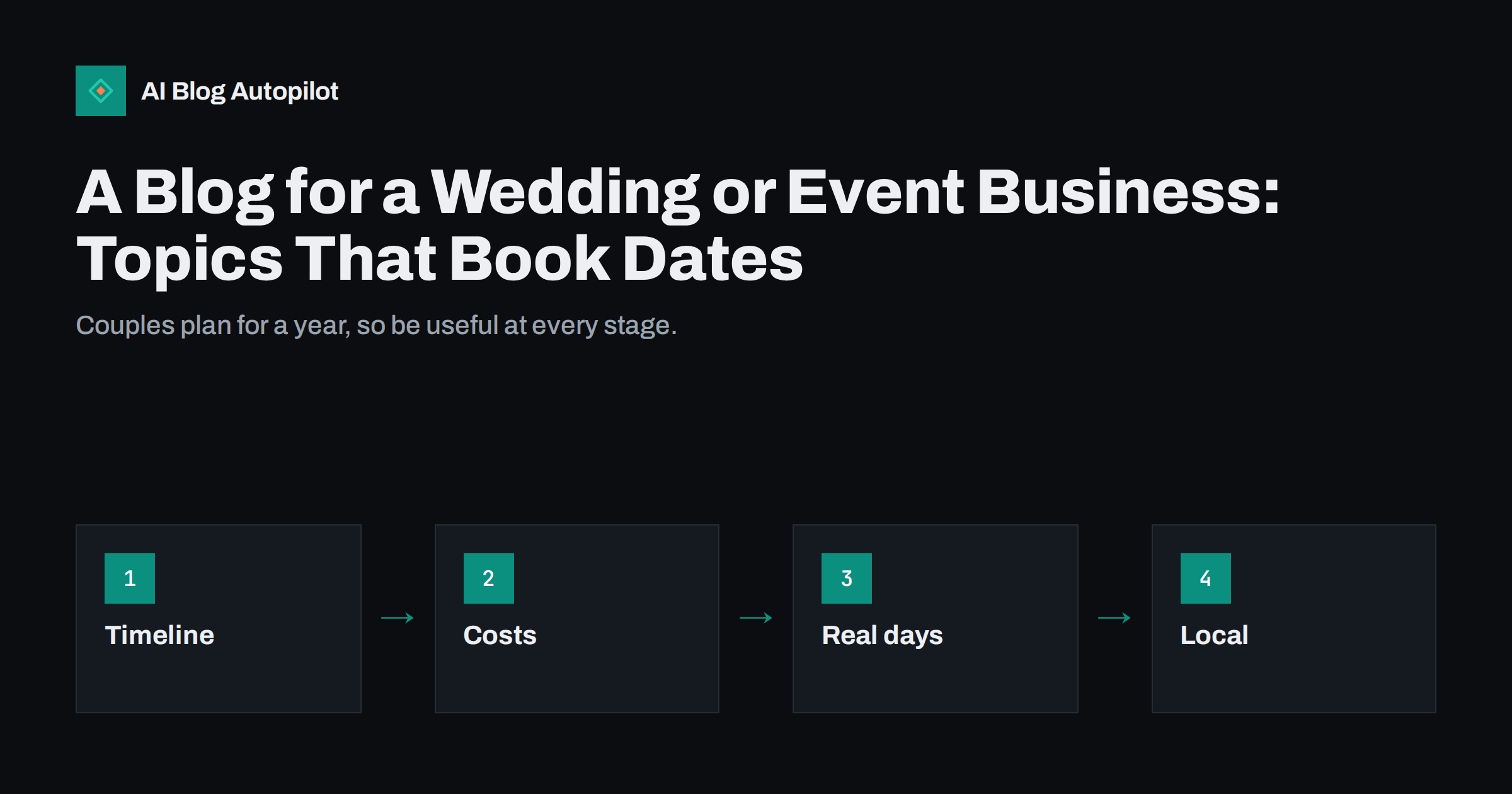
Short answer: a wedding or event business should publish content for each stage of planning: how far ahead to book, what a realistic budget looks like, how the day or event runs, what is included in your service and how to arrange a viewing or call. Show real events with permission, give honest cost ranges and explain what you cannot do. Because bookings are made months ahead, publish seasonal guides early and keep availability and prices up to date.
Weddings and events are planned in stages. Clients begin with broad searches about venues and budgets, narrow down to suppliers and finally ask about details such as timings and weather plans. A blog lets you meet them at each stage, and answer the questions that you currently handle by phone and email. It also shows your standards before anyone has met you, which matters when the purchase is large and the date cannot be repeated.
Match content to the planning stages
Start by listing what clients need at each point. At the start they ask about dates, venues, guest numbers and budgets. A few months in they ask about suppliers, menus, music, timelines and accessibility. In the last weeks they want checklists, running orders and plans for rain. Write at least one page for each stage and link them in order, so a reader who finds one at the start of a search can follow the sequence to the end and land on your booking page.
Use the real questions your team hears. A coordinator who has run fifty events knows which questions come up repeatedly: how long a ceremony takes, how to seat difficult families, what to do about speeches that overrun. These are better topics than anything found in a keyword tool. Our guide to turning customer questions into blog topics describes how to capture them without extra effort.
Think also about the questions that are asked only by the people paying. Parents, employers and committees want to know about contracts, deposits, cancellations, insurance and what happens if the date has to change. Put these on a dedicated page in plain language. A clear explanation of how a postponement works, for example, can be the page that finally persuades a nervous couple to commit, because it shows that you have thought about the worst case and have a fair answer ready.
Honest cost guides
Cost is the question clients most want answered, and many suppliers avoid it. Publish a guide that explains typical ranges for your service, what drives the price and what is included or excluded. For a venue, explain hire fees, minimum numbers, catering, corporate rates, overnight stay and what is charged on top. For a planner or photographer, explain packages and what a deposit secures. Give examples for small, medium and large events, and state clearly that they are examples and not quotes.
Update the page when prices change and show the date. A cost guide that says “from” without explaining what moves the price helps nobody. Explain the trade-offs honestly, for example that a weekday date is cheaper than a Saturday in summer, or that adding a second location raises costs. Our article on writing honestly about what things cost explains why this builds trust and brings serious enquiries.
Timelines, checklists and running orders
Practical documents are among the most shared and bookmarked pages on an event site. Write a planning timeline, from twelve months out to the day itself, and a day-of checklist. Add a sample running order for a ceremony, a reception or a conference, with times that can be adjusted. Offer a printable version, but keep the full text on the page so that it can be read by search engines and assistive tools.
Explain the reasoning behind each step. Why should photographs be taken before the meal? Why must dietary requirements be confirmed two weeks ahead? What happens if the guest list changes after the final numbers are sent? Real explanations help clients make decisions and show that you have experience. Keep the tone calm, because planning an event is stressful, and avoid language that pushes people to buy more than they need.
Accessibility and dietary needs deserve their own guide as well. Explain how guests with reduced mobility, hearing or sight can take part, what adjustments you can make and what you cannot. Describe how you handle allergies and special diets, including how kitchens separate ingredients and how guests are informed. Be precise, never overstate what your kitchen can guarantee and say how far ahead you need the information. Organisers search for these details, and few suppliers provide them.
Show real events, with permission
Real events are the best proof, but privacy matters. Ask the client before you publish photographs or stories, show them the draft and let them remove anything they dislike. Do not name guests, and avoid showing children without the parents’ consent. Describe the brief, the plan, the problems you solved and the result. A story about moving a ceremony indoors thirty minutes before it began shows far more skill than a gallery of perfect weather.
Credit the other suppliers you worked with and ask for their approval, too. A stylist, a florist and a band will all be glad to share a page that names them, and they may link back to it. This is a fair, simple form of local promotion that is similar to the approach in our guide to digital PR on a small budget.
Local pages for venues, suppliers and logistics
Couples and organisers search by place. Write about your area from a practical viewpoint: nearby hotels and transport, parking, accessibility, noise rules, local registry or licensing requirements, typical weather by season and suitable alternatives. For a supplier, explain the areas you cover and travel costs. For a venue, describe the spaces and capacity, with a plan that is easy to read and a note about step-free access.
Check legal and licensing information carefully, because rules differ between countries and regions and change. Link to official sources and say when you last checked them. Do not give legal advice. Where you mention a partner supplier, say whether the relationship is a formal partnership or only a recommendation, so that readers are not misled about commercial arrangements.
Plan content around the booking season
Most events are booked many months before the date, and searches peak at predictable times. Publish guides for summer weddings in the autumn and winter, corporate event guides before the budget year begins and holiday party pages in early autumn. Update the same page each year so that it keeps its address and gathers authority. Use the quieter months to write the pages you need in the busy ones, and schedule them ahead.
Show availability carefully. If you publish a calendar, keep it correct, or label it as indicative. An out-of-date calendar frustrates clients and wastes your time. A simple note such as “popular dates fill about a year ahead” is honest and helps people plan without creating false urgency.
For corporate events, write separately for the person who organises them. They care about budgets, approvals, invoices, technical equipment, timekeeping and risk. Offer a page about conferences, away days and parties, with a sample brief, typical timings and what you need from the client. Mention how you handle changes at short notice, and provide a clear contact for the day itself. Business buyers choose suppliers who make their own work easier, and a page that shows you understand this will bring a steadier kind of enquiry than the private market.
Reviews, enquiries and follow-up
Add a short, clear enquiry route to every page, with the information you need to answer: date, number of guests, location and budget range. Reply promptly and link to the pages that answer the likeliest questions. After the event, ask for a review and a short story if the client is happy to share one. Keep the original wording of reviews, link to the source and never invent a quote.
Track where enquiries come from by asking one simple question on the form. Over a season, you will see which guides lead to viewings and which are read but never followed up. Strengthen the first kind and shorten or merge the second. This habit fits well with the approach in our article on choosing between traffic and leads as a target.
Finally, remember the people who attend. Guests search for directions, dress codes, accommodation and gift suggestions, and they often reach the couple’s or the organiser’s page through your site. A short guest guide, such as how to find the venue, where to park and what the day will be like, makes the event smoother and shows your care. It also gives people another reason to visit and remember your name, which is useful when they later plan an event of their own.
How AI Blog Autopilot helps
AI Blog Autopilot writes full SEO articles for your WordPress blog from the topics, keywords, audience and tone you set, with FAQ sections, tags and SEO meta included, and it shares each one to your social networks. For an event business, it can keep planning guides and seasonal pieces coming through the busy season, when you have no time to write. Approval mode lets you read each article before it goes live, so you can check costs, remove anything that sounds like a promise and add the details from your own events. See the pricing page for plans.
Related reading
- Blog Strategy for a Local Business
- Planning Seasonal Content Without Scrambling Every Year
- Traffic or Leads: Which Number Should a Blog Chase?
- Webinar and Event Recaps as Blog Posts That Earn Search Traffic
The bottom line
Clients plan weddings and events in stages, so write for each stage: timelines, honest costs, running orders, real stories and local logistics. Show real events with permission, keep prices and availability current and make enquiries easy. The blog then does part of the selling long before anyone visits the venue.
FAQ
When should an event business publish seasonal guides?
Several months before the season, because many clients book up to a year ahead. Update the same page each year so it keeps its address and authority.
Should I publish prices for weddings and events?
Publish typical ranges and the factors that change them, and make clear that examples are not quotes. It filters out poor matches and brings serious enquiries.
Can I show photos from clients’ events?
Only with the client’s permission, and avoid naming guests or showing children without the parents’ consent.
How do I show availability without causing problems?
Keep any calendar accurate or label it as indicative, and explain that popular dates fill early rather than pushing false urgency.
Is it safe to give legal or licensing advice?
No. Link to official sources, say when you checked them and suggest that clients confirm local requirements with the authority.