ENEnglish
 LTLietuviškai
 DEDeutsch
 FRFrançais
 RUРусский
 ESEspañol
 PLPolski
 ITItaliano
 UKУкраїнська
 CSČeština
 PTPortuguês
 JA日本語
 LVLatviešu valoda
 ETEesti
 HUMagyar
 IDBahasa Indonesia
 TRTürkçe
 HIहिन्दी
 ELΕλληνικά
 ARالعربية
 THไทย
 VITiếng Việt
 RORomână
 MSBahasa Melayu
 BNবাংলা
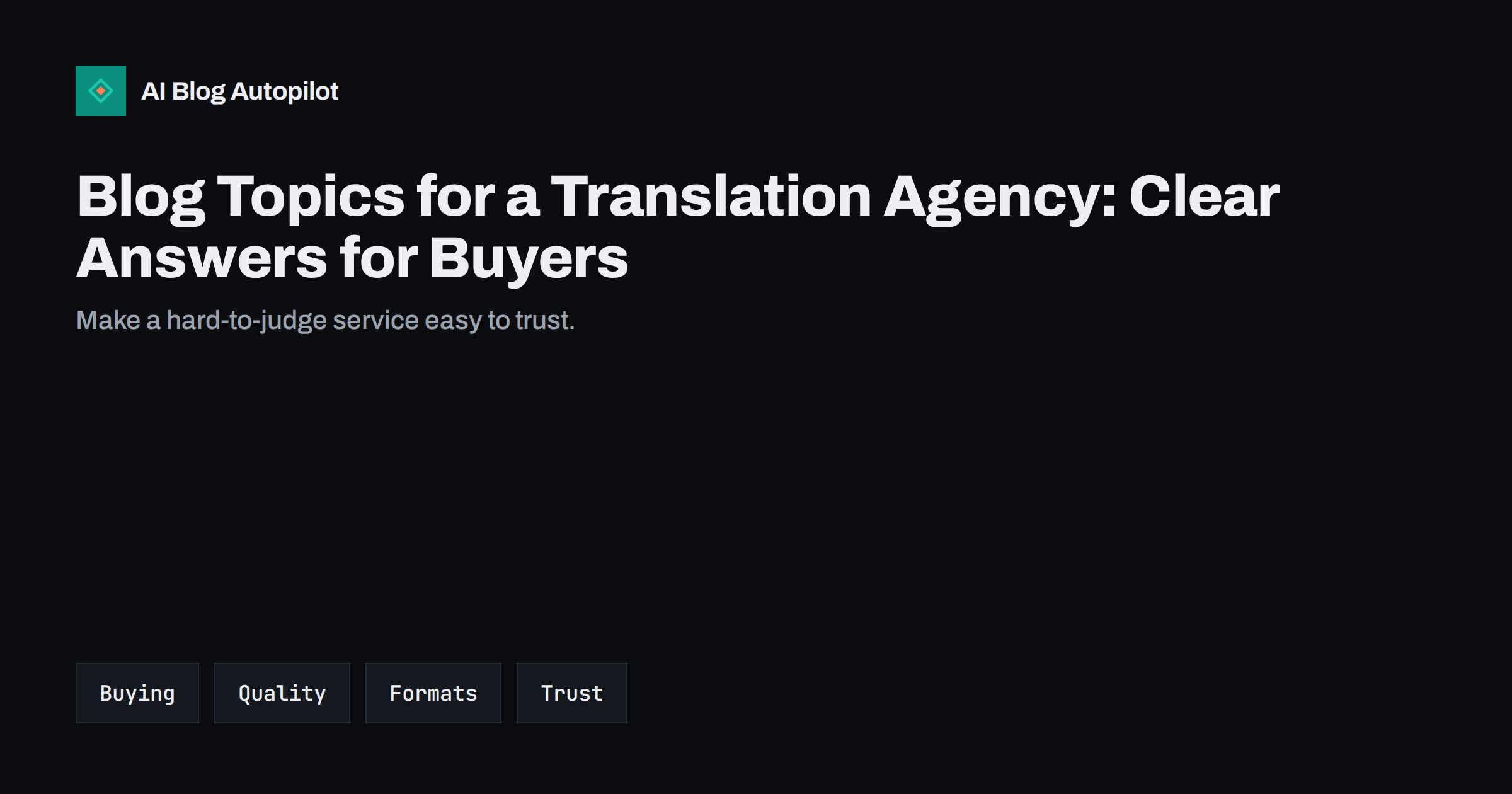
Short answer: a translation agency should blog about what buyers cannot easily judge: how quotes are calculated, what affects turnaround, how quality is checked, which file formats work best, when a certified or sworn translation is needed, how confidentiality is handled and how to prepare a text for translation. Write for one kind of client at a time, show real process and examples, and avoid claims such as perfect or native-level quality that nobody can prove.
Buying a translation is difficult. The client often cannot read the result, so they rely on trust, price and speed. That makes clear explanations unusually valuable. An agency that explains how it works, what it needs and what can go wrong looks organised and careful before any contact.
This guide lists topic groups for an agency or a freelance team, explains how to write about quality and price without exaggeration, and shows how to handle language pairs, specialist subjects and sensitive documents responsibly.
Explain how quotes and deadlines work
The first search is often about cost and time. Describe how a quote is built: the word or page count, the language pair, the subject, the format, the deadline and any extras such as proofreading, layout or a second reviewer. Say how you count words, how repetitions are treated and what the minimum charge covers.
Explain turnaround in ranges, and say what changes them. A short email and a technical manual do not move at the same speed, and a rush needs more people and more checks. If you offer express work, state how it affects price and quality control. Readers who understand the trade-offs choose better and complain less.
Be open about what you need from the client: the final source text, reference files, preferred terms, the target audience and the purpose of the translation. A page that lists these items, with a downloadable brief form, saves time and avoids misunderstandings. The structure in writing honest articles about what things cost helps present the cost factors clearly.
Describe what happens when a client is unhappy. Explain how feedback is handled, how quickly you respond, who reviews a complaint and how corrections are made and recorded. A clear and fair procedure is a sign of confidence, and it helps clients who are unsure whether a difference of style is an error. Ask clients to mark specific passages, and explain how you separate mistakes from preferences.
Show how quality is checked
Quality is the heart of the service and the hardest to demonstrate. Describe your process in plain steps: assignment to a translator who knows the subject, translation, self-check, review by a second linguist, final checks for numbers, names, formatting and consistency, and delivery. Say who the people are, in general terms, and how you choose them.
Explain terminology. A glossary agreed at the start keeps wording consistent across documents and over time, especially for companies with product names, legal phrases or technical terms. Write about how clients can supply their own glossary and how you maintain translation memories, and what that means for cost and consistency.
Be honest about machine translation. Many clients ask whether it is acceptable. Describe where it can help, such as understanding a foreign email, and where it is risky, such as contracts, medical material or marketing copy. If you use tools in your own workflow, say how a human remains responsible for the final text. Avoid vague promises, and do not claim that any process produces flawless work.
Give practical preparation tips that readers can act on today: send editable files, remove hidden comments and tracked changes, supply fonts or images with text separately, explain abbreviations and name the audience. A short checklist for each type of project reduces rework and lowers the price, which readers notice and remember.
Cover document types and formats
Buyers search by what they have in front of them: a contract, a website, a user manual, a brochure, a presentation, subtitles, an app or a set of certificates. Write one page for each type, explaining what is special about it, what files are best, how layout is handled and what to prepare in advance.
For websites, explain that translation is more than words. Menus, buttons, error messages, images with text, dates, currencies and links all need attention. The guides on choosing which languages to publish in and hreflang for a multilingual blog give background that clients with websites will appreciate, and you can link to them where it helps.
For documents with layout, describe the options: editable source files, a translated copy with the original layout, or text only. For subtitles, explain timing, line length and reading speed. Show a short before-and-after example, with the client’s permission or with your own text, so that readers can see what the work looks like.
Explain certified, sworn and official translations
Many searches are about official documents: birth and marriage certificates, diplomas, powers of attorney, court papers and immigration files. The rules differ widely by country and by receiving authority, and the same words can mean different things in different places. Do not assume the reader knows the difference between a certified, sworn, notarised or legalised translation.
Write a careful explainer. Name the country and the year, describe in general terms what is usually requested and why, and link to the official source. Tell readers to confirm the requirement with the authority that will receive the document before ordering. State clearly what your agency can and cannot provide, and what the client must supply, such as original documents or scans of a certain quality.
Avoid giving legal advice. A page that says what you do and refers readers to the correct authority is far more useful than one that guesses. Update such pages at least once a year, and show the date of the last review at the top.
Offer a way to test without risk. A small paid sample, a free estimate from a short excerpt or a call to discuss terminology lets a hesitant buyer see how you work. Explain the conditions plainly, including what counts as a sample and how long the offer lasts, and do not use free work as a trick to collect contact details.
Write about confidentiality and security
Clients send contracts, medical records, financial reports and personal documents. They want to know how the agency protects them. Describe your practices in plain language: who sees the material, how files are stored and sent, how long they are kept, how translators are bound by confidentiality and what happens at the end of a project.
Only state what is true and verifiable. Do not claim a certification or a standard you do not hold, and do not list tools by name unless you want to be tied to them. If clients can request a confidentiality agreement or a data processing agreement, say how. For large clients, a short security overview page that can be sent to a procurement team is often decisive.
Review these pages whenever your process or tools change. The advice in disclaimers and notices on a business blog helps with wording notices on the site itself.
Write about the difficult parts of language itself, such as formal and informal address, regional variants, units and date formats, names and titles, and humour that does not travel. Short pages on these topics attract curious readers, and they show that translation is a craft with decisions, not a mechanical conversion. Keep the examples short and well explained, and avoid mocking real companies for their mistakes.
Show subject expertise and real examples
Specialist subjects create trust. If you translate legal, medical, technical, financial, marketing or game content, write a page about each, describing the challenges: terminology, tone, regulation, units, cultural references and risks of error. A short, careful piece on why one wrong word can change a clause shows the reader that you understand the stakes.
Use examples. A before-and-after sentence that shows how a literal translation misleads and how a better version works is memorable. If you publish case studies, get written permission, remove anything confidential and avoid unverifiable numbers. The article on how to write a case study that persuades without exaggerating explains how to keep them honest.
Show the team. Short profiles of translators and project managers, with languages, subjects and experience, give a human face to the service. Respect their privacy and ask for consent before naming anyone or showing a photograph.
Plan a modest publishing rhythm. One careful article every week or two, kept accurate and updated, beats a burst of posts that nobody maintains. Reuse the questions that come in through email and calls, and keep a note of which pages lead to requests for a quote, since those are the pages to improve first.
Reach several markets and languages
An agency often serves clients in more than one place. Decide which languages your own site should be in and write them natively rather than by machine alone. The article on translating articles or writing natively in each language explains the trade-offs, and AI search beyond English describes how non-English pages are found and cited.
Write pages for language pairs that you specialise in, but only if you have real depth in them. A page that lists dozens of pairs with the same text is thin and unhelpful. Mention the countries, industries and kinds of documents you handle most, and link to your contact options, including a way to send a document for a free estimate.
Think about the buyer’s journey. A procurement manager, a lawyer, a marketing lead and a private person each need different pages. Compare your plan with the ideas in blog strategy for professional services firms, which covers similar trust and proof challenges.
How AI Blog Autopilot helps
AI Blog Autopilot can write and publish articles on your chosen topics, with FAQ sections, tags and SEO meta, and share them to your social networks. Give it your language pairs and your services, and have a linguist check every rule, process step and example before each article goes live. See the pricing page for plans and monthly credits.
Related reading
- Blog Strategy for Professional Services Firms
- Choosing Which Languages to Publish In
- Translating Articles or Writing Natively in Each Language
The bottom line
Explain quotes, quality checks, formats and confidentiality in plain steps, show real examples and avoid promises nobody can prove.
FAQ
What should a translation agency blog about first?
Start with how quotes and deadlines work, how quality is checked and what the client should prepare.
Should I publish prices?
You can explain the factors and show examples with conditions. If not, explain how to request an estimate quickly.
How do I write about certified translations?
Name the country and year, explain in general terms and tell readers to confirm the requirement with the receiving authority.
Can I show client work?
Only with written permission and without confidential details. Your own sample texts are a safer way to show quality.
Should I mention machine translation?
Yes, honestly. Say where it helps, where it is risky and how a human remains responsible for the final text.