ENEnglish
 LTLietuviškai
 DEDeutsch
 FRFrançais
 RUРусский
 ESEspañol
 PLPolski
 ITItaliano
 UKУкраїнська
 CSČeština
 PTPortuguês
 JA日本語
JA日本語 LVLatviešu valoda
 ETEesti
 HUMagyar
 IDBahasa Indonesia
 TRTürkçe
 HIहिन्दी
 ELΕλληνικά
 ARالعربية
 THไทย
THไทย VITiếng Việt
 RORomână
 MSBahasa Melayu
 BNবাংলা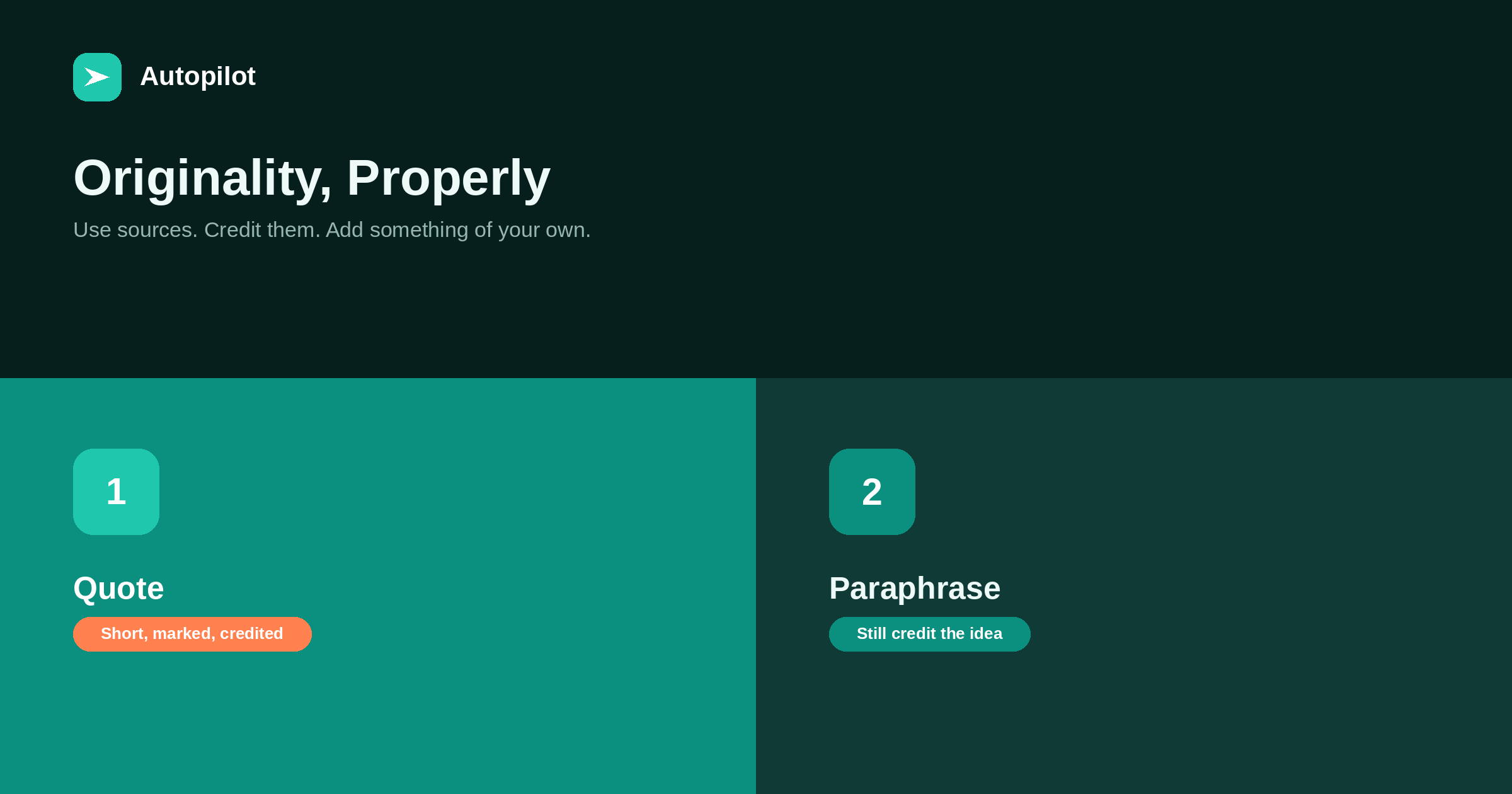
Short answer: plagiarism is presenting someone else’s words or distinctive ideas as your own. Copying sentences is the obvious form; close paraphrase, reusing another article’s structure and examples, and presenting someone’s research without credit are the less obvious ones. Use sources openly: quote briefly with marks and attribution, credit ideas you paraphrase, and link to the original. Check drafts, including automated ones, for passages that closely match existing pages. Originality comes from substance — your experience, data and view — not from rewording.
Few businesses set out to plagiarise. It happens through shortcuts: a paragraph lifted from a competitor as a starting point, an article restructured from the top result, a statistic copied without its source.
Understanding what counts, and building a few habits, prevents nearly all of it. It also leads naturally to the kind of originality that makes an article worth reading.
What counts
Plagiarism covers more than copied sentences.
| Form | Example | Acceptable? |
|---|---|---|
| Copying text | Paragraphs taken verbatim | No |
| Close paraphrase | Same sentences with words swapped | No |
| Structural copying | Another article’s outline, examples and order | No |
| Uncredited ideas or data | Someone’s research presented as yours | No |
| Short quotation, credited | A sentence in quotation marks with source | Yes |
| Common knowledge | Widely known facts | Yes |
The test is whether a reader would be misled about where the words or distinctive ideas came from.
Using sources properly
Sources strengthen an article when used openly.
- Quote briefly, in quotation marks, with the author or publication named and a link.
- Paraphrase in your own structure, and still credit the source of a distinctive idea or finding.
- Link to the original, not to someone else’s summary of it.
- Keep quotations short; long extracts raise copyright questions as well as originality ones.
fact-checking before you publish covers finding and using primary sources.
Automated drafts
Automated drafts are usually generated rather than copied, but they can reproduce common phrasings or, occasionally, passages close to existing text on a subject. They also tend to summarise what is widely published, which is a separate originality problem.
Two checks help. Run drafts through a plagiarism checker periodically, especially at the start, and look for sentences that sound too polished or too specific to be generic. And add material only you have, which is the real fix for sameness — see adding something original.
Learning from competitors without copying
Reading what ranks is useful research. Reproducing it is not.
Note what is covered and what is missing; close the tab before writing. If your outline mirrors a competitor’s heading by heading, with the same examples in the same order, it is too close, even if every sentence is reworded. learning from what already ranks covers the difference.
Checking drafts
Plagiarism checkers compare text against published pages and flag matches. They are useful for catching copied passages and close paraphrase.
They do not catch structural copying or uncredited ideas, and they flag common phrases and properly quoted material. Read the results rather than trusting a percentage. A handful of matched common phrases is normal; a matched paragraph is not.
When someone copies you
If your content appears elsewhere without permission, first decide whether it matters. A scraper site copying articles rarely affects you, because search engines are usually good at identifying the original.
If a copy outranks you or misleads readers, contact the site owner, and if that fails, use the copyright removal processes search engines and hosts provide. Keep records of your publication dates.
Originality is substance
Rewording a common article does not make it original. An article is original when it contains something readers cannot get elsewhere: your experience, your data, your view, a clearer explanation, a better example.
That kind of originality is also what readers and search engines value. Nobody can guarantee it will rank, but it gives the article a reason to exist.
Self-plagiarism and reusing your own content
Reusing your own words is not plagiarism in the usual sense, but it creates other problems. Two of your pages with the same paragraphs compete with each other and look like duplicate content. Republishing a guest post on your own blog without saying so can breach the agreement with the publication.
When you want to reuse material, rewrite it for the new context, or link to the original rather than copying it. Where the same text genuinely must appear in two places, such as a standard disclaimer, that is normal and harmless. Duplicate content covers the difference.
Attribution in practice
Good attribution is short and specific. Name the source in the sentence — according to a report by the national statistics office — and link to the page where the information appears. For quotations, name the person and their role.
Avoid vague attributions such as experts say or research shows. They give readers nothing to check and they look like a way to borrow authority without earning it. If you cannot name the source, you probably should not use the claim.
Attribution also protects you. If a sourced fact turns out to be wrong, readers can see where it came from, and correcting it is straightforward.
Why it matters beyond rules
Copied or closely paraphrased content rarely helps a business even when nobody notices. It adds nothing readers cannot find in the original, it gives search engines no reason to prefer your page, and it undermines the credibility that a blog exists to build. The practical case for originality is as strong as the ethical one: the article that says something new is the one that earns attention.
A simple policy
Write down three rules and share them with everyone who produces content: no text taken from other sites except short credited quotations; distinctive ideas and data always credited and linked; every article includes something original to the business.
Include them in the brief, check them in editing, and most problems never arise.
Related reading
If this was useful, these cover the questions that usually come next.
- Adding something original — where originality comes from
- Learning from what already ranks — learning without copying
- Fact-checking before you publish — sources, used properly
The bottom line
Treat copied text, close paraphrase, structural copying and uncredited ideas as plagiarism. Quote briefly with credit, paraphrase in your own structure, and link to originals. Check drafts, including automated ones, and read the results rather than trusting a score. Make every article original in substance, not just in wording.
FAQ
What counts as plagiarism in a blog post?
Copying text, closely paraphrasing it, reproducing another article’s structure and examples, or presenting someone’s ideas or data without credit.
Can I quote other articles?
Yes, briefly, in quotation marks, with the source named and linked.
Do I need to credit paraphrased ideas?
For distinctive ideas, findings or data, yes. Common knowledge does not need a citation.
Can automated drafts contain plagiarism?
Occasionally they reproduce close phrasings. Check drafts periodically and add original material to every article.
Are plagiarism checker scores reliable?
They catch copied passages but flag common phrases and quotes, and miss structural copying. Read the matches rather than trusting the percentage.
What should I do if someone copies my article?
Often nothing, if it does not affect you. If it does, contact the site and, if needed, use copyright removal processes.