ENEnglish
 LTLietuviškai
 DEDeutsch
 FRFrançais
 RUРусский
 ESEspañol
 PLPolski
 ITItaliano
 UKУкраїнська
 CSČeština
 PTPortuguês
 JA日本語
 LVLatviešu valoda
 ETEesti
 HUMagyar
 IDBahasa Indonesia
 TRTürkçe
 HIहिन्दी
 ELΕλληνικά
 ARالعربية
 THไทย
 VITiếng Việt
 RORomână
 MSBahasa Melayu
 BNবাংলা
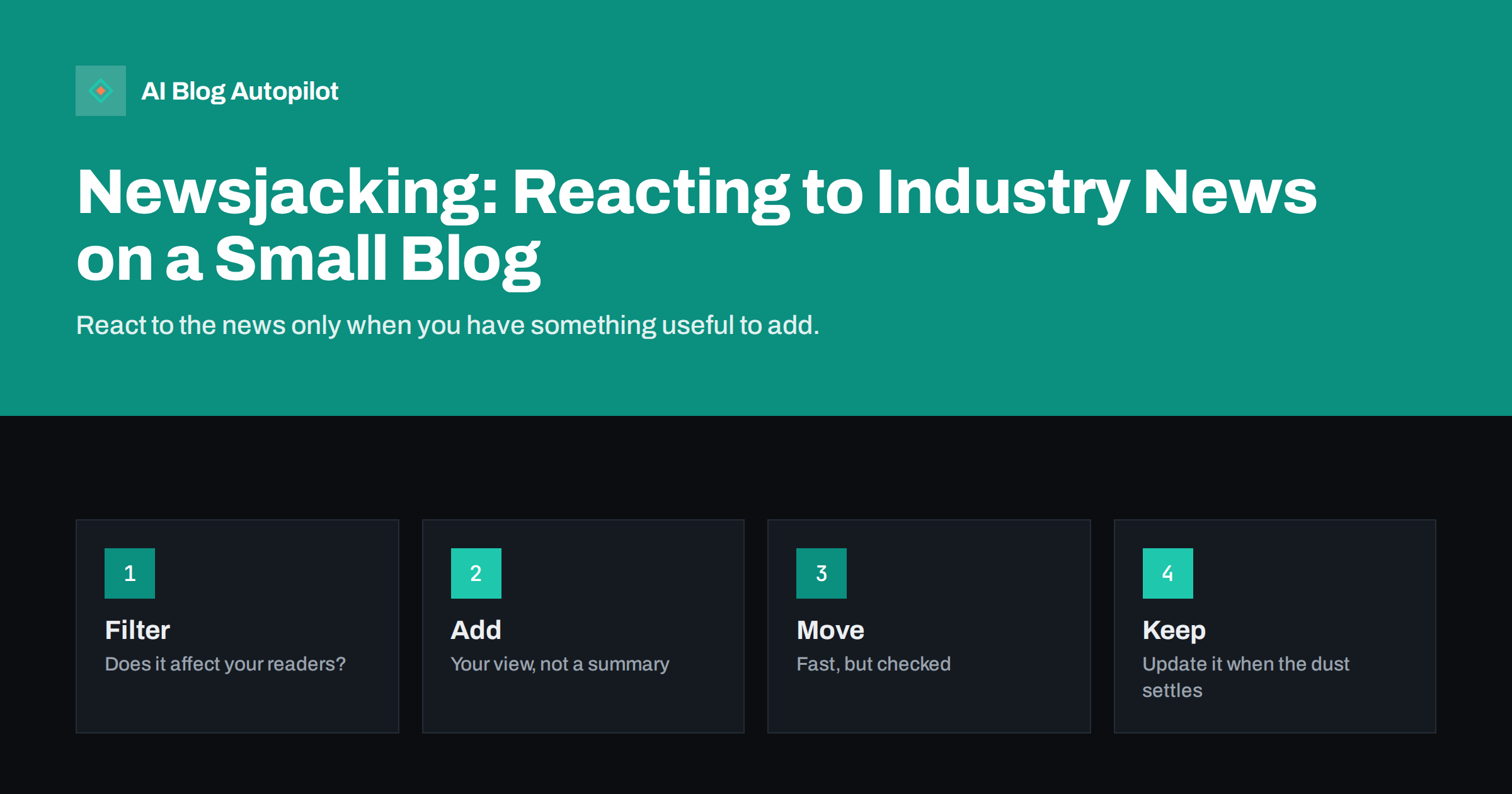
Short answer: newsjacking means publishing a timely article that connects a news event to your own field. It works for a small blog only when the story really affects your readers, when you can add something that the news reports do not, such as practical consequences, an expert view or a checklist, and when you can publish quickly without sacrificing accuracy. Most news is not worth reacting to. Choose a handful of events a year, write a short and useful piece, label it clearly with its date and update or consolidate it afterwards so that it does not become dead weight.
News tempts blogs because the attention is already there: people are searching, sharing and asking questions. But the same is true of every other site, including large publishers who can publish within minutes. A small business blog will rarely win a race to report the story. It can, however, win the follow-up question: “what does this mean for me?” That is where your experience of your own customers and field gives you an advantage the news desk does not have. This article explains how to decide what to react to, how to write the response and how to avoid the common ways reactive content goes wrong.
What newsjacking is, and what it is not
Done well, newsjacking is a service. A change in regulation, a platform policy update, a price rise from a major supplier, a high-profile outage or a major study in your sector all create questions for the people who read your blog. A good reactive article answers those questions quickly and honestly. Done badly, it is opportunism: a forced link between a trending topic and a product, with no value for the reader. Readers can tell the difference, and so can editors and search engines that reward helpful content.
It is also not news reporting. You do not need to be first or to break anything. You need to be useful, and usefully timed. Our article on evergreen versus news content explains why most of a business blog should be durable material, with news responses as a small, deliberate share.
Deciding whether to react
Run each candidate story through a few quick questions. If the answer to most is no, let it pass.
- Does it affect your readers’ decisions or work? A story that is interesting but changes nothing for your audience belongs on social media at most.
- Can you add something? Practical steps, a cost estimate, a comparison with what happened before, a view from your own experience or a plain-language explanation of something complex all count. A summary of the headlines does not.
- Is it in your field of competence? Reacting to a story you do not understand, or in a field where you have no standing, risks errors and damages trust.
- Is it appropriate? Avoid exploiting tragedies, disasters or private misfortune for attention. If you have to ask whether it is tasteless, it is.
- Will it still matter in a month? If the answer is no, a short post or social update may be enough.
- Can you be accurate quickly? If the facts are still changing, wait or publish a clearly marked first look.
Most blogs will find that only a few stories a year pass all six. That is the right number.
Where the stories come from matters too. Set up a small, calm system for noticing what matters, rather than watching the news all day. Follow the official sources in your field, such as regulators, standards bodies and platform announcement pages. Subscribe to a small number of trade newsletters. Set alerts for a few specific phrases related to your business. Ask your customer-facing colleagues what customers asked about this week. Our article on Google Trends for blog topics shows how to see whether interest in a subject is rising. Keep a shared note of candidate stories, and review it once or twice a week so that you react to developments deliberately rather than anxiously.
Writing the response
Speed matters, but the structure of the article matters more, because it is what makes a quick post useful.
- Open with the answer to “what happened and what does it mean for you?” in two or three sentences.
- State the facts with sources, linking to the original announcement or document rather than to other commentary, and put the date prominently on the page.
- Explain the consequences for different kinds of reader: who is affected, who is not and what changes in practice.
- Give actions. A short list of what to check or do this week turns commentary into help.
- Separate fact from opinion. Say clearly which parts are confirmed and which are your interpretation.
- Admit uncertainty. “This is not yet clear” is better than a confident guess that you later have to correct.
Keep the title plain and searchable: the event and the question, not a pun. Include the key terms people will type, and add a simple FAQ for the questions you expect, since reactive searches are often phrased as questions. Check numbers and names twice; a wrong detail published in a hurry is much more damaging than a slower article.
A short worked example
Imagine you run a blog for a small accountancy practice, and the tax authority announces a change to the deadline for a common filing. Hundreds of articles will report the date. Yours should do something different. The title names the change and the question: what the new deadline means for small employers. The first paragraph gives the new date, the old date and who is affected. The next section explains, with a link to the official notice, which clients need to act and which do not. A checklist follows: three things to gather this week, one thing to avoid and the point at which to ask for professional help. A small FAQ answers the questions your clients actually asked you by phone that morning. The article is perhaps six hundred words, took an hour or two and is genuinely better for your readers than the general news reports because it is organised around their decisions.
A week later, you add a note at the top that the authority published further guidance, and you adjust two paragraphs. In three months, when the change is routine, you merge the article into your permanent guide to filing deadlines and leave a link from the old address. That is the whole life cycle, and it shows the principle: speed and specificity first, durability afterwards.
Timing is partly a matter of preparation. If you already know that a regular event is coming, such as an annual platform update, a budget announcement or a seasonal rule change, prepare the outline and the background sections in advance so that only the facts need to be filled in on the day. Agree who decides whether to react, who checks the facts and who publishes, so that the process does not stall on questions of authority. A lightweight approach is a one-page checklist: the decision questions above, the sources to check, the review step and the scheduled follow-up date. Keep it with your editorial documents so that anyone on the team can use it. When nothing in the checklist applies, do nothing; staying quiet on most stories is part of the strategy.
Where AI assistance helps and where it does not
Software can help you draft quickly, but news is the area where it is easiest to publish something wrong. A tool that writes from existing knowledge will not know about an event that happened this morning, and it may fill gaps with plausible details. If you use drafting help for a reactive article, supply the source facts yourself, check every claim against the original source and read the result as an editor would. Our article on fact-checking before publication lists the steps. For breaking developments, a person should always be the final judge of what is true.
After publication: update, consolidate, or retire
A reactive article has a life cycle. In the first days it attracts attention; after a few weeks, the situation has either settled or moved on. Plan for that.
- Update it when facts change, with a visible note stating what was updated and when. Our article on handling corrections describes how to do this clearly.
- Fold it into a durable guide if the topic is a lasting one. A regulation change, for example, may deserve a permanent explainer, with the original news post redirected or linked to it.
- Mark it as historical if it remains useful as a record, with a note at the top that the situation has since changed.
- Remove or redirect it if it has no remaining value, following the guidance on pruning content.
Do not leave stale news posts at the top of the site. A visitor who lands on an out-of-date reaction and sees no update gets a poor impression of the whole blog.
Common mistakes
- Reacting to everything, which fills the blog with thin posts and exhausts the team.
- Repeating the headlines with no added value, which gives no reason to read your version.
- Forcing a product link where it does not belong.
- Presenting speculation as fact because the story was moving quickly.
- Using hashtags of tragedies or sensitive events to attract views, which can harm the brand more than silence.
- Forgetting the follow-up, leaving an out-of-date article that nobody checks.
How AI Blog Autopilot helps
AI Blog Autopilot is designed for the steady, evergreen part of a blog: it writes full SEO articles for your WordPress blog from the topics, keywords, audience and tone you set, with FAQ, tags and SEO meta, so that the base of your content keeps growing while you handle the few timely stories yourself. For anything time-sensitive, use approval mode and treat the draft as a starting point to be checked against the original sources. The pricing page lists the plans.
Related reading
- Evergreen or News Content: What a Business Blog Should Publish
- Digital PR on a Small Budget
- How to Handle Corrections on a Blog
- Using Google Trends to Choose and Time Blog Topics
The bottom line
React to the news only when it affects your readers and you can add something they cannot get from the headlines. Decide with a short set of questions, rely on primary sources, write the answer first, separate fact from opinion and plan what happens to the article afterwards. A few well-judged responses a year build a reputation for useful judgement; constant chasing builds a pile of thin pages.
FAQ
Is newsjacking good for SEO?
It can bring short bursts of traffic, but the lasting value comes from helpful articles that you update or fold into durable guides. Thin reactions rarely help.
How fast do I need to publish?
Fast enough to be relevant, but accuracy matters more than speed. A small blog rarely wins a race against news sites, and does better with the practical follow-up.
Should I put a date on a news-based post?
Yes, clearly, along with a note of any later updates. Readers need to know how current the information is.
What if the story turns out to be wrong or changes?
Update the article with a visible note explaining what changed, as described in your corrections practice. Do not quietly rewrite it.
How many news-based posts is reasonable?
Only a few a year for most business blogs. The rest of the calendar should be durable content that stays useful.