ENEnglish
 LTLietuviškai
 DEDeutsch
 FRFrançais
 RUРусский
 ESEspañol
 PLPolski
 ITItaliano
 UKУкраїнська
 CSČeština
 PTPortuguês
 JA日本語
JA日本語 LVLatviešu valoda
 ETEesti
 HUMagyar
 IDBahasa Indonesia
 TRTürkçe
 HIहिन्दी
 ELΕλληνικά
 ARالعربية
 THไทย
THไทย VITiếng Việt
 RORomână
 MSBahasa Melayu
 BNবাংলা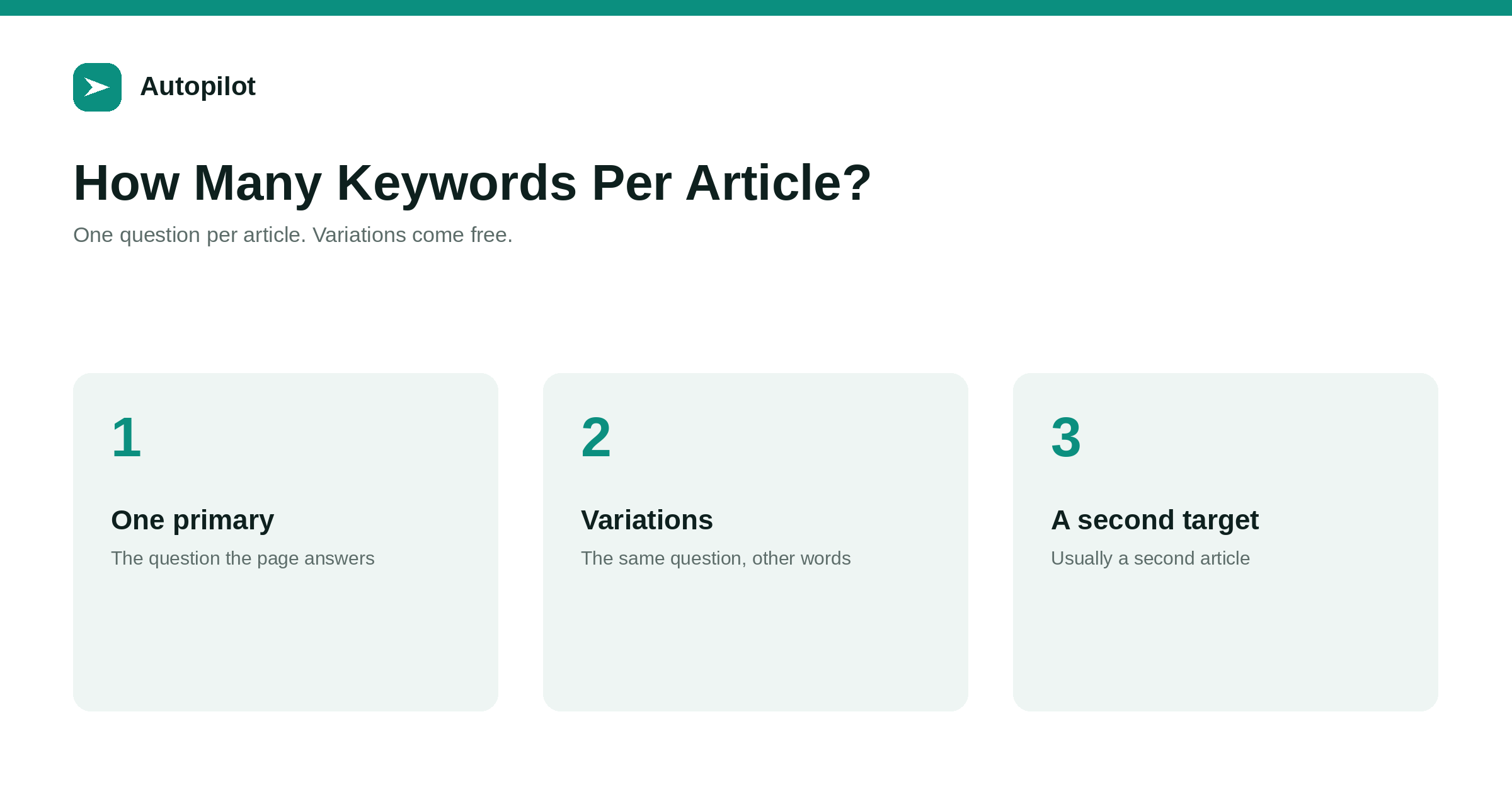
Short answer: target one question per article. A page has a primary phrase — the question it exists to answer — and it will naturally rank for dozens of variations of that question without any effort, because those variations are the same query in different words. Adding a second, genuinely different target does not double your coverage; it produces an article that answers both questions partially. The useful test is whether one page could satisfy both searchers completely. If not, that is two articles, and writing them separately is both easier and more effective.
The question usually comes from a spreadsheet: a list of forty phrases and an instinct that each article should carry several of them, so that forty phrases need only eight articles.
That instinct is backwards. A page that tries to serve four questions serves none of them well, and modern search does not need you to repeat a phrase to understand what a page is about.
One question, many phrasings
The distinction that resolves most of this: a variation is the same question in different words; a second keyword is a different question.
How long should a blog post be, ideal blog post length, blog post word count and how many words in a blog article are one question. A page answering it well will appear for all of them, and you do not need to write any of them into the text deliberately.
How long should a blog post be and how often should I publish are two questions. They are related, they belong in the same cluster, and they are not the same article — which is the distinction clusters and pillar pages is built on.
The test that settles it
Ask: could one page completely satisfy somebody searching for A and somebody searching for B?
| Phrase A | Phrase B | One article? |
|---|---|---|
| ideal blog post length | how long should a blog post be | Yes, same question |
| how to write a content brief | content brief template | Yes, one page can do both |
| how to automate a blog | best blogging platform | No, different decisions |
| alt text guide | image file size for web | No, related but separate |
| content pruning | how to delete old blog posts | Yes, same job |
| keyword research | search intent | No, one is a step inside the other |
When the answer is no and you write one article anyway, you get a page that spends half its length on each question and loses to focused pages on both.
What actually happens when you add targets
Three predictable effects, none of them good.
The structure fragments. Sections stop following a single line of reasoning because they are each serving a different query.
The introduction becomes vague. It cannot answer the title in the first hundred words, because there are three titles — which is exactly the failure introductions that do not waste time describes.
You write the same article twice. Two pages both half-covering the same two questions is the main source of internal competition, and merging them later costs more than splitting them now.
Keyword density is not a thing
A related worry deserves killing outright: there is no target percentage for how often a phrase should appear.
Search engines have understood synonyms and related concepts for many years. An article about internal linking that uses the words links, anchor text, pages and navigation is obviously about internal linking whether or not the exact phrase appears eleven times.
What repetition does do is make writing worse. If a phrase appears so often that a reader notices, you have damaged the page for no benefit — and adding phrases during editing is one of the habits editing a draft tells you to drop.
Where the primary phrase should appear
Not as a quota, but as a matter of clarity: a reader scanning should be able to tell what the page answers.
That usually means the title, the opening sentences, at least one heading where it fits naturally, and the URL slug. Four places, each because it genuinely helps somebody orient, not because four is the number.
The title and description deserve real attention since they decide the click, and titles and descriptions covers writing them. Everything else follows from answering the question properly.
When a second phrase genuinely belongs
There is one case worth naming: an article whose subject is legitimately compound, where the reader’s question contains both parts.
Delete, merge or redirect is one decision with three outcomes, so one page covers it. Freelancer versus agency versus automation is one comparison, not three articles. In both, somebody searching any part of it wants the whole thing.
The check is still the same: would a searcher for one part be satisfied by the whole page? If yes, it is one question wearing several phrasings.
Planning this across a blog
At the level of a content plan, the rule becomes simple: one question per article, and every article’s question stated in one sentence before it is written.
Doing that in planning rather than in drafting prevents the commonest scaling problem, which is an archive where six articles compete for one phrase because nobody checked. planning a month of articles covers planning a month at a time, and the one-sentence question is the field that matters most.
If you already have overlaps, they are not a crisis. Find them by grouping your published URLs by subject, then merge the pairs that answer the same question — the process in deleting, merging or redirecting. One good page beats two half pages, reliably.
Related reading
If this was useful, these cover the questions that usually come next.
- Search intent — the test for whether two phrases are one article
- Picking topics worth writing — where the primary question comes from
- Deleting, merging or redirecting — what to do once two pages compete
The bottom line
One question per article, stated in a sentence before anything is written. Variations of that question come free and need no repetition. A second genuinely different question is a second article, and writing it separately is easier than untangling the merged version later. Ignore density targets entirely.
FAQ
How many keywords should one blog post target?
One question. The page will rank for many phrasings of that question automatically, because they are the same query in different words. A second, genuinely different question belongs in a second article.
What is the difference between a variation and a second keyword?
A variation is the same question worded differently, such as ideal blog post length and how long should a blog post be. A second keyword is a different question, which a single page can only answer partially.
Is there an ideal keyword density?
No. Search engines have long understood synonyms and related terms, and repeating a phrase to hit a percentage only makes the writing worse. Write the answer properly and the relevant words appear naturally.
Where should the main phrase appear?
The title, the opening, one heading where it fits naturally, and the URL. Four places because each helps a reader orient, not because four is a required count.
Can one article ever cover two phrases?
Yes, when the subject is genuinely compound and a searcher for either part wants the whole page — a three-way comparison, or a single decision with several outcomes. The test is whether one page satisfies both searchers completely.
What do I do if two of my articles target the same thing?
Merge them into the stronger URL and redirect the other. Two half-answers compete with each other and with everyone else; one complete answer does not.