ENEnglish
 LTLietuviškai
 DEDeutsch
 FRFrançais
 RUРусский
 ESEspañol
 PLPolski
 ITItaliano
 UKУкраїнська
 CSČeština
 PTPortuguês
 JA日本語
JA日本語 LVLatviešu valoda
 ETEesti
 HUMagyar
 IDBahasa Indonesia
 TRTürkçe
 HIहिन्दी
 ELΕλληνικά
 ARالعربية
 THไทย
THไทย VITiếng Việt
 RORomână
 MSBahasa Melayu
 BNবাংলা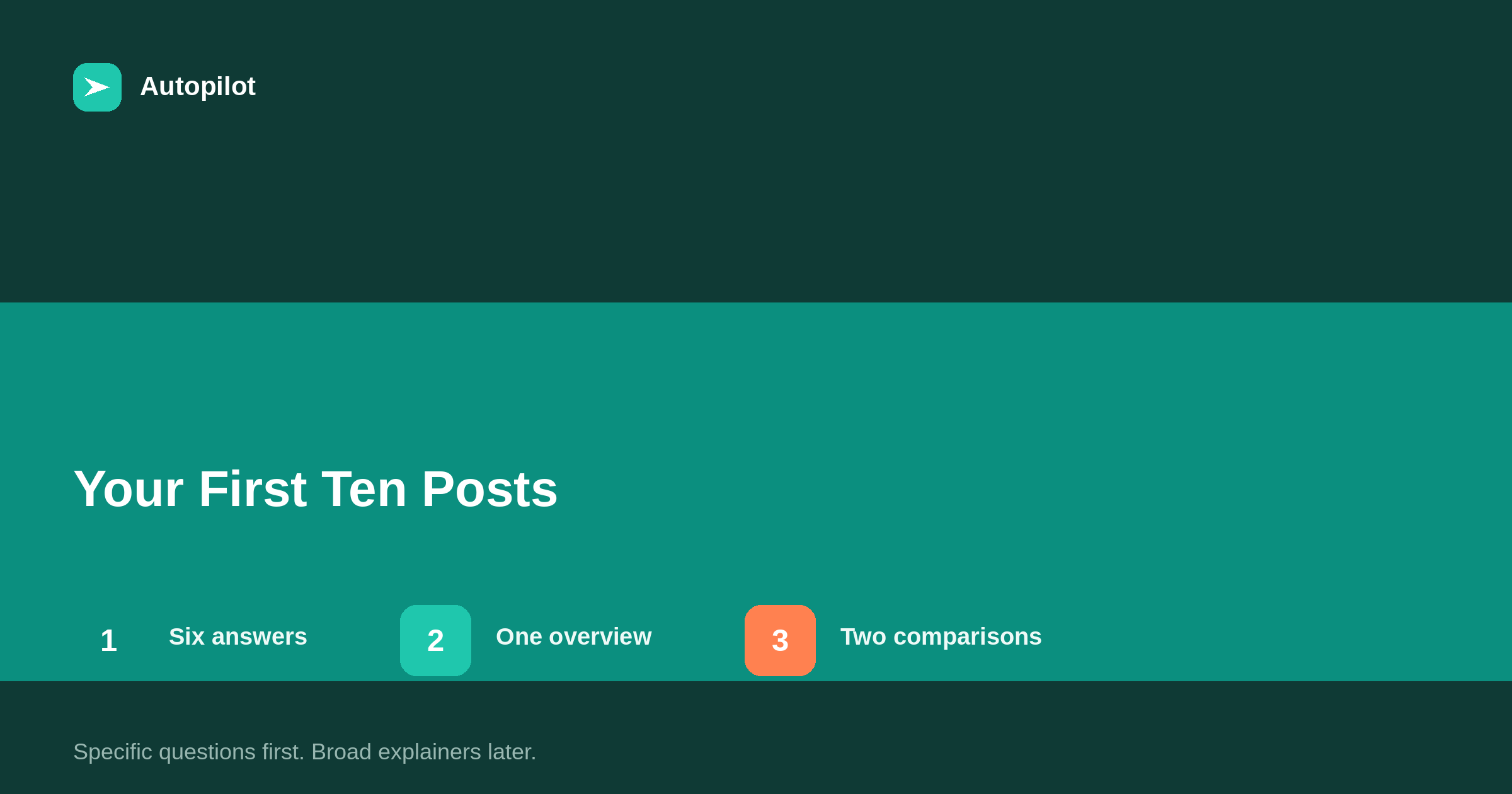
Short answer: start with six specific questions your customers actually ask, answered completely; one broad overview of your main subject that links to them; two comparison or choosing articles for people close to a decision; and one original piece built on something only your business knows. Leave broad explainers of general terms for later, because a new site cannot compete for them and they attract readers furthest from buying. Link the ten together as you go so the blog is a structure from the start.
The first ten posts shape a new blog more than any later ten. They set the subjects, the voice and the structure, and they are the pages a new site has the best chance to win with.
Most new blogs spend them on broad explainers — what is X, why Y matters — which is the category a new site is least able to compete in.
Six specific customer questions
Go through recent emails, calls and support tickets and pick the six questions you are asked most often. Write each as the customer would type it.
These make the best first articles for three reasons. They have real demand, even if tools report little. They are often answered badly elsewhere, which makes them winnable for a new site. And your answers contain experience — what actually goes wrong, what you recommend and why — that general articles lack.
They also start paying off immediately in another way: your team can link to them instead of writing the same reply again.
One overview of your main subject
One article should be a broad, genuinely useful overview of your main subject, linking out to the specific articles as they appear.
It will not rank for the broad term for a long time, and that is not its job yet. Its job is to be the hub that the specific articles link back to, so a reader who arrives on one question can find the rest — the structure described in clusters and pillar pages.
Update it every time a new article in the subject is published.
Two comparison or choosing articles
People close to a decision search for comparisons: option A against option B, how to choose between approaches, what to look for.
Two such articles, written honestly — including where your own offer is the wrong choice — serve readers at exactly the stage where a business can help them. A comparison that concludes you win on every point reads as an advert; one that says who each option suits is useful.
One original piece
The tenth article should contain something nobody else has: a number from your operations, a process you developed, a detailed account of a customer project, or a reasoned disagreement with common advice.
It will not necessarily get much search traffic. It is the article most likely to be linked to, shared, or used by your sales team, and it sets the tone for what the blog is — see adding something original.
Why broad explainers should wait
What is content marketing, why SEO matters, the benefits of blogging: every established site has these, and a new site cannot outrank them.
| Article type | Competition | Reader stage | For a new blog |
|---|---|---|---|
| Broad explainer | Very high | Curious | Later, if at all |
| Specific customer question | Often low | Has a problem | First |
| Comparison | Moderate | Deciding | Early |
| Original piece | None | Varies | Early |
Broad explainers have a place once the blog has a body of specific articles to link from them. Starting with them means spending the first months on the pages least likely to be read.
Linking them as you go
Each of the ten should link to at least two others where it genuinely helps a reader, and all the specific articles should link to the overview.
Doing this as you publish costs a minute per article. Doing it later means rereading everything. internal linking as you publish covers the habit, and it matters more on a new site, where internal links are the main way search engines discover how pages relate.
What each of the ten should include
Whatever the type, each of the first ten articles should carry the same basic elements: a short answer at the top, headings that describe their sections, at least one addition from your own experience, a title and description written deliberately, a featured image, and an FAQ where genuine leftover questions exist.
Setting that standard on the first ten is much easier than retrofitting it to fifty later, and it becomes the template the rest of the blog follows — the shape set out in how to structure an article.
Pacing the ten
Ten articles over five to ten weeks is a reasonable start for a small team: one or two a week, each properly answered and reviewed.
Publishing all ten in one day is possible and not harmful, but it removes the chance to learn from the first few. The first two or three articles usually reveal what the instructions got wrong, and fixing that before the rest improves all of them.
After the ten, take the next topics from finding the gaps in your blog, and keep the same balance: mostly specific questions, a comparison or two, something original each month. None of this guarantees traffic or leads; it makes sure the first months are spent on pages a new site can actually win.
Related reading
If this was useful, these cover the questions that usually come next.
- Starting a business blog — the steps before these ten
- Finding the gaps in your blog — where the next ten come from
- Long-tail keywords — why specific questions come first
The bottom line
Six specific customer questions, one overview hub, two honest comparisons and one original piece. Link them together as you publish, pace them over several weeks so the first few can improve the rest, and leave broad explainers until there is a body of specific articles to support them.
FAQ
What should the first posts on a business blog be?
Mostly answers to specific questions customers actually ask, plus one overview of your main subject, one or two honest comparisons, and one original piece built on your own experience.
Should I start with broad explainer articles?
Usually not. Established sites dominate broad terms, and their readers are furthest from buying. Specific questions are more winnable and more useful for a new blog.
How quickly should I publish the first ten posts?
Over five to ten weeks is reasonable. It lets the first articles reveal problems with your instructions before the rest are written.
How do I find questions for the first posts?
From your own emails, calls, chat and support tickets. Pick the six questions you answer most often, written in the customer’s own words.
Do the first posts need internal links?
Yes. Link each to related articles where it helps a reader, and link all specific articles to the overview. On a new site this is a key way pages are discovered and understood.
Will the first ten posts bring traffic quickly?
Usually not immediately. New pages take weeks to be indexed and months to settle, especially on a new domain. Keep publishing through the quiet period.