ENEnglish
 LTLietuviškai
 DEDeutsch
 FRFrançais
 RUРусский
 ESEspañol
 PLPolski
 ITItaliano
 UKУкраїнська
 CSČeština
 PTPortuguês
 JA日本語
JA日本語 LVLatviešu valoda
 ETEesti
 HUMagyar
 IDBahasa Indonesia
 TRTürkçe
 HIहिन्दी
 ELΕλληνικά
 ARالعربية
 THไทย
THไทย VITiếng Việt
 RORomână
 MSBahasa Melayu
 BNবাংলা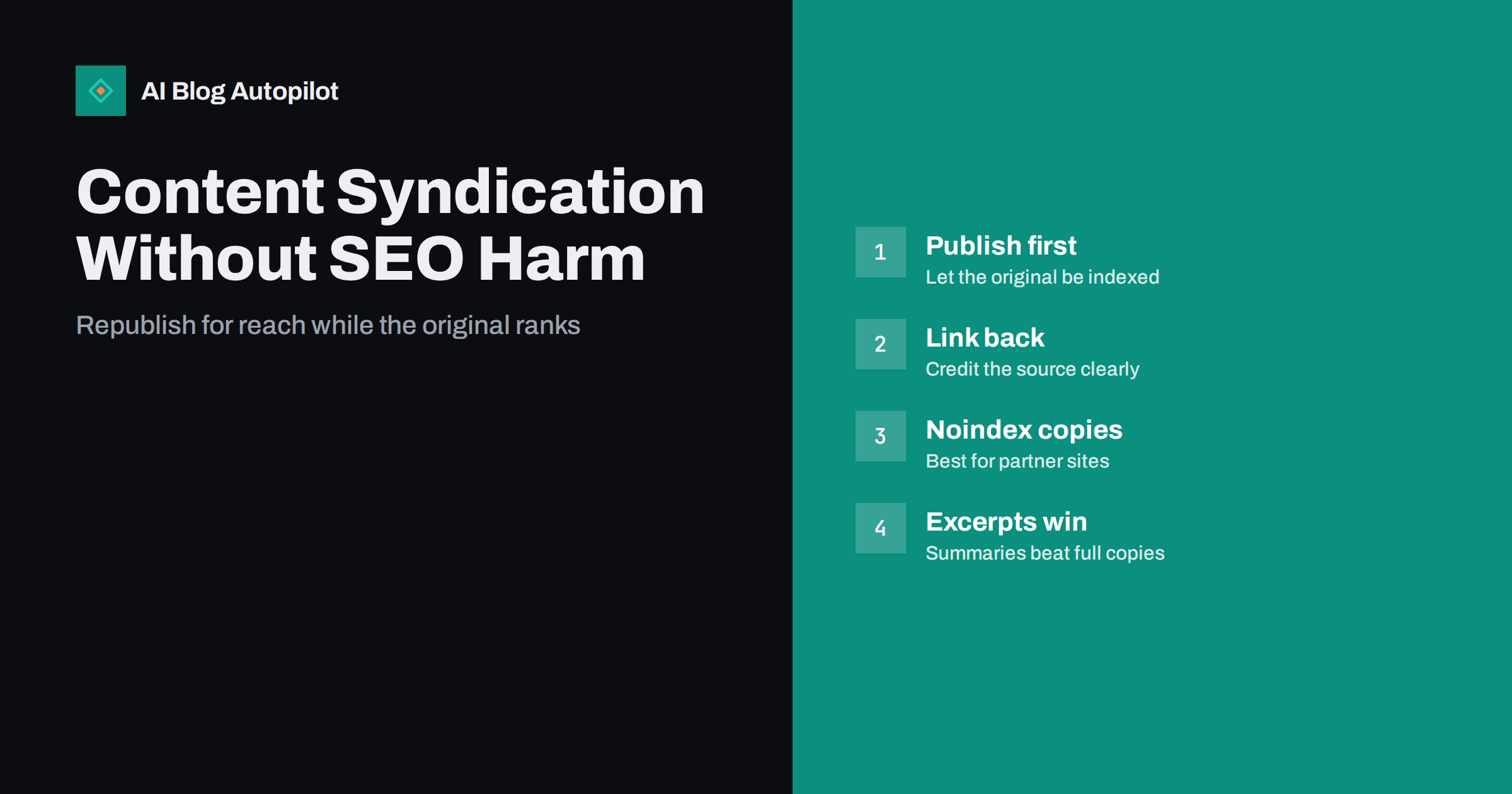
Short answer: content syndication means republishing an article that first appeared on your blog on another site, such as a publication, a partner’s blog, Medium or LinkedIn. It can bring new readers, but the copy can outrank your original. To reduce that risk, publish on your own site first and let it be indexed, make every copy link clearly to the original, ask partners to keep their copy out of search with noindex where possible, and consider publishing an adapted summary instead of the full text.
Writing a good article takes time, so it is natural to want it read by as many people as possible. Republishing the same piece on larger platforms looks like an easy win: their audience is bigger, and the work is already done.
The catch is duplicate content. When the same article exists on two sites, search engines usually show only one version for a given query, and they do not always pick yours. A large publication or platform often has more authority than a small blog, so the syndicated copy can end up taking the search traffic the original was supposed to earn. This guide explains how to syndicate while protecting the original.
What syndication is and is not
Syndication is the authorised republication of your content elsewhere, in full or in part. Common forms include:
- Republishing on platforms such as Medium or LinkedIn articles.
- A trade publication or partner blog running your article, often with an author note.
- News aggregators and industry portals that carry your posts.
- Guest contributions that reuse material from your blog.
It is different from scraping, where sites copy your content without permission, and from guest posting in its usual sense, where you write something original for another site. The SEO considerations overlap, but syndication is the one you control and can plan.
Why syndicated copies can outrank the original
Search engines try to avoid showing several identical pages for one search. When they find duplicates, they choose one version to show, based on many signals. Google explains how it chooses and how site owners can influence the choice in its guide to consolidating duplicate URLs.
Across different websites, several factors can favour the copy:
- The partner site may be crawled more often and discover the content first if it publishes quickly.
- It may have far more links and a stronger reputation overall.
- Its page may attract more links and shares because of its bigger audience.
There is no penalty involved. Duplicate content from syndication is not punished; it is filtered. But being filtered out of results for your own article is still a loss.
Protecting the original: the options
There are several ways to signal which version is the original. They differ in how strong they are and how much cooperation they need from the partner.
Noindex on the syndicated copy
The most reliable protection is for the partner to add a noindex directive to their copy. Their readers can still read it, but search engines keep it out of results, so only your original competes in search. Google’s current guidance recommends this approach for syndicated content when you want your version to appear in search. Many partners are reluctant, because they also want search traffic, so it is a point to negotiate.
Cross-domain canonical tag
A canonical tag on the copy pointing to your original URL tells search engines which version you consider primary. It is a signal rather than an instruction, and across different sites it is not always followed, particularly when the pages differ. Google has said canonical is not its recommended method for syndication, but where a partner will add it and not noindex, it is still better than nothing.
A clear link to the original
At minimum, every syndicated copy should include a visible link back to the original, typically “This article first appeared on …” with a link near the top or bottom. It helps readers, gives search engines a clue about the source and sends interested readers to your site.
Delay and adaptation
Publishing on your own site first and waiting until it is indexed and has had time to gather signals, often a week or two, improves the chance that search engines treat your version as the original. Adapting the copy, with a different introduction, a shorter version or a different angle, reduces the overlap further.
When syndication is worth it
Before worrying about the technical details, ask whether a particular syndication opportunity is worth the effort and risk at all. It usually is when:
- The partner’s audience overlaps with your customers and is hard to reach any other way.
- The partner is a respected name in your field, so appearing there builds credibility beyond the article itself.
- The article is about a topic where your own page is unlikely to rank strongly soon, so the partner’s reach matters more than search traffic.
- The partner agrees to credit you properly and link back to your site.
It is usually not worth it when the partner is a low-quality aggregator that republishes everything, when they refuse any link or credit, or when the article is one of your strongest search performers. Your best-ranking evergreen articles are exactly the ones you should be most careful about duplicating in full. For those, offer the partner an adapted version or a fresh article on a related topic instead.
Platform by platform
Medium offers an import feature that can set a canonical link to your original automatically when you import a story from its URL. Check that the canonical appears after import. Medium’s audience can be a useful secondary readership for some topics.
LinkedIn articles do not offer a canonical setting. Many people publish a summary or an adapted version with a link to the full article on their blog, rather than the whole text. For B2B topics, a well-written LinkedIn post with key points and a link often performs better than a full republished article anyway.
Partner and industry sites vary. Ask about noindex or canonical before agreeing, request a link back to the original and agree on timing. Put it in writing, even in a short email.
Your own other sites, such as a regional site or a sister brand, are easiest to control. Use canonical tags or noindex on the copies, or better, write a distinct version for each audience.
Full copy, excerpt or adaptation?
You do not have to syndicate the full text. Often a partial approach gives most of the reach with far less risk:
- Full republication gives the partner’s readers the complete article but creates the most direct competition with your original. Use it with noindex or canonical protection.
- Excerpt with link: the first few paragraphs or a summary, ending with “Read the full article on …”. Very little duplication, and readers who want more come to your site.
- Adapted version: rewritten for the platform’s audience, with a different structure or angle. Effectively new content that references the original.
- Key takeaways post: a list of main points, especially suited to social platforms, with a link to the full piece.
For most small blogs, excerpts, adaptations and takeaway posts are the safer default. Full syndication makes most sense when the partner has a genuinely valuable audience and agrees to protect your original.
A practical syndication checklist
- Publish on your own blog first and confirm the article is indexed.
- Wait a week or two before any full republication.
- Agree with the partner on noindex, or at least a cross-domain canonical, in writing.
- Make sure the copy links clearly to your original, with your name as author.
- Prefer an adapted version or excerpt where the partner allows it.
- Check the syndicated page after publication: is the link there, and is the noindex or canonical in the source?
- Monitor search results for the article’s main query. If the copy consistently outranks the original, ask the partner to add noindex or reduce the copy to an excerpt.
What to do when a copy outranks you
If a syndicated copy is ranking instead of your original, start with the partner. Ask politely for noindex, a canonical tag or a shorter version with a link. Many partners agree once the issue is explained. Meanwhile, strengthen your own version: update it, link to it from your other articles and share it. If the copy is unauthorised, it is scraping rather than syndication, and you can contact the site or, where appropriate, use the copyright removal processes that search engines provide.
How AI Blog Autopilot fits in
AI Blog Autopilot publishes each article on your own WordPress blog first and then shares it to your social networks with its own text for each network, rather than copying the full article elsewhere. That approach keeps the complete article on your domain while still reaching readers on other platforms. Any full syndication deals with partners remain your decision, using the precautions above. See how AI Blog Autopilot works.
Related reading
- Duplicate Content: What Counts and What Doesn’t
- Canonical Tags Explained Without the Jargon
- Using LinkedIn to Distribute a Business Blog
- Repurposing an Article: One Piece, Several Formats
The bottom line
Syndication can widen your readership, but the copy can outrank your original, especially on a larger site. Publish on your blog first, let it be indexed, and make every copy link back clearly. Ask partners for noindex, or at least a canonical tag, and prefer excerpts or adapted versions where you can. Check the copies after publication and act if they take your place in search.
FAQ
Is syndicated content penalised by search engines?
No. Syndication is not penalised, but search engines usually show only one version of duplicated content. The risk is that they choose the copy on another site rather than your original.
Should I republish my blog posts on Medium?
It can reach new readers. Use Medium’s import feature so the story carries a canonical link to your original, publish on your blog first and check that the canonical appears correctly after import.
Is a canonical tag enough to protect my original?
Not always. A cross-domain canonical is a signal, not a guarantee, and search engines recommend noindex on syndicated copies when you want only your version in search. A canonical is still better than no protection.
How long should I wait before syndicating an article?
Wait until your original is indexed, and ideally a week or two longer so it can gather some signals. Publishing the copy first or at the same time increases the chance the copy is treated as the original.
What is safer than full syndication?
Publishing an excerpt, a summary of key points or an adapted version with a link to the full article. These reach new readers with little duplication and send interested readers to your site.