ENEnglish
 LTLietuviškai
 DEDeutsch
 FRFrançais
 RUРусский
 ESEspañol
 PLPolski
 ITItaliano
 UKУкраїнська
 CSČeština
 PTPortuguês
 JA日本語
JA日本語 LVLatviešu valoda
 ETEesti
 HUMagyar
 IDBahasa Indonesia
 TRTürkçe
 HIहिन्दी
 ELΕλληνικά
 ARالعربية
 THไทย
THไทย VITiếng Việt
 RORomână
 MSBahasa Melayu
 BNবাংলা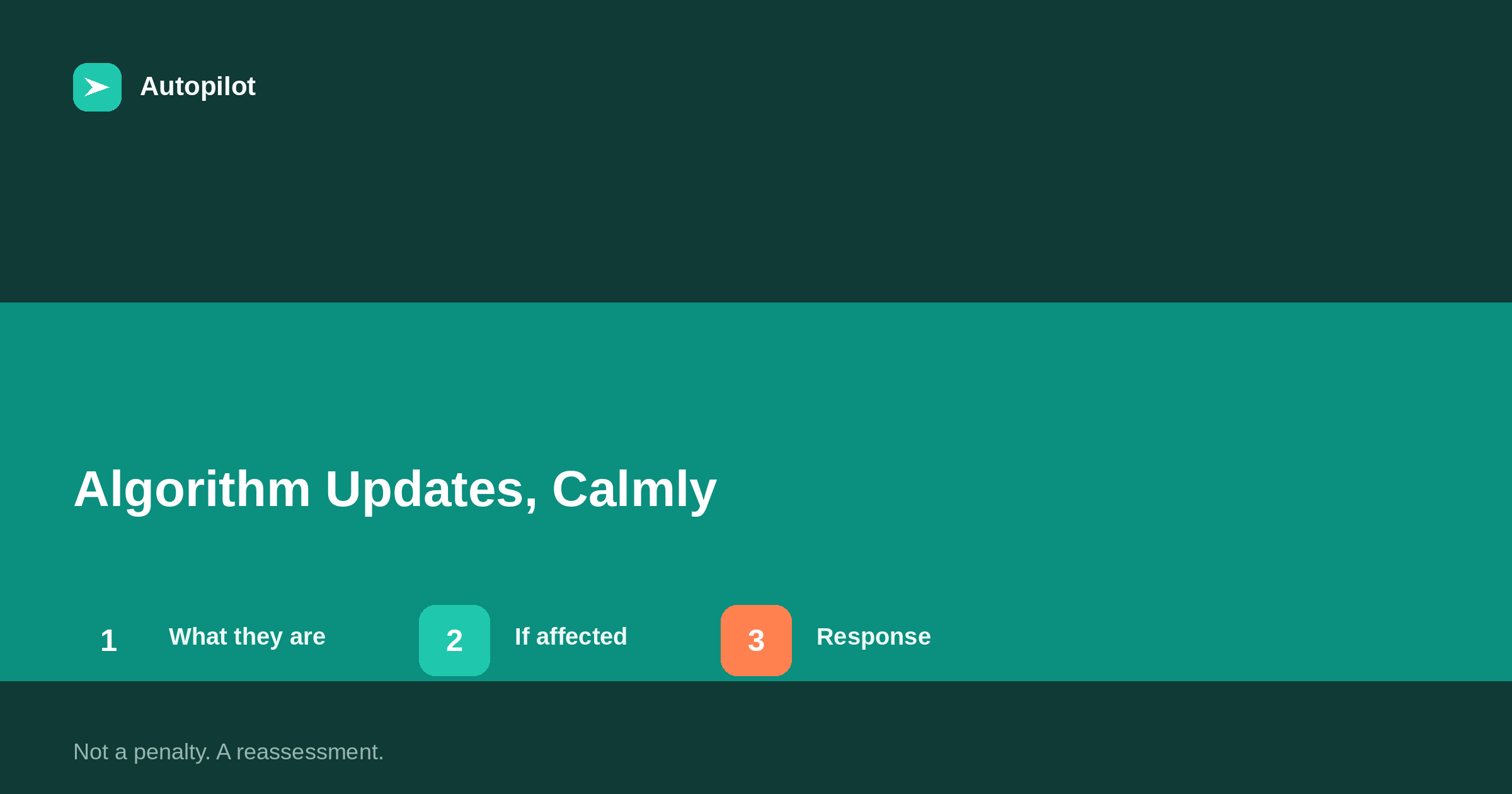
Short answer: search engines change their ranking systems constantly, with a few larger updates each year that are sometimes announced. An update is a reassessment of which pages best answer queries, not a penalty. If one affects you, check that the timing matches, identify which pages and queries changed, compare them with what now ranks, and assess them honestly against published guidance on helpful content. Improve genuinely rather than chasing theories, and expect any recovery to take time, often until later updates.
When search traffic changes sharply, attention often turns to algorithm updates. Forums fill with theories, tools publish volatility charts, and advice ranges from sensible to superstitious.
Understanding what updates are makes the response much calmer and more effective.
What an update is
Search engines adjust their ranking systems continually, most changes too small to notice. A few times a year, larger updates change how certain qualities are assessed, and some of these are announced.
An update is a reassessment of which pages best serve searchers. When some pages rise, others necessarily fall. That is not a penalty; manual penalties are separate and reported in Search Console.
Was it the update?
Check whether the timing matches. A drop that began on the date of an announced update, affected many pages at once, and has no technical explanation is plausibly update-related.
A drop at a different time, limited to a few pages, or coinciding with a site change, probably has another cause. what to do when traffic drops covers ruling those out first.
Assess the affected pages honestly
Look at the pages that lost the most and ask the questions published guidance asks about helpful content.
| Question | Honest check |
|---|---|
| Does it answer the question fully? | Would a reader need to search again? |
| Does it show real experience? | Anything a summary could not contain? |
| Is it accurate and current? | Facts, dates, screenshots |
| Who stands behind it? | Named author or organisation, contact details |
| Is it made for readers? | Or mainly to attract search traffic? |
what search engines actually say about AI content covers the guidance. Compare your pages with those that now rank above them.
Sitewide or page-level
Some updates assess sites as a whole as well as individual pages. If a large share of a site’s content is thin or unhelpful, it can affect how the rest is judged.
That is one reason an audit after an update is often worthwhile: removing or improving weak content across the site can matter as much as fixing the pages that dropped. auditing a blog covers the process.
What not to do
Several common reactions waste effort or cause harm.
- Rewriting everything immediately, before understanding what changed.
- Chasing theories from forums about single factors.
- Changing dates without changing content.
- Buying links or using other shortcuts to compensate.
- Deleting large numbers of pages without checking their value.
Improving genuinely
The response that tends to help is the one that would have been worth doing anyway: make pages more useful, more accurate, more specific, more clearly accountable.
Add first-hand experience and data — adding something original — merge overlapping articles, update outdated ones, and strengthen author and organisation information. experience, expertise and trust covers the qualities involved.
Timing of recovery
Improvements may not show quickly. Some effects are reassessed only with later updates, which can be months apart.
That makes patience part of the response. Keep improving and publishing; measure over quarters, not weeks. Nobody can promise that improvements will restore previous positions, since other sites are improving too.
Reading update announcements
When updates are announced, the announcements usually describe their aims in general terms, such as rewarding helpful content or reducing spam. Read the official description rather than summaries of it.
Treat detailed claims from third parties about exactly what an update targets with caution. Volatility tools show that rankings moved, not why. Patterns observed across many sites can be informative, but they are hypotheses, not documented rules.
The practical question is always the same: judged honestly, are your affected pages the most helpful answers to their queries? If not, that is where to work.
Gains as well as losses
Updates also lift pages. If some of your pages rose, look at what they have in common: specifics, experience, structure, freshness. That is useful evidence about what to do more of, and it is often more instructive than studying the losses.
Keeping a change log
A simple log of site changes and content improvements, with dates, makes it possible to separate the effects of your own work from the effects of updates. Without it, every movement in traffic invites guesswork. With it, you can see whether improvements to a group of pages were followed by recovery at the next update.
Automated content and updates
Sites publishing large volumes of automated content sometimes worry that updates target it specifically. Published guidance targets unhelpful content produced mainly to attract search traffic, however it is made. Automated articles that are reviewed, accurate, specific and genuinely useful are judged on the same basis as any other page.
Where automation has produced many thin or overlapping pages, an update may expose that. The fix is the same as for any site: consolidate, improve, and publish fewer, better pages if necessary.
Getting a second opinion
After a significant loss, an outside view helps. Someone who does not know the site can often see more clearly whether pages genuinely answer their queries. Ask a colleague, a customer or an adviser to compare your page with the one now ranking and say which they would prefer, and why. Their answer is usually more useful than any volatility chart.
Staying resilient
Sites that weather updates well tend to have a few things in common: content written for readers, real expertise, honest claims, a clear owner, and traffic from more than one source.
Building channels you own, such as a newsletter, reduces dependence on any one search engine’s assessment — a newsletter built from your articles covers one.
Related reading
If this was useful, these cover the questions that usually come next.
- What to do when traffic drops — the wider diagnosis
- What search engines actually say about AI content — the guidance updates reflect
- Experience, expertise and trust — the qualities updates tend to reward
The bottom line
Updates are reassessments, not penalties. Confirm the timing matches, rule out other causes, and assess affected pages honestly against published guidance and against what now ranks. Improve genuinely, avoid theories and shortcuts, audit weak content sitewide, and measure recovery over quarters.
FAQ
What is an algorithm update?
A change to how a search engine ranks pages. Small changes happen constantly; larger ones a few times a year, some announced.
Is an algorithm update a penalty?
No. It is a reassessment. Manual penalties are separate and reported in Search Console.
How do I know if an update affected my site?
Check whether a drop began on the date of an announced update, affected many pages at once, and has no technical explanation.
What should I do after being affected?
Assess affected pages honestly, compare with what ranks now, and make genuine improvements. Avoid hasty sitewide changes.
How long until I recover?
Often months, sometimes until later updates. Recovery is not guaranteed.
Can I protect my site from updates?
Not completely. Helpful, accurate, accountable content and diverse traffic sources make a site more resilient.