ENEnglish
 LTLietuviškai
 DEDeutsch
 FRFrançais
 RUРусский
 ESEspañol
 PLPolski
 ITItaliano
 UKУкраїнська
 CSČeština
 PTPortuguês
 JA日本語
JA日本語 LVLatviešu valoda
 ETEesti
 HUMagyar
 IDBahasa Indonesia
 TRTürkçe
 HIहिन्दी
 ELΕλληνικά
 ARالعربية
 THไทย
THไทย VITiếng Việt
 RORomână
 MSBahasa Melayu
 BNবাংলা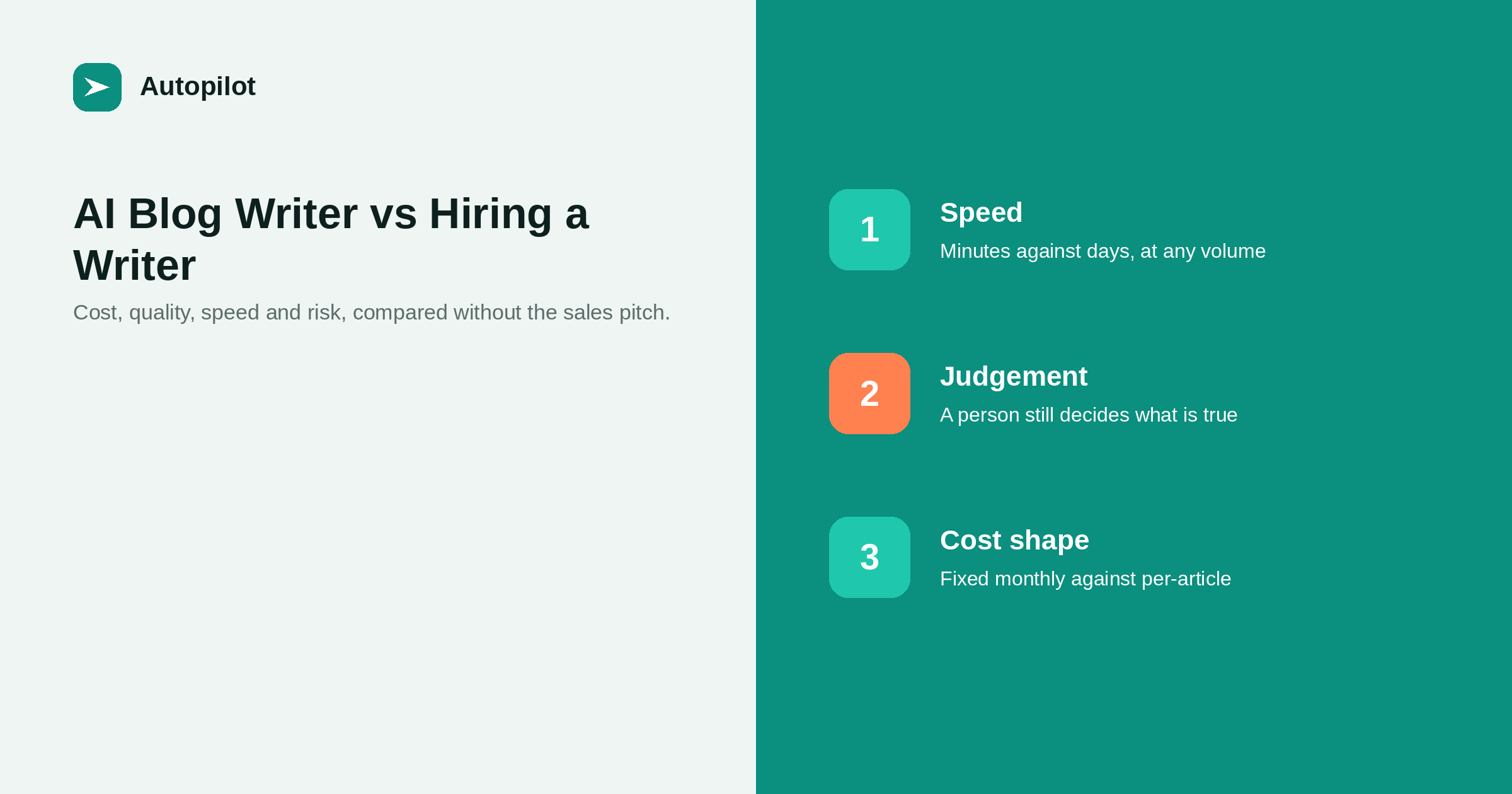
Short answer: they are good at different things, and most blogs end up using both. An AI writer wins on speed, volume, consistency of structure and cost per article; a human writer wins on original reporting, opinion, sensitive subjects and anything that needs a real point of view. The practical split is to automate the explanatory backbone of a blog — guides, how-tos, definitions, comparisons — and pay a person for the handful of pieces that need expertise or a name attached.
The comparison is usually framed as a replacement question, which is the wrong frame and leads to bad decisions in both directions. Nobody asks whether a spreadsheet replaces an accountant. The useful question is narrower: for a given article, which produces a better result for what it costs?
This is an honest attempt at that answer, written by a company that sells one of the two. Where a human writer is clearly better, it says so.
Cost: different shapes, not just different numbers
The instinct is to compare a monthly subscription with a per-article rate, but the shapes differ in a way that matters more than the totals.
A hired writer is a variable cost. Ten articles cost roughly ten times one article, and the invoice arrives whether or not the pieces performed. Freelance rates vary enormously by language, specialism and market, so any single figure quoted here would be misleading — but the shape is reliably linear.
An AI writer is a fixed cost with a ceiling. You pay for a bundle of articles a month whether you use them or not, and the marginal article inside that bundle is effectively free. That rewards consistent publishing and punishes stop-start months, which is why monthly credits that do not roll over are worth paying attention to when picking a plan.
The hidden cost in both cases is review time. Someone reads the draft either way.
Speed: the difference is structural
A commissioned article realistically takes days — brief, draft, revision, delivery — and the calendar, not the writing, is what consumes them. Five writers do not make it five times faster, because briefing and reviewing five people is its own job.
Generated drafts arrive in minutes and scale sideways without extra coordination. That matters in two specific situations: launching a blog from nothing, where you need thirty articles before anything compounds, and reacting to a change in your field within hours rather than next week.
It matters far less for a blog publishing two considered articles a month. If that is your cadence, speed is not the reason to choose either.
Quality: where each one wins
Quality is not one thing, which is why the argument goes in circles. Split it and the picture becomes clear.
| What the article needs | Better from AI | Better from a person |
|---|---|---|
| Clear explanation of a known subject | Yes | |
| Consistent structure and FAQ | Yes | |
| Coverage at volume | Yes | |
| Original reporting or interviews | Yes | |
| A genuine opinion worth arguing with | Yes | |
| Customer stories and specifics | Yes | |
| Regulated or high-risk claims | Yes | |
| Writing in several languages at once | Yes |
The left column is most of a blog. The right column is the part readers remember and link to. A blog with only the left column is competent and forgettable; a blog with only the right column is excellent and too small to be found.
Risk: what can go wrong with each
The failure modes are different and worth naming.
With a generated draft, the risk is a confident sentence that is not true — an invented statistic, an outdated rule, a feature described that does not exist. These are easy to catch precisely because they are specific: check every number and every claim about a product, and most of the risk disappears.
With a hired writer, the risk is different: an article that is fine but generic, delivered late, or written by someone who understood the brief differently than you did. That is harder to catch because nothing in it is wrong.
Neither risk is an argument against the other approach. Both are arguments for reading what you publish.
How most blogs end up splitting the work
The pattern that keeps appearing, once teams stop treating this as a loyalty test:
- Automated: explainers, how-to guides, comparisons, definitions, recurring updates, translations of anything above.
- Human: the founder’s argument, the customer story, the post-incident write-up, anything with a byline that matters.
- Both: a generated draft that a person rewrites into something with a point of view, which is usually faster than either alone.
If you want to test the split cheaply, the first three articles on Autopilot are free. Run them on subjects you know well, then decide which of your own topics you would never hand over. That list is your human writer’s job description. Plans and monthly article limits are on the pricing page.
Related reading
- How to Measure Whether a Blog Is Working
- How to Edit an AI Draft: The Four Passes That Matter
- How to Write a Content Brief an AI Can Actually Use
The bottom line
Treat this as a sourcing decision, not an identity one. The explanatory backbone of a blog — the guides and comparisons people search for — is work that automation does quickly, cheaply and consistently. The pieces that carry a name, an argument or a customer’s words are worth paying a person for. Most blogs need both, and the ones that decide deliberately spend less than the ones that pick a side.
FAQ
Is AI writing cheaper than a freelancer?
Per article, usually yes, and the gap widens with volume because the subscription has a ceiling and freelance cost is linear. At two articles a month the difference is small enough that quality should decide.
Can readers tell the difference?
They can tell when an article has nothing to say, which is not the same question. A well-structured explanation of a real subject reads the same whoever typed it; a piece with no point of view is obvious either way.
Should I disclose that an article was AI-assisted?
That is an editorial decision rather than a search requirement. Many publishers add a short note on how content is produced, which costs nothing and answers the question before a reader asks.
What about my brand voice?
Voice is a brief, not a byline. Write down the tone and the things you would never say, and apply it to both sources. Voice drifts with human writers for exactly the same reason.
Can I use both without the blog feeling inconsistent?
Yes, and most blogs that do it well use the same structure everywhere — same heading style, same FAQ pattern, same length discipline. Consistency of format hides differences of origin.
Does an AI writer work in other languages?
Autopilot writes natively in 25 languages rather than translating from English, which reads better than a translation layer. Whether your market needs that is a separate question from whether the tool can.