ENEnglish
 LTLietuviškai
 DEDeutsch
 FRFrançais
 RUРусский
 ESEspañol
 PLPolski
 ITItaliano
 UKУкраїнська
 CSČeština
 PTPortuguês
 JA日本語
JA日本語 LVLatviešu valoda
 ETEesti
 HUMagyar
 IDBahasa Indonesia
 TRTürkçe
 HIहिन्दी
 ELΕλληνικά
 ARالعربية
 THไทย
THไทย VITiếng Việt
 RORomână
 MSBahasa Melayu
 BNবাংলা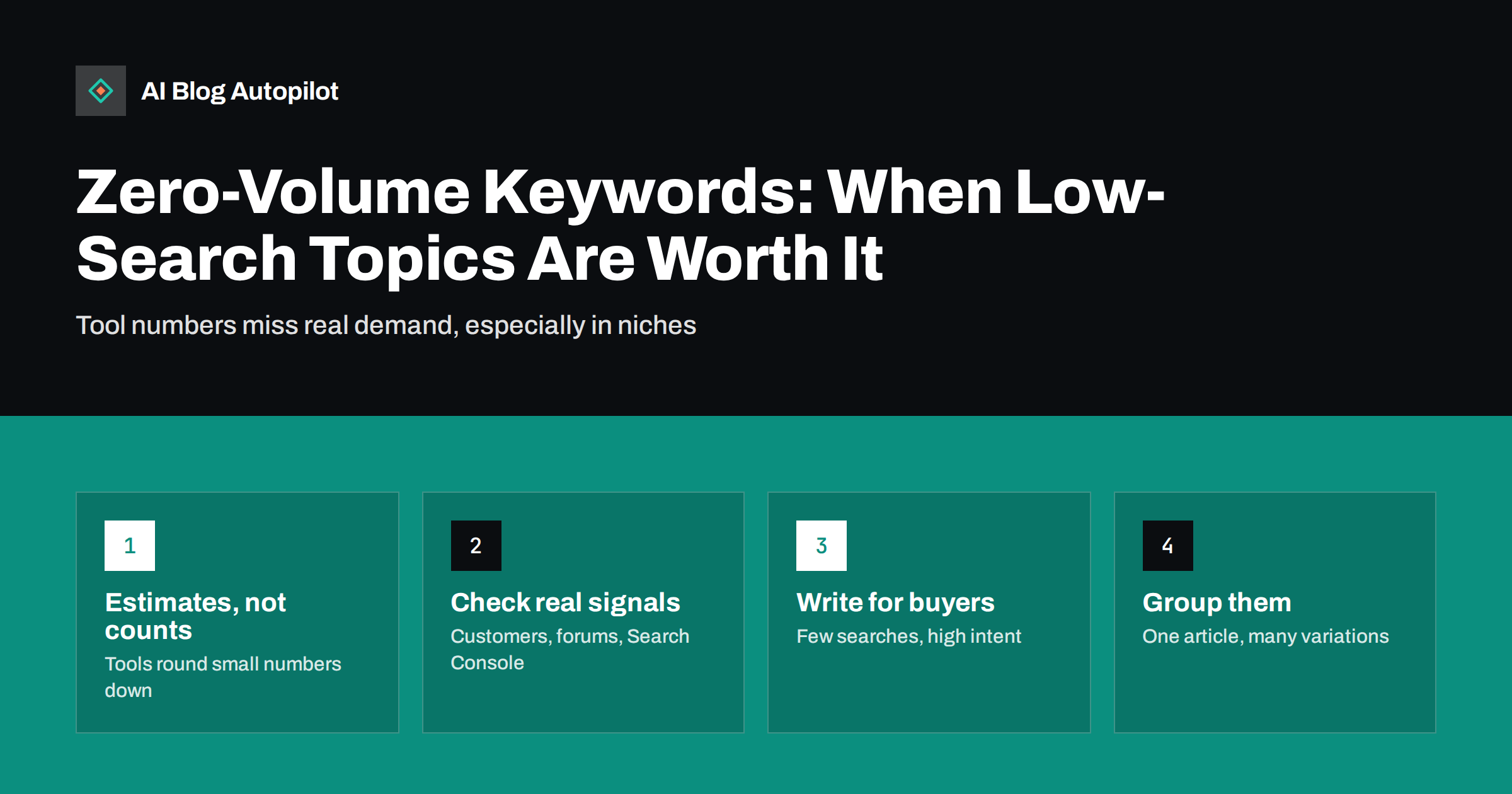
Short answer: a “zero-volume” keyword is a search query that a keyword tool reports as having no or almost no monthly searches. That number is an estimate, and tools routinely show zero for queries that real people do type, especially in niche, B2B or local topics and for new phrases. Such keywords are worth writing for when they match what your customers actually ask, show clear buying or problem-solving intent, or belong to a group of related variations that one article can cover.
Keyword research tools have trained many site owners to ignore anything below a certain number. That habit makes sense for large consumer sites competing for big terms, but it misleads small and specialist blogs. Some of the most valuable articles a business blog publishes target queries no tool would ever rate highly. This guide explains why the numbers show zero, when to trust them and how to decide whether a low-volume topic deserves an article.
Why keyword tools show zero
Keyword volume figures are not direct counts of searches. They are estimates built from limited data, and several things push small numbers to zero:
- Data sources are partial. Tools combine data from advertising platforms, clickstream panels and their own models. None of them sees every search.
- Small numbers are rounded or grouped. Advertising tools often show ranges or bucket low-volume queries together. Third-party tools then round tiny estimates down to zero.
- Close variants are merged. A tool may attribute all searches for several similar phrasings to one main keyword and show zero for the others, even though each phrasing is searched.
- New topics lag. Queries about new products, regulations or techniques appear months before tools pick them up.
- Language and country gaps. Data for smaller languages and markets is thinner, so estimates there are less reliable.
The practical conclusion: “zero” means “the tool has no reliable estimate”, not “nobody searches this”. For more on how these numbers are built, see the guide to long-tail keywords.
Why low-volume topics can be valuable
The value of a keyword is not only its volume. A query searched by twenty people a month can be worth far more than one searched by twenty thousand, if those twenty are the right people.
- High intent. Specific queries such as “how to migrate invoices from one accounting tool to another” come from people with a real problem, often close to a decision.
- Low competition. Large sites rarely write for tiny queries, so a clear, specific article can rank quickly even on a new blog.
- Many variations. One article that answers a specific question well often ranks for dozens of related phrasings. The combined traffic can be meaningful even when each one shows zero.
- Sales usefulness. Articles that answer exact customer questions double as material for sales conversations and support, which has value regardless of search traffic.
- AI answer potential. Detailed, specific questions are exactly the kind people ask AI assistants in full sentences. A page that answers them clearly has a chance of being used as a source.
Signals that a zero-volume keyword is real
Because the tool cannot tell you, look for evidence elsewhere. A low-volume topic is worth considering if several of these are true:
- Customers ask it. The question appears in sales calls, support tickets, emails or chat logs. This is the strongest signal of all.
- Search Console shows it. Your own site already gets impressions for the phrase or close variants, even without a dedicated article.
- Search suggestions include it. Autocomplete and “People also ask” boxes only show queries that people actually search, although they do not show how many.
- Communities discuss it. Forum threads, community groups and Q&A sites contain the question in similar words.
- Competitors or directories cover it. If specialist sites have pages targeting the topic, they probably see some demand for it.
- The results page is weak. When you search the phrase and find only loosely related pages, old forum posts or thin answers, there is room for a good article.
What these topics look like in practice
The pattern is easier to see with a few illustrative examples. These are typical shapes of low-volume topics, not data from any particular site.
- A bookkeeping firm might find that a tool shows zero searches for “what records to keep after closing a limited company”. Clients ask it every year, the answer is specific, and the people asking are exactly the firm’s potential customers.
- A software company might see no volume for “how to move data from [old tool] to [new tool]”. Yet every switching customer searches something like it, usually just before choosing a product.
- A local installer might see zero for “can a heat pump run with old radiators”. The question comes up in almost every quote visit, and a clear article saves time on each one.
- A B2B supplier might see no volume for a technical standard or certificate name. The few people who search it are often buyers or engineers writing a specification.
In each case, the business already has the evidence: the question keeps coming up in real conversations. The keyword tool is the least informed participant in the decision.
When to skip a zero-volume keyword
Not every low-volume phrase deserves an article. Skip it, or fold it into another page, when:
- The query is a minor variation of a topic you already cover. Add a section or an FAQ to the existing article instead of creating a near-duplicate that competes with it. The guide on how many keywords one article should target explains how to decide.
- The topic has no connection to what you sell or know. Traffic from unrelated queries rarely turns into customers.
- You cannot say anything useful. A 300-word answer padded to 2,000 words helps nobody and weakens the blog.
- The only evidence is a tool’s “related keywords” list. Machine-generated variations are not proof that anyone searches them.
A simple process for evaluating low-volume topics
This process works in a spreadsheet and takes a few minutes per topic.
- Collect candidate questions from customers, Search Console queries, autocomplete and community sites.
- Group similar phrasings into one topic. “Can I export invoices”, “how to export invoices to CSV” and “invoice export format” may belong together.
- Score each group from 1 to 3 on business relevance, evidence of real demand and your ability to answer well.
- Search each topic and note how well the current results answer it.
- Prioritise groups with high relevance, clear evidence and weak existing answers, regardless of the tool’s volume figure. Keep a short note of why each topic was chosen, so you can learn from the results later.
- Check results after publishing in Search Console. Impressions for the target phrase and its variants will show real demand within a few months.
Writing articles for zero-volume topics
These articles work best when they are precise. A few guidelines:
- Use the reader’s own words in the title and first paragraph. If customers say “invoice export”, do not title the post “Financial document portability”.
- Answer immediately. People with specific questions want the answer first and the context second.
- Cover the close variations in subheadings and an FAQ, so one article can serve all the phrasings in the group.
- Link to broader articles on the same theme and from them back to this one. Specific articles gain from being part of a clear topic cluster.
- Keep it honest. If the answer is “you can’t do that”, say so and explain the alternatives. Readers remember a straight answer.
How zero-volume topics fit into a content plan
A balanced plan for a small business blog often mixes three kinds of article: a few broader guides that target measurable demand, a larger number of specific articles built from real questions, and occasional pieces for sales or trust, such as comparisons and case descriptions. Zero-volume topics usually fall into the second group. They are rarely the articles that bring the most visits individually, but together they often bring the most qualified readers.
Review the mix every quarter. If the specific articles collect impressions and enquiries, keep adding them. If some groups show no impressions at all after several months, the demand may really be absent, and you can shift effort elsewhere. Equally, if one specific article starts attracting enquiries, look at the questions around it: the neighbouring topics are often just as underestimated by the tools.
How AI Blog Autopilot fits in
AI Blog Autopilot plans articles from the topics, keywords, audience and tone you give it, so you can feed it the real questions your customers ask, not just what a volume tool rates highly. On the Pro and Agency plans it can also import topic ideas from Search Console, which is where many hidden low-volume queries first appear. Each article is written with an FAQ and SEO meta and checked automatically before publishing. See the plans on the pricing page.
Related reading
- Keyword Research for an Automated Blog: Picking Topics Worth Writing
- Using People Also Ask as a Content Source
- Search Intent: The Four Types and What Each Needs
The bottom line
Zero in a keyword tool means the tool does not know, not that nobody searches. Judge low-volume topics by real signals: customer questions, Search Console data, search suggestions and weak existing answers. Group variations into one precise article, write it in the reader’s words, and let your own search data show whether the demand is there.
SSS
What does zero search volume mean in a keyword tool?
It means the tool has no reliable estimate for that phrase. Volume figures are modelled from partial data and small numbers are often rounded to zero, so real people may still search it.
Should a new blog target zero-volume keywords?
Often yes, if the topics match what customers ask. They face little competition, can rank quickly and tend to attract readers with specific needs. Just make sure each article is genuinely useful and not a near-duplicate of another post.
How can I check demand for a keyword the tools ignore?
Look at customer questions, Search Console impressions, autocomplete suggestions, People also ask boxes and community discussions. Several of these together are better evidence than any single volume number.
Can one article rank for many zero-volume variations?
Yes. A clear article on a specific topic often appears for many related phrasings. Covering the common variations in subheadings and an FAQ helps it match more of them.
How long should I wait before judging a low-volume article?
Give it a few months. Check Search Console for impressions on the target phrase and close variants. If there are none at all after that time, the demand may be too small to justify more articles on that exact angle.
Are zero-volume keywords useful for AI search?
They can be. People ask AI assistants detailed, specific questions in full sentences, which are similar to many low-volume queries. A page that answers such a question clearly is a good candidate to be cited.