ENEnglish
 LTLietuviškai
 DEDeutsch
 FRFrançais
 RUРусский
 ESEspañol
 PLPolski
 ITItaliano
 UKУкраїнська
 CSČeština
 PTPortuguês
 JA日本語
 LVLatviešu valoda
 ETEesti
 HUMagyar
 IDBahasa Indonesia
 TRTürkçe
 HIहिन्दी
 ELΕλληνικά
 ARالعربية
 THไทย
 VITiếng Việt
 RORomână
 MSBahasa Melayu
 BNবাংলা
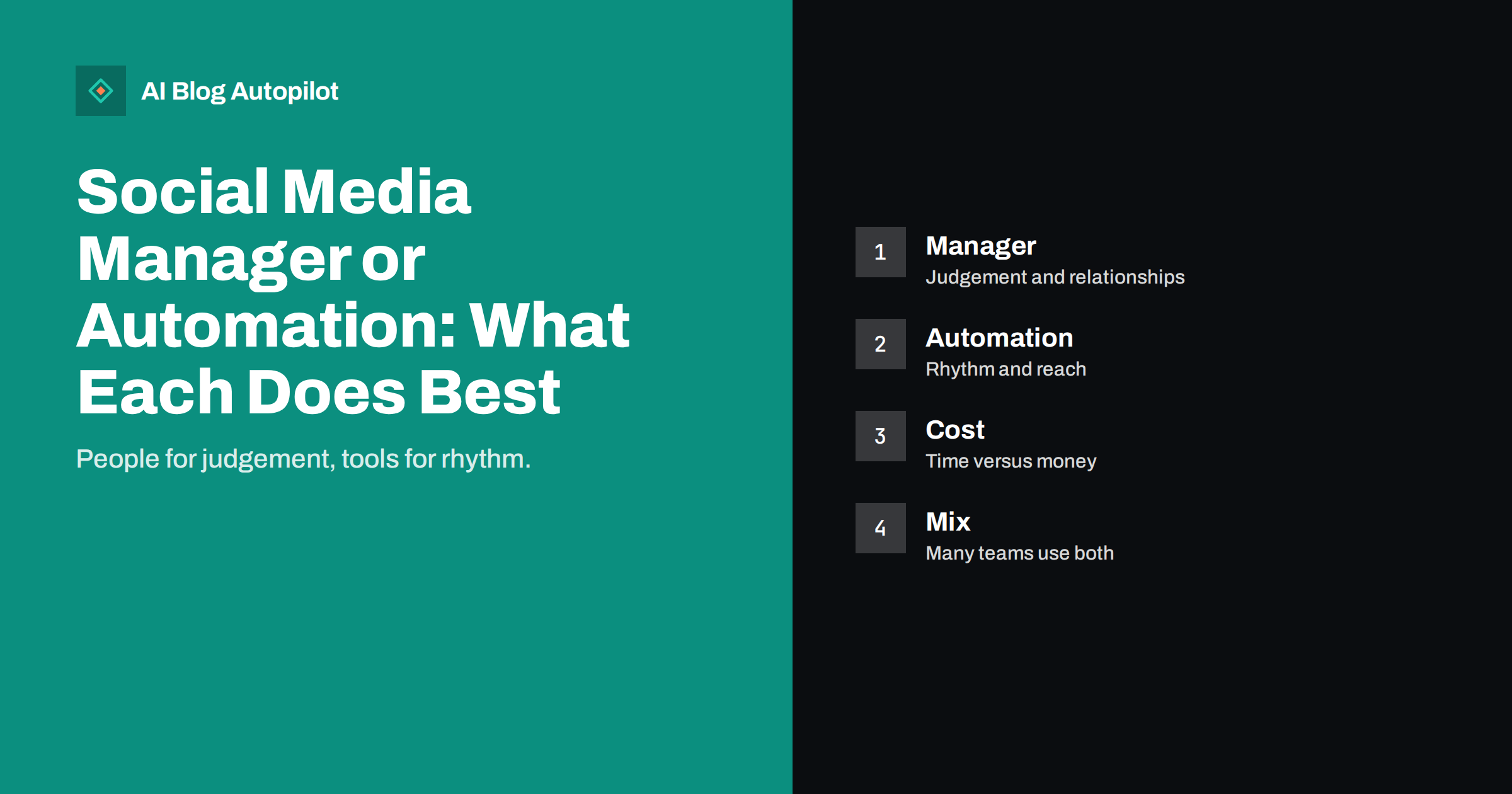
Short answer: a social media manager brings judgement, creativity and real conversations, while automation brings consistency, reach and speed at a low cost. Choose a person for strategy, community and fast reactions; choose automation for steady publishing across many networks; and consider combining both so that people handle the human work and tools handle the routine.
Small businesses often face a simple budget question: pay someone to run social media, or use a tool that posts for you. The honest answer is that they do different jobs. A comparison that treats them as rivals misses the point, and the best results often come from dividing the work sensibly.
This guide compares the two on tasks, quality, cost, risk and fit. It will help you decide what to keep in-house, what to hand to a person or agency and what to automate, whatever the size of your business.
What a social media manager does
A manager plans a strategy, decides what to say and to whom, writes or edits posts, creates or briefs images and video, replies to comments and messages, watches what competitors do and reports on results. Above all, they exercise judgement: they know when to speak, when to stay silent and how a message may be read.
They can react to events as they happen. A news story, a customer complaint or a joke that is trending can be handled in minutes by someone who understands your brand. They can also build relationships with customers, partners and local groups by taking part in conversations instead of only broadcasting.
The cost is time and money. A good manager, whether in-house, freelance or agency, is a significant expense for a small business, and quality varies. They also cannot be everywhere at once, so a single person usually covers limited networks and hours. The guide to freelancer, agency or automation compares options for writing.
What automation does
Automation publishes at set times, without someone pressing a button each time. It can share every new blog article to many networks, adapt text to each one, repeat evergreen content and keep a rhythm during holidays, evenings and busy weeks. It does not get tired or forget.
AI Blog Autopilot is one example. Its pages say that it writes 2,000 to 3,000-word articles for your WordPress blog and shares every one to 60 social networks, at the best time, in 25 languages. It also offers a social-only mode with native posts for each network, with no website needed. Details come from the product’s own pages, so check them for current wording.
The strengths are consistency and scale. A small team cannot manually post to dozens of networks at different times, but a tool can. The weaknesses are that automation cannot read the mood of a conversation, answer a worried customer or spot a delicate situation. It does what it is set up to do, and no more.
Comparing the work, task by task
Look at the tasks one at a time. Strategy and positioning belong to people. Planning the month can be shared: a person sets goals and themes, and a tool schedules. Writing first drafts can be automated, with human review for tone and facts. Publishing is best automated, because it is repetitive and time-sensitive.
Engagement belongs to people. Replies, questions, thanks and complaints need a human voice, especially when emotions are involved. Monitoring mentions and trends needs both: tools can alert, but a person decides what matters. Reporting can be largely automated, with a person to interpret.
Crisis handling is firmly a human job. If something goes wrong, pause scheduled posts and let a person decide what to say. The guide to when to pause scheduled social posts offers a short checklist. Everything depends on who is watching.
Do not forget the learning curve. A new manager needs weeks to understand your products, customers and tone, and an agency needs onboarding. A tool needs setup, connection of accounts and tuning of instructions. In both cases, the first month is rarely representative, so judge the result after a fair period, not after the first week.
Consider continuity. A person may leave, fall ill or go on holiday, and the accounts may go quiet or become confused. A tool keeps running as long as it is configured, which makes it a useful safety net for the routine. Whatever you choose, keep your logins, brand guide and content plan in a place that more than one trusted person can reach.
Cost, time and hidden costs
Compare real costs. A manager costs salary or fees, plus management time to brief and review. Automation costs a subscription, plus setup time and periodic checks. For a business with a limited budget, the difference can decide whether social media is done at all.
Count the cost of inconsistency. Posting in bursts, then going silent for weeks, wastes the effort already spent. Many small businesses start with enthusiasm and fade. Automation can protect against this, giving a steady presence even when staff are busy.
Also count the cost of errors. A badly judged post can harm a brand, and a manager without enough knowledge of your business can make it. Automation with no review can post something out of date. In both cases, a clear approval process and a person who knows your business keep risk low. See automated social posting mistakes for the usual pitfalls.
Quality and brand voice
A skilled manager develops and protects a brand voice and can adapt it to each network. Automation can follow written instructions on tone and audience, but it cannot absorb the unspoken sense of your business. The more precise your instructions, the better the results.
Write a voice guide that both a person and a tool can follow: how you greet, what words you use and avoid, how you handle humour and what subjects are off-limits. The article on brand voice guidelines shows how. Review samples regularly.
Native posts, written for each network instead of copied, matter more than people think. A tool that adapts text, length and timing to each network can look natural, while a copy-paste approach looks lazy. Check how your chosen method handles this. The guide to choosing social networks helps you decide where to be.
Think about the size of your audience and the nature of your products. A business with a few high-value customers may do better with personal outreach than with broad posting. A shop with a mass market benefits from regular visible posts. A service with seasonal peaks needs bursts at the right time, which a person can orchestrate and a tool can then schedule.
Consider languages and regions. A business that serves several countries faces a difficult task if it must hire speakers of each language. Automation that writes natively in many languages can help here, though a native speaker should still check samples. The AI Blog Autopilot pages state that articles are written directly in each of 25 languages, not translated from English, so you can judge samples for yourself.
Which businesses suit which approach
A very small business with no marketing budget and a blog may do best with automation and a short weekly check by the owner. A shop with a lively community and frequent news may need a person who can reply quickly. A professional services firm may want a manager for thought leadership and automation for sharing articles.
Agencies and freelancers can use automation to cover routine publishing for many clients, freeing time for strategy and creative work. A larger company may keep a team for community and campaigns and use automation for evergreen resharing and regional or multilingual coverage.
Think about regulation and sensitivity. In fields such as health, finance and law, a qualified person should review all public statements. Automation may still help with scheduling, but approval matters. The AI Blog Autopilot pages note that AUTO is the default mode and that approval is optional if you prefer to see each article first.
Keep the human parts truly human. Reply to comments yourself, thank people who share your posts, ask followers questions and respond to private messages promptly. Automated publishing does not mean automated friendship. Audiences quickly sense when nobody is listening, and a handful of thoughtful replies each week can outweigh a dozen extra posts.
Use data to decide where to spend scarce human attention. Look at which posts attracted comments or questions, and put your effort there. If a network brings little response after several months, reduce the time you spend on it, or let automation maintain a light presence while you focus on places where your customers actually are.
A simple hybrid model
Many teams find a middle path. A person sets the monthly themes, reviews a sample of posts and handles replies, while automation writes, schedules and publishes the routine posts. Evergreen content is reshared by the tool, and the person focuses on timely items and conversations.
Divide the week. Spend ten minutes on Monday to check the content map and scheduled posts, ten minutes mid-week for replies and mentions, and ten minutes on Friday to record results and plan changes. Thirty minutes a week can keep a presence healthy when the publishing itself is automated.
Agree who is responsible for what. Write down who answers comments, who approves sensitive posts and who can pause everything in an emergency. Clear roles prevent gaps. The article on blog team roles offers a template.
How to decide
Ask five questions. What do we want social media to do for us? How much time can we give each week? Do customers expect quick replies on social media? What is the risk of a mistake? What can we afford this year? The answers point to a manager, a tool or a mixture.
Start small and measure. Try automation for a few months, watch results and see where you need more human input. Or hire a manager for a short project and compare the effect. Keep notes on cost, time and outcomes so that the decision is based on evidence, not a feeling.
Review the choice every six months. Your business, your networks and the tools themselves change. What was right last year may not be right now, and a calm review prevents you from sticking with a poor fit.
How AI Blog Autopilot helps
AI Blog Autopilot covers the routine part: it writes articles and shares each one to your networks at suitable times, with a content map where you can see it all. The people on your team keep the conversations. Look at the plans, including the Social plan for those without a website.
Related reading
- Turning Blog Posts Into Social Posts
- Replying to Comments on Social Posts
- Social Media Metrics for Bloggers
The bottom line
Use people for strategy, judgement and conversations, use automation for steady publishing and reach, and combine them with clear roles and a quick weekly check.
SSS
Can automation replace a social media manager?
Not fully. Automation handles routine publishing, but judgement, replies and crisis handling need a person.
What is automation best at?
Steady publishing across many networks at set times, resharing evergreen content and covering busy or quiet periods.
What is a manager best at?
Strategy, brand voice, creative ideas, real conversations and quick reactions to events.
Is a hybrid approach sensible for a small business?
Yes. A person sets themes, reviews samples and answers comments while a tool writes and schedules routine posts.
How much time does a hybrid approach need?
Often around thirty minutes a week for checking, replying and planning, though it depends on your audience and networks.