ENEnglish
 LTLietuviškai
 DEDeutsch
 FRFrançais
 RUРусский
 ESEspañol
 PLPolski
 ITItaliano
 UKУкраїнська
 CSČeština
 PTPortuguês
 JA日本語
JA日本語 LVLatviešu valoda
 ETEesti
 HUMagyar
 IDBahasa Indonesia
 TRTürkçe
 HIहिन्दी
 ELΕλληνικά
 ARالعربية
 THไทย
THไทย VITiếng Việt
 RORomână
 MSBahasa Melayu
 BNবাংলা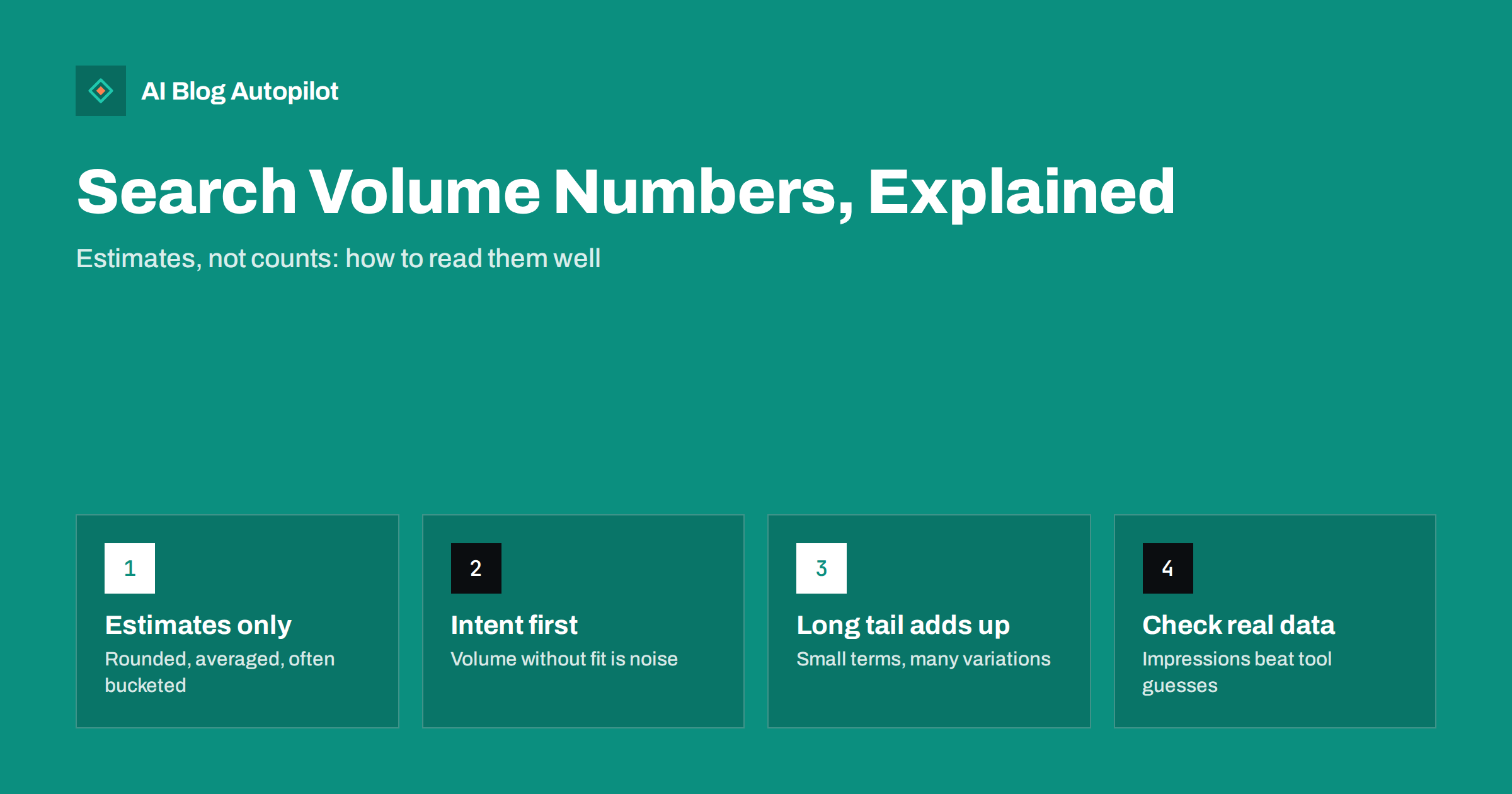
Short answer: search volume is an estimate of how often a phrase is searched per month, usually averaged over a year and rounded into broad ranges. It is useful for comparing phrases against each other, not for predicting your traffic. A term showing zero or ten searches can still bring steady visitors, and a term showing thousands can bring almost none if the results are dominated by answers or big brands. Use volume as one input alongside intent, competition and your own Search Console data.
Almost every keyword tool shows a number next to each phrase, and that number quietly drives a lot of content decisions. Bloggers skip topics because a tool said “20” and chase topics because it said “12,000”. Both reactions are often wrong.
This article explains what the figure actually represents, the specific ways it misleads a small or new blog, and a practical way to use it without letting it decide everything.
What a search volume figure actually measures
A search volume figure is an estimate of the average number of times a specific phrase was typed into a search engine in a month, for a given country and language. That sentence contains several assumptions worth unpacking.
- It is an average. Most tools average twelve months. A phrase searched heavily in December and rarely in June shows one smooth number that is true for no individual month.
- It is for one exact phrase, or a cluster. Some tools report the exact wording; others group close variants together. The same phrase can therefore show different numbers in different tools, and neither is wrong by its own rules.
- It is for one location. A figure for the United States says nothing about the United Kingdom, and a figure for English says nothing about German searches for the same idea.
- It is rounded or bucketed. Advertising platforms often show ranges rather than exact values, and third-party tools model their own estimates from partial data, clickstream panels and ranking positions.
In other words, the number is a modelled estimate built from incomplete information. It is useful as a relative signal. It is not a count of people who will read your article.
Why the numbers often disagree between tools
If you check the same phrase in three tools, you will often see three different figures, sometimes several times apart. That is not a sign that one tool is broken. They start from different data and make different choices.
Some tools lean on advertising data, which is grouped and rounded. Others build estimates from ranking data and the traffic they assume each position receives. Some merge singular and plural forms, some keep them separate. Some refresh monthly, others less often.
The practical lesson: pick one tool for comparisons and stay with it. Comparing a figure from one tool against a figure from another tells you more about the tools than about the searches.
The five ways volume misleads a blog
The number is not dishonest. It simply answers a narrower question than people ask of it. These are the most common misreadings.
- Treating volume as traffic. Even the first result does not receive every click. Some searches end on the results page because the answer is shown there, some go to ads, maps or video, and clicks spread across several results. A realistic share for any one page is a fraction of the volume, and it varies widely by query type.
- Ignoring the long tail. A page rarely ranks for one phrase. A well-written article typically appears for dozens or hundreds of related queries, most of which show tiny or zero volume individually. Together they can outweigh the headline phrase.
- Missing the intent. A high-volume phrase may be navigational (people looking for a specific brand) or transactional (people ready to buy from a shop). A blog article rarely satisfies either, so the volume is not available to you.
- Overlooking seasonality. An annual average hides peaks. A topic averaging 500 a month might have 2,000 in one month and almost none the rest of the year, which changes when you should publish.
- Trusting zero. Tools commonly show zero or “no data” for phrases that are searched, just not often enough to register in their sample. New topics, niche professional questions and emerging product names frequently fall into this gap.
High volume, low value: when big numbers are a trap
Big numbers are tempting for a young blog, and they are usually the hardest to win and the least useful to win.
Broad, short phrases tend to have mixed intent. Someone searching a single word might want a definition, a shop, a news story or a local business. The search engine responds with a mixture of result types, and a blog article competes for a small slice of attention against established sites.
Broad phrases also attract visitors who are not your audience. An accountant ranking for a general money term may get visits from students, journalists and people in other countries who will never become clients. The traffic looks good in a report and does nothing for the business, a trade-off covered in more detail in traffic or leads.
A better pattern for most small sites is to start with specific phrases that describe a real problem the business solves, then build towards broader terms once the site has a body of related content. Starting with long-tail keywords explains why that sequence tends to work.
Low volume, high value: phrases worth writing for anyway
Some of the most useful articles on a business blog target phrases that tools rate as barely searched.
- Problem-specific questions such as how to fix a particular error or handle a particular situation. The people typing them have an urgent need, and a clear answer builds trust quickly.
- Comparison and “versus” queries between two products, methods or options. These are typed by people close to a decision.
- Cost and pricing questions for a service category. Searchers are evaluating spending money.
- Industry-specific variants, such as a general topic applied to one profession or sector that you serve.
- Questions your customers actually ask. If sales or support hear the same question every week, other people are searching it, whatever the tool says.
Ten visitors a month who are ready to act can be worth more than a thousand who are browsing. Volume cannot tell you which kind you are getting; intent can.
A practical way to use volume in topic selection
Volume is most useful as a tie-breaker and a sense check, not as the first filter. A simple process that works for most blogs:
- List topics from your business first. Services, products, customer questions, objections and common mistakes in your field. This keeps the list relevant before any numbers appear.
- Look at the results page for each topic. Are the top results articles, or shops, tools and videos? If a blog post cannot satisfy the intent, drop it regardless of volume. The four types of search intent is a useful reference here.
- Check volume to compare close variants. Between two phrasings of the same idea, the higher estimate is usually the better title and main phrase, provided the intent is the same.
- Group related phrases into one article. Several low-volume variants that share an intent belong on one page, not five thin ones.
- Note seasonality. If the trend line shows peaks, schedule the article a month or two before the peak so it has time to be indexed.
- Revisit with real data. After a few months, your own impressions data replaces the estimate.
Replacing estimates with your own data
Once a site has been live for a while, the most reliable search volume data you have is your own. Search Console shows impressions: how often your pages appeared in results for each query, along with clicks and average position.
Impressions are not the same as total searches, because you only see queries where you appeared. But they are real, recent and specific to your site, and they reveal the long-tail queries tools miss entirely. It is common to find that an article ranks for phrases you never targeted, some with more impressions than the phrase you chose.
Three habits make this data useful:
- Filter the performance report by page to see every query one article appears for.
- Look for queries with many impressions and a position between roughly 8 and 20. These are the phrases where a small improvement matters most.
- Look for questions in the query list. Each one is a candidate for an FAQ entry or a new article.
Google’s own documentation on the Performance report explains exactly how impressions, clicks and position are counted, which is worth reading once so the numbers are not misinterpreted.
Volume, difficulty and intent together
No single metric chooses topics well. Used together, three questions cover most decisions:
| Question | What it tells you | Where to look |
|---|---|---|
| Does the intent match an article? | Whether a blog post can rank at all | The live results page |
| Who ranks now? | Whether a site your size can compete | The top ten results and their depth |
| Roughly how much demand is there? | Which variant to prioritise | A keyword tool, then your own impressions |
Notice that volume comes last. When intent matches and the competition is beatable, even a modest estimate is worth writing for. When intent does not match, no volume is high enough.
How AI Blog Autopilot handles topic selection
AI Blog Autopilot plans articles from the topics, keywords, audience and tone you give it, with each article built around a real search query and delivered with FAQ, tags and SEO meta. An automatic quality check reviews length, structure, keyword and meta before anything is published. On the Pro and Agency plans, topics can also be imported from Search Console, which brings your own query data into planning instead of relying only on estimates. You can see how it works on the AI Blog Autopilot home page.
Related reading
- Keyword Research for an Automated Blog: Picking Topics Worth Writing
- Long-Tail Keywords: Why a New Blog Should Start There
- How Many Keywords Should One Article Target?
- Google Search Console: The Five Reports That Matter
The bottom line
Search volume is an estimate of relative demand, averaged and rounded, and different tools will disagree. Use it to compare close variants and spot seasonality, not to predict traffic or to rule topics out. Put intent and realistic competition first, group related phrases into single strong articles, and replace estimates with your own impressions data as soon as you have it.
SSS
What does search volume mean?
Search volume is an estimate of how many times a phrase is searched per month in a given country and language. Most tools average it over twelve months and round it, so it is best read as a relative indicator of demand rather than an exact count.
Why do keyword tools show different search volumes for the same phrase?
Each tool uses different data sources, grouping rules and update schedules. Some merge close variants and some keep them separate, so their estimates differ. Compare phrases within one tool rather than across tools.
Is it worth writing for keywords with zero search volume?
Often, yes. Tools frequently show zero for phrases that are searched but too rarely to register in their data, and specific questions from real customers tend to attract visitors who are ready to act. Check that the intent fits an article and that the topic matters to your business.
How much traffic will I get if I rank first for a keyword?
Only a share of the volume, and the share varies a lot. Some searches end on the results page, some clicks go to ads, maps or videos, and clicks spread across several results. Treat volume as an upper bound, not a forecast.
Where can I find real search data for my own blog?
Search Console shows the queries your pages appeared for, with impressions, clicks and average position. It only includes searches where your site was shown, but it is real and recent, and it reveals long-tail queries that keyword tools miss.