ENEnglish
 LTLietuviškai
 DEDeutsch
 FRFrançais
 RUРусский
 ESEspañol
 PLPolski
 ITItaliano
 UKУкраїнська
 CSČeština
 PTPortuguês
 JA日本語
 LVLatviešu valoda
 ETEesti
 HUMagyar
 IDBahasa Indonesia
 TRTürkçe
 HIहिन्दी
 ELΕλληνικά
 ARالعربية
 THไทย
 VITiếng Việt
 RORomână
 MSBahasa Melayu
 BNবাংলা
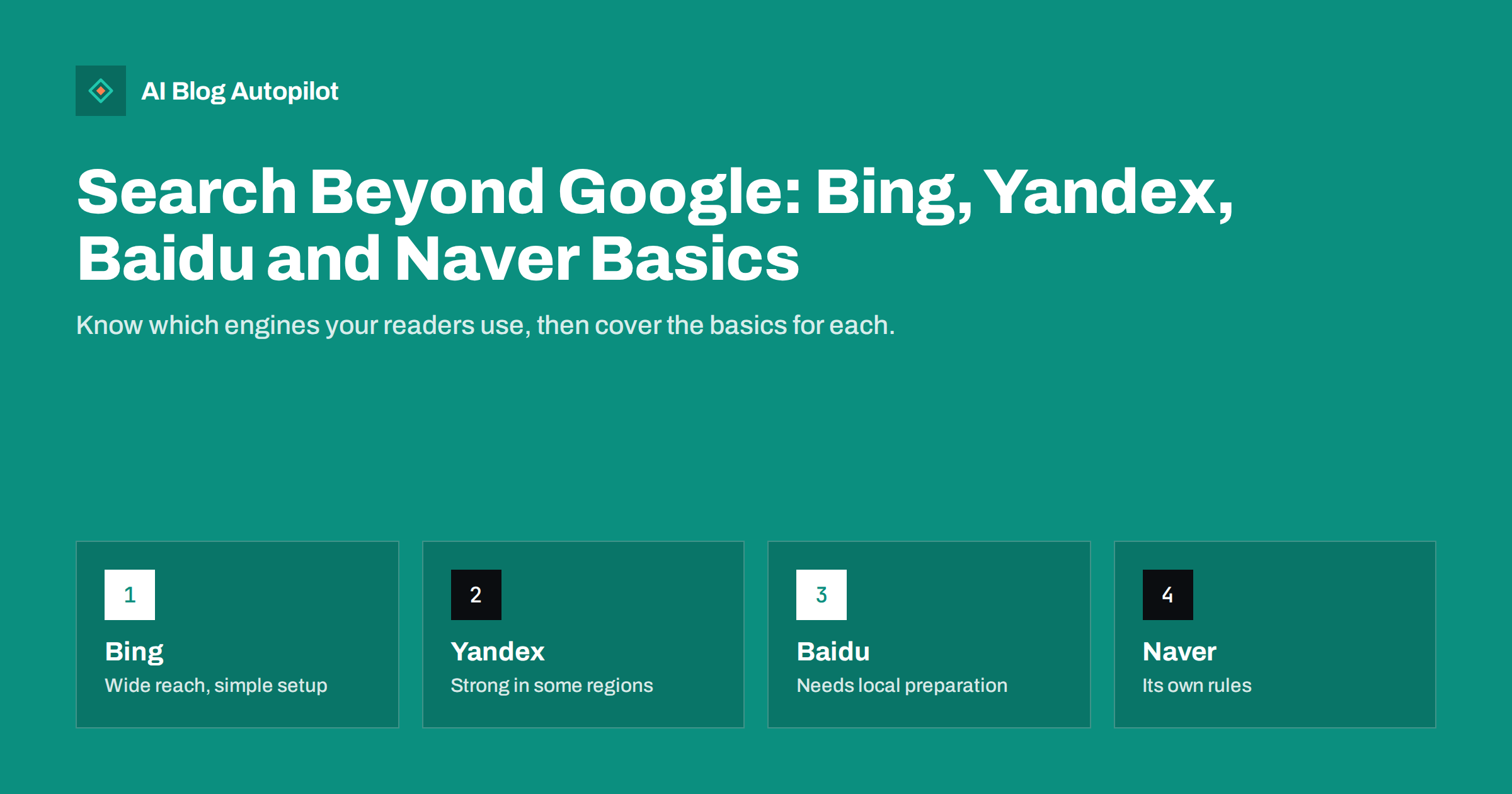
Short answer: Google is the main search engine for most blogs, but other engines matter in some markets and for some readers. Bing supplies results to several other products and is simple to support. Yandex, Baidu, Naver and regional engines each have their own tools, rules and favourite signals. Check which engines send you visitors now, cover the shared basics for all of them and add special work only where the number of readers justifies it.
A blog written in several languages, or aimed at readers abroad, sooner or later meets a question: should we care about search engines other than Google? The honest answer is that it depends on where your readers live. This article gives an overview of the main engines, explains what they have in common and suggests how to decide, without turning your blog into a project of its own for each one.
The details of these services change, so use the official help pages of each engine for current requirements. The aim here is to give you a map and a method.
Start with your own data
Before you plan anything, look at where your visitors come from. In your analytics, open the report on traffic sources and look at the share from each search engine, by country. For a small blog the figures may be small, but they still show direction. If one engine sends a notable share in one country, that is a reason to look closer.
Also check which engines your readers might use but do not yet send traffic. If you write in a language where a regional engine is popular and you get no visits from it, your site may not be indexed there. The simplest test is to search for your site name and for the title of a recent article in that engine.
Set aside a small budget of time. One hour a quarter for a second engine is realistic, while a full separate strategy is not, unless the market is important. The reports in Search Console have counterparts in other engines, so the habits that you build there will carry over.
Bing and the engines that use it
Bing is the most widely useful second engine. Its results appear in several other products, and its index feeds some assistants and search features. Many of the things that help on Google, such as clear titles, good content and fast pages, help on Bing too. The practical difference is that it offers its own webmaster tools, with reports and a way to submit your sitemap.
Setting it up takes minutes. You can verify your site, often by importing the settings from Search Console, and submit the sitemap. The article on Bing Webmaster Tools for bloggers explains the setup and what to look at. You can also use IndexNow, as in IndexNow and fast indexing, to tell participating engines about new pages at once.
Bing also treats some signals a little differently, for example it has often been said to give more weight to exact matches of words in titles and to social signals. Treat such claims with caution, and test on your own site. For most blogs, good basics are enough.
Keep in mind that your readers’ region matters more than the engine’s name. A reader in one country may use a different engine from a reader in another country who speaks the same language. Look at the country data in your reports before assuming that a language group uses one engine, and note which countries actually send traffic.
Yandex
Yandex is a major search engine in Russia and is used in some neighbouring countries and by Russian-speaking readers elsewhere. It has its own webmaster tool, where you can add your site, submit a sitemap and see how pages are indexed. The engine pays attention to the language and the region of a site, so signals such as the language of the text and the location of the audience matter.
If you write in Russian, a clear language declaration and a sensible site structure help. Use proper language markup, and keep the text of each page in one language. If you serve several languages, hreflang annotations are helpful, as covered in hreflang for a multilingual blog.
Check any legal or practical limits that apply to your business before you target this market. Your own policies, local rules and the wishes of your customers may all affect this decision, and they are for you to weigh.
Baidu
Baidu is the main search engine in mainland China. Reaching its users is a larger step than adding a webmaster account. Sites that serve this market often use hosting that is fast within the country, a local business licence for the domain and content in simplified Chinese, and the engine prefers sites that load quickly there.
A foreign blog that is slow or blocked within the country may be indexed poorly even if everything else is right. Baidu also has its own webmaster platform, mainly in Chinese. If China is a real market for you, plan the project with local help, and do not expect the usual settings to be enough.
If China is not a priority, do not worry about it. Make sure that your site is reachable and that you do not block its crawler by accident in your robots.txt file, and let it be. The guide to robots.txt for a blog explains what to check.
Many of these engines also run portals with blogs, answers and communities. For some of them, content on their own platforms is shown prominently in results, so a plain website may compete with posts on the engine’s own services. If the market matters to you, find out how content from outside the portal is treated, and consider whether a presence on the platform makes sense alongside your own blog.
Naver, Seznam and other regional engines
Some countries have a strong local engine. Naver is widely used in South Korea and offers its own search advisor tool, with expectations around blog and community content. Seznam serves many readers in the Czech Republic, and others exist in other countries. Each has a tool or a form to submit sites.
The common thread is that these engines tend to favour content in the local language, written for local readers, and hosted or linked in ways that suit local habits. A translation that was done word by word, or a page that is clearly meant for another country, is less likely to do well. The article on translating or writing natively explains why native writing works better.
Look for the official help pages for each engine and follow its own rules about sitemaps and verification. Avoid unofficial guides that claim secret ranking tricks, which are usually outdated or wrong.
The basics that help everywhere
A set of habits works in nearly every engine. Have a clear, fast, mobile-friendly site. Write titles and headings that match the way people search. Provide an XML sitemap and mention it in robots.txt. Use consistent internal links so that crawlers can reach every page, and avoid duplicate content across addresses.
Declare the language of each page, and keep one language per page. Use structured data where it matches the content. Keep your server stable and your pages free of errors, since all crawlers dislike repeated failures, as the article on server errors and downtime explains.
These steps are part of ordinary good practice, so they cost little extra. If you have done them well for Google, you have already done most of what other engines require.
Be realistic about measurement as well. Traffic from a minor engine can be too small to judge a change by. Instead of expecting a clear signal each month, track a few simple facts: whether your pages are indexed, whether the sitemap is read without errors and whether branded searches show your site. If those are healthy, the rest follows from your content.
Deciding where to invest
Use a simple rule: add effort where there is both a real audience and a realistic chance to serve it. If an engine sends a growing share of your traffic, or if you plan to enter a market where it leads, give it a proper look. If neither is true, cover the basics and watch the numbers.
Consider the cost of content. Writing for a market means writing in its language and for its readers, and not only submitting a sitemap. If you do not plan to publish in that language, the engine will have little to index. Choose languages first, as discussed in choosing which languages to publish in, and engines second.
Review your choice each year. Search habits change, new engines and assistants appear and your own audience may shift.
One more safeguard is to use the same sitemap and the same canonical addresses for all engines, instead of building separate versions of the site. A single, clean structure is easier to maintain, and it avoids duplicate content problems. Separate sites for each engine are rarely worth the cost for a blog.
Keeping the work manageable
Make a small table with one row per engine: whether the site is verified, whether the sitemap is submitted, who checks it and the date of the last check. Put the logins in your password manager, and record who owns each account.
Set a quarterly reminder to look at each tool for errors, to compare traffic by engine and to note any change in your plan. This takes under an hour for most blogs.
Finally, do not let the extra engines distract from the main task, which is to publish content that readers find useful. Strong content is the one thing that all engines, and the AI tools that draw on them, reward.
How AI Blog Autopilot helps
AI Blog Autopilot writes SEO articles directly in 25 languages and publishes them to your WordPress blog with FAQ sections, tags and SEO meta, so you can serve readers who use regional search engines in their own language. The number of languages depends on the plan, so check the pricing page before you plan a multilingual blog.
Related reading
- Bing Webmaster Tools for Bloggers: Is It Worth Setting Up?
- Choosing Which Languages to Publish In
- Country Domains, Subfolders or Subdomains for Other Languages
The bottom line
Check which engines your readers use, cover the shared basics and add special work only where an engine brings real traffic. Use the official tools of each engine, and review the plan once a year.
SSS
Do I need to optimise for search engines other than Google?
Only if your readers use them. Check your analytics by country, cover the shared basics and add extra work where the audience justifies it.
Is Bing worth setting up for a small blog?
Usually yes. Setup is quick, it shares many requirements with Google and its index feeds other products.
Can I reach readers in China with a normal blog?
It is possible but difficult. Speed within the country, local hosting and simplified Chinese content matter, so plan it with local help if it is a real market.
Do regional engines prefer local-language content?
Generally yes. Content written natively for local readers tends to serve them better than a literal translation.
What helps on every search engine?
A fast, mobile-friendly site, clear titles, a sitemap, consistent internal links, declared page languages and a stable server.