ENEnglish
 LTLietuviškai
 DEDeutsch
 FRFrançais
 RUРусский
 ESEspañol
 PLPolski
 ITItaliano
 UKУкраїнська
 CSČeština
 PTPortuguês
 JA日本語
 LVLatviešu valoda
 ETEesti
 HUMagyar
 IDBahasa Indonesia
 TRTürkçe
 HIहिन्दी
 ELΕλληνικά
 ARالعربية
 THไทย
 VITiếng Việt
 RORomână
 MSBahasa Melayu
 BNবাংলা
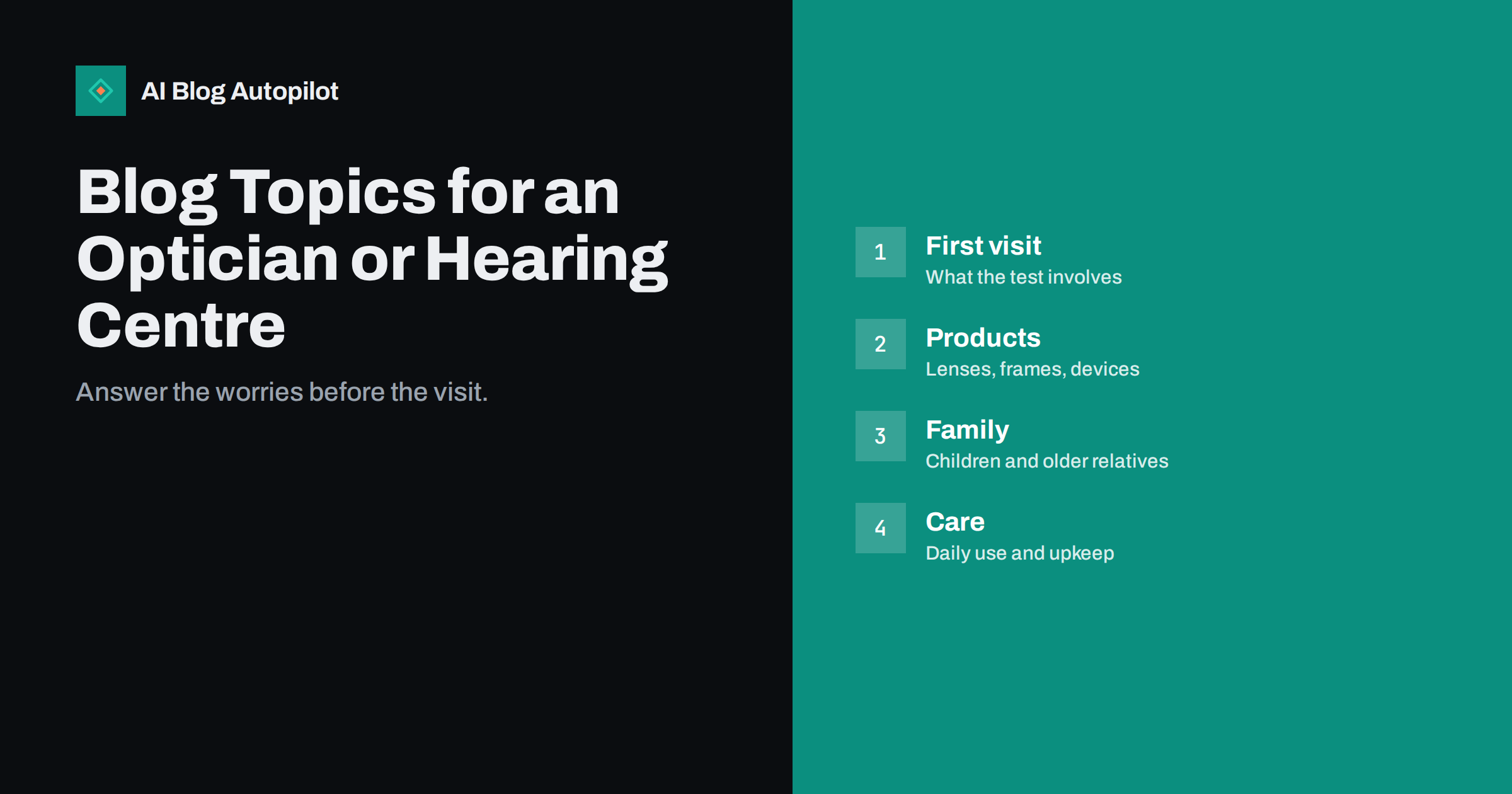
Short answer: an optician or hearing centre blog works best when it answers the questions people ask before they book: what a test involves, how long it takes, what the options cost and what to expect afterwards. Write in plain language, keep medical claims careful and consistent with professional guidance, and leave diagnosis to your practitioners.
People often delay a first visit because they are unsure what will happen, or worried about cost and about what the test might find. A helpful article removes some of that uncertainty and shows that your team is calm and clear. That is the best reason to write, and it also happens to suit search engines and AI assistants, which look for direct answers.
This guide gives topic ideas grouped by the questions of different readers, with notes on tone and accuracy. It suits independent practices, small chains and clinics that offer eye tests, hearing tests, glasses, contact lenses and hearing devices.
Explain the first visit step by step
The first visit is the biggest barrier. Write one article for each type of appointment: an eye test, a contact lens fitting, a children’s eye test, a hearing check. Describe what happens in order: arrival, questions about health and daily life, the tests themselves, the explanation of results and the next step. Say how long each part takes and what to bring, such as current glasses, a list of medicines or a relative who can help.
Include practical details people search for: whether an appointment is needed, how to get there, parking, access for wheelchairs, and what to do if someone feels anxious. Add a short note on how to prepare, for example not to wear contact lenses to a particular appointment if that is your practice’s advice. Check each detail with the team before publishing, since procedures differ between practices.
Photographs of the real premises and team help a nervous visitor picture the visit. Use them with permission, and describe them with plain alt text, as the guide to writing alt text explains.
Answer cost and funding questions
Cost is a major worry. Write an honest article about what affects the price of glasses, lenses, contact lens plans and hearing devices, without inventing numbers. Explain what is included in a typical price, what costs extra, and how repairs and follow-up visits are handled. If prices vary, say what they depend on and invite readers to ask for a quote.
Explain how funding works in your country, such as public schemes, insurance or employer benefits, but only where you are sure of the rules and can link to the official source. Rules change, so add a date to the article and review it regularly. The article on writing honest articles about what things cost gives a structure you can follow.
Avoid pressure. A reader who feels respected is more likely to book, and more likely to recommend you to a friend.
Add a reassurance article for people who have just been told they need glasses, contact lenses or a hearing device for the first time. Describe the adjustment period honestly: things may feel unfamiliar at first, and it is normal to have questions in the first weeks. Explain how to get help, when a follow-up visit is useful and how to tell whether something needs adjusting. Readers who find this page after buying will feel looked after, and those who find it before buying will see how you treat customers.
Comparison pages are popular too, such as glasses or contact lenses, daily or monthly lenses, or the main styles of hearing device. Keep them factual and explain who each choice suits. A small table of pros and cons helps, as long as the text below it explains the details. Avoid claiming that one option is best for everybody, since a practitioner must assess each person.
Cover products without sounding like a catalogue
Readers choose between lens types, coatings, frame materials, contact lens styles or hearing device styles. Write guides that explain the differences in everyday terms: who each option suits, the trade-offs and the questions to ask. For example, a guide to lenses for people who work at a screen all day, or to frames for a small face, answers a real need.
Be fair about alternatives. If a cheaper option is fine for some people, say so. If a more advanced option brings a real benefit for others, explain the benefit without exaggeration. Never promise results that depend on the individual. Phrases such as many people find or your practitioner will advise are honest and still helpful.
Mention brands only where you are sure of the facts and have the right to name them. Link to the manufacturer’s own information if it adds value, and make sure any external link is reliable.
Write also for the people who care for someone else. A carer may need to know how to help a person with dementia accept glasses, how to clean a hearing device for a relative or how to arrange transport to an appointment. These are small, practical guides that few competitors write, and they are often shared between family members.
Consider articles for particular working lives too: drivers, people who work outdoors, musicians, teachers and office workers all have specific needs. A guide titled for one of these groups speaks directly to the reader and matches the way they describe their problem to a search engine.
Write for children, parents and older relatives
Different readers need different articles. Parents search for signs that a child may need an eye test, how often to have one and how to help a child accept glasses. Adult children search for how to talk to a parent who may be losing hearing, or how to prepare for an appointment together. Write each as a separate, clearly titled guide.
Use a kind and respectful tone, especially for older readers. Avoid language that treats hearing or sight changes as a failing. Explain that these changes are common and that help is available. Use larger text, short paragraphs and clear headings so that the page is easy to read for people with weaker eyesight, as the guide to accessibility for a blog suggests.
Offer simple checklists, such as questions to ask at an appointment or things to note before a visit. Readers can print them and bring them along.
Short video demonstrations are particularly helpful for care topics, such as inserting and removing lenses or changing a hearing device battery. If you add video, include a written version of the steps and a transcript, so that readers who cannot play sound can follow along and search engines can read the content. Keep clips short and shot in good light.
Collect the questions customers ask at the desk or by phone for a month. Each repeated question is a good article title. Write the answer exactly as a member of staff would say it, then add the details they sometimes forget. The page then helps the next customer before they call.
Explain daily care and troubleshooting
Existing customers are a valuable audience. Write short guides on cleaning glasses safely, storing contact lenses, replacing small parts, caring for hearing devices, changing batteries or fixing common problems. These articles are searched often and show that your help continues after the sale.
Be clear about the limits. Explain which problems readers can fix at home and which need a visit, and give a clear way to contact you. For anything that might be urgent, such as sudden changes in vision or hearing, say plainly that the reader should contact a medical professional or emergency service at once, following the guidance of your national health service.
Keep these guides updated when products change. A page about a device you no longer sell should say so and point to the current information.
Handle health claims with care
Eye and hearing health is a sensitive subject. Do not diagnose in an article, do not suggest that a product cures a condition and do not contradict medical advice. Rely on recognised sources, name the practitioner who reviewed the article and add the review date. This builds trust with readers and with search engines that look for experience and expertise.
Check the advertising and professional rules in your country, since healthcare businesses are often restricted in how they describe services and results. If you are unsure, ask your professional body or a qualified adviser before publishing. The guide to writing on topics that affect health and money covers the extra care these subjects need.
Keep patient privacy in mind. Do not publish stories or photographs of patients without clear written permission, and avoid details that could identify someone.
Plan a calendar around the year
Many topics follow the calendar. Back-to-school periods bring questions about children’s eye tests. Sunny seasons bring questions about sunglasses and protection. Winter brings questions about fogging glasses and cold-weather care. Awareness days for sight and hearing can also give a reason to publish helpful guides.
Mix evergreen guides with timely ones. Keep a list of the questions your team hears most often at the desk and on the phone; each question is a potential article. After publishing, ask staff to give the link when a customer asks the same question, so the article does its work in the shop as well as on search.
Review results every few months. See which guides bring bookings or calls, which are read to the end and which questions are still unanswered. Update the best articles and write the next ones from what you learn.
How AI Blog Autopilot helps
AI Blog Autopilot can write and publish articles on the topics you choose, with FAQ sections, tags and SEO meta, and share them to your social networks. For health topics, check every article with your practitioners before it goes live. See the pricing page for plans.
Related reading
- Blog Strategy for a Local Business
- Blog Topics for a Clinic
- Writing on Topics That Affect Health and Money
The bottom line
Answer the questions that keep people from booking, explain costs honestly, write for each family member and keep every health statement careful and reviewed.
SSS
What should an optician blog write about first?
What happens at a first eye test, how long it takes, what to bring and what it costs, since those questions stop people booking.
Can I mention prices on the blog?
Yes, if you can keep them current. If prices vary, explain what they depend on and invite readers to ask for a quote.
How do I avoid giving medical advice?
Describe options and what to expect, do not diagnose, and send urgent or personal questions to a qualified professional.
Can I show photos of patients?
Only with clear written permission, and avoid details that could identify the person.
How often should I update health articles?
Review them at least once a year and whenever rules, products or procedures change, with the review date shown.