ENEnglish
 LTLietuviškai
 DEDeutsch
 FRFrançais
 RUРусский
 ESEspañol
 PLPolski
 ITItaliano
 UKУкраїнська
 CSČeština
 PTPortuguês
 JA日本語
JA日本語 LVLatviešu valoda
 ETEesti
 HUMagyar
 IDBahasa Indonesia
 TRTürkçe
 HIहिन्दी
 ELΕλληνικά
 ARالعربية
 THไทย
THไทย VITiếng Việt
 RORomână
 MSBahasa Melayu
 BNবাংলা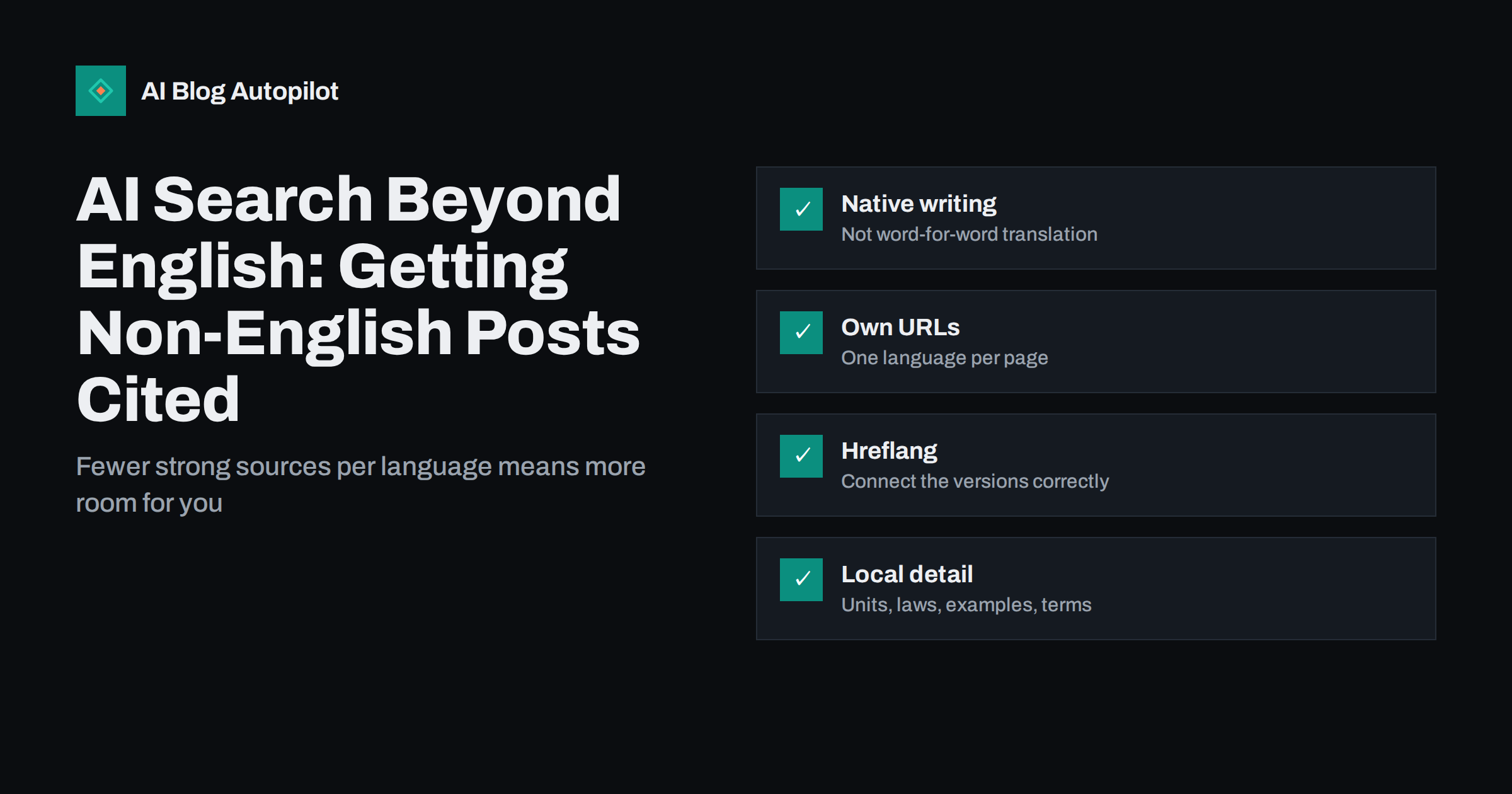
Short answer: AI answers in search are shown in many languages, and they cite pages in the language of the question when good ones exist. In most languages other than English there are far fewer thorough, well-structured articles on any given topic, so a clear post written natively in that language has a real chance of being used as a source. The foundations are the same as for ordinary search: separate crawlable URLs per language, correct hreflang, natural native writing, local detail and answer-first structure.
Most advice about AI search is written in English, about English results. But a large share of searches happen in other languages, and AI features and assistants answer those questions too. For a business that serves customers in German, Polish, Spanish, Lithuanian or Japanese, the question is practical: when someone asks an AI assistant a question in their own language, whose page does it cite? This article explains how multilingual content is found and used by AI search, and what makes the difference.
How AI search handles other languages
AI features in search engines and standalone AI assistants work in many languages. When someone asks a question, the system looks for relevant sources, often by running several related searches, and then writes an answer with links to the pages it relied on. Language enters this process in a few ways:
- The question sets the answer language. An answer to a question asked in Italian is written in Italian, and the system generally prefers sources that match the language and region of the searcher.
- Sources can cross languages. Where local sources are weak or missing, some systems draw on sources in other languages, most often English, and summarise them in the user’s language.
- Local results still matter. The indexing and ranking systems behind AI features are the same ones behind normal search results. A page that is not indexed or never ranks for local queries is unlikely to be cited.
The consequence is an opportunity. In English, dozens of strong pages compete for every common question. In a smaller language there may be only a few, and some of those are thin or poorly translated. A good native article can stand out.
Why translated content often underperforms
Many sites add languages by running English articles through machine translation and publishing the result. It is quick, but it tends to produce content that is weaker in exactly the ways AI search notices:
- Unnatural phrasing. Word-for-word translation keeps English sentence structure and idioms that native readers would never use. The page may not match the words people actually type.
- Wrong terminology. Technical, legal and commercial terms often have established local equivalents. A literal translation can miss the term that everyone searches for.
- Irrelevant examples. References to US tax rules, imperial units or foreign brands make an article less useful for local readers, and less likely to be picked as a local source.
- Missing local questions. Readers in different countries ask different follow-up questions. A translated article answers the English audience’s questions in another language.
The better approach is to write each language natively from the same brief, adapting examples, terms and details. The guide on translating versus writing natively compares both approaches in detail.
Technical foundations for multilingual blogs
AI search cannot cite a page it cannot find or cannot tell apart from other versions. These basics matter more than any special tactic:
- One language per URL. Give each language version its own address, such as
/de/or/es/folders. Do not switch language on the same URL based on browser settings or cookies, because crawlers usually see only one version. - Hreflang between versions. Mark which pages are translations or localisations of each other, with every version referencing all others and itself. Google explains the details in its guide to localized versions of your pages, and our article on hreflang for multilingual blogs covers common mistakes.
- Correct language declaration. Set the
langattribute on the HTML element for each version. It helps browsers, screen readers and parsers. - Translated metadata. Titles, meta descriptions, image alt text and FAQ questions must be in the page’s language, not left in English.
- Language-specific sitemaps or entries. Make sure every language version appears in your XML sitemap and is linked from the navigation of that language.
- Internal links within the language. Link German posts to other German posts. A language section that only links back to English pages is weakly connected.
Writing so AI answers can use your non-English posts
The writing habits that help AI search in English work in every language, and they matter more where competition is thin:
- Answer first. Put a direct two- to four-sentence answer at the top, in plain language. Systems that summarise sources find it easily, and readers do too.
- Use the local question as a heading. Phrase headings the way people in that market ask. The same question can be worded quite differently from one language to the next.
- Define local terms. A short, clear definition of a local concept, a tax form, a regulation or a trade term, is exactly the kind of passage AI answers quote.
- Keep sections self-contained. Each section should make sense on its own, so that a system lifting one passage does not lose the context.
- Add an FAQ in the language. Local follow-up questions with short answers are useful to readers and easy to cite.
- Be precise with numbers and dates. Use local formats and say where rules differ by country. Vague claims are less useful as sources.
Local detail is the real advantage
The strongest reason an AI system would cite your Polish or Dutch article instead of summarising an English one is that your article contains something the English sources do not. That usually means local specifics:
- Rules, standards or procedures that apply in that country.
- Local prices expressed in general terms, or typical ranges, where you are sure of them.
- Names of local institutions, platforms or document types that readers will recognise.
- Seasonal timing, holidays and working customs that affect the advice.
- Examples from the local market rather than generic international ones.
Only include details you can verify. An invented local fact is worse than a missing one, because it spreads when it is quoted.
Choosing which languages to cover
Adding languages multiplies work, so start where it pays off. Good candidates are languages your customers already use, markets where you can deliver the product or service, and languages where the search results for your topics are visibly weak. Check your analytics for visitors from each market and your Search Console for queries in other languages that already bring impressions. The guide to choosing which languages to publish in sets out a simple way to decide.
It is usually better to cover two or three languages well than ten languages badly. A small, well-maintained language section builds trust with readers and gives search engines consistent signals.
Common mistakes on multilingual blogs
Most multilingual blogs that struggle in search and AI answers make one of a handful of mistakes. They are easy to check for:
- Half-translated pages. The article body is in Spanish, but the title, menu, buttons and FAQ are still in English. Readers and systems both get mixed signals about the page’s language.
- Automatic redirects by location. Sending every visitor to a language based on IP address can stop crawlers, which often come from one country, from ever seeing the other versions.
- One canonical for all languages. Pointing every language version’s canonical tag at the English page tells search engines to ignore the translations.
- Stale translations. The English article was updated, but the other versions still contain the old advice. Keep a list of which versions depend on which source article.
- Empty language sections. A language folder with three posts and a translated menu looks unfinished. Grow each section steadily or keep it unpublished until it has real depth.
Measuring visibility in other languages
Measurement follows the same rules as English content, with a few adjustments:
- In Search Console, filter the Performance report by country and by page folder, such as
/de/, to see how each language performs. Google counts appearances in AI features within normal Search performance data. - In analytics, look at referrals from AI assistants separately for each language section.
- Ask the questions your local customers ask in AI assistants yourself, in their language, and note which sources are cited. Repeat monthly, because answers change.
How AI Blog Autopilot fits in
AI Blog Autopilot writes articles in 25 languages, each written directly in its language rather than machine-translated from English, and publishes them to your WordPress blog with titles, meta descriptions, tags and an FAQ in the same language. The number of languages depends on the plan, so you can start with one or a few markets. Setting up language folders and hreflang stays with your WordPress multilingual configuration. See the plans on the pricing page.
Related reading
- Blogging in 25 Languages: How to Reach International Readers with AI
- How to Get Your Blog Cited by ChatGPT, Perplexity and Google AI Overviews
- Structured Data for a Blog: What Is Worth Adding
The bottom line
AI search works in many languages, and outside English there are usually fewer strong sources for any topic. Separate language URLs, correct hreflang, native writing, local detail and answer-first structure give your non-English posts a fair chance of being cited. Start with the languages your customers actually use, and do them properly.
SSS
Do AI Overviews appear in languages other than English?
Yes. Google shows AI Overviews in many languages and countries, and AI assistants answer questions in many languages as well. The answer is written in the language of the question.
Will AI search cite a machine-translated article?
It can, but machine-translated pages often use unnatural phrasing and miss local terms, which makes them weaker sources. Articles written natively for the language and market usually match local questions better.
Do I need hreflang for AI search?
Hreflang is not an AI-specific requirement, but it helps search engines show the right language version, and AI features in search rely on the same index. For a multilingual blog it is part of the basic setup.
Should every language version have the same content?
The core topic should match, but each version should adapt examples, terms and details to its market. Local specifics are often what makes a non-English page worth citing.
How can I see whether AI answers cite my non-English pages?
Ask typical local questions in AI assistants in that language and note the sources, filter Search Console data by country and language folder, and check analytics for referrals from AI assistants to each language section.
Is it better to use folders or separate domains for languages?
Both can work. Folders such as /de/ on one domain are usually simpler to manage and share the site’s existing reputation, while separate country domains send a stronger local signal but need more work. Most small blogs choose folders.