ENEnglish
 LTLietuviškai
 DEDeutsch
 FRFrançais
 RUРусский
 ESEspañol
 PLPolski
 ITItaliano
 UKУкраїнська
 CSČeština
 PTPortuguês
 JA日本語
JA日本語 LVLatviešu valoda
 ETEesti
 HUMagyar
 IDBahasa Indonesia
 TRTürkçe
 HIहिन्दी
 ELΕλληνικά
 ARالعربية
 THไทย
THไทย VITiếng Việt
 RORomână
 MSBahasa Melayu
 BNবাংলা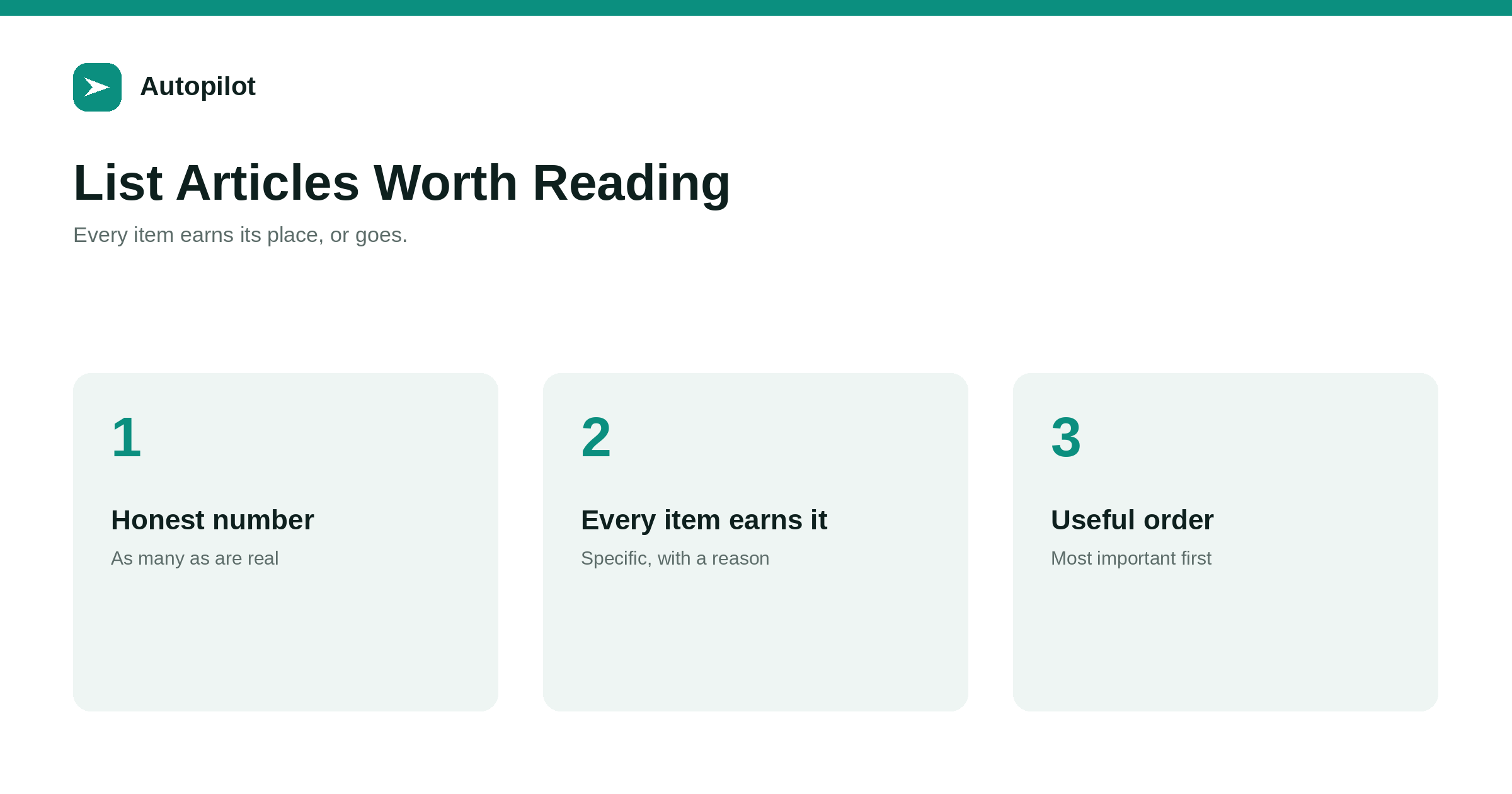
Short answer: let the content decide the number: include as many items as are genuinely distinct and useful, and no more. Make each item specific, with a reason or an example that shows why it matters. Order the list so it helps the reader — most important first, or in the sequence they would act — and say which order you chose. Cut items that repeat another in different words or that nobody would act on. A list article should still have an introduction with the point and a short close saying what to do first.
List articles have a poor reputation because they are so easy to make badly: choose a round number, fill it with loosely related points, and publish. Readers skim, find nothing specific, and leave.
The format itself is fine. A list is a clear way to present parallel, distinct items. The problems come from treating the number as the goal rather than the content.
Let the content set the number
A title promising ten items tends to produce six real ones and four fillers. Decide the number after listing the genuinely distinct items, not before.
If you have seven, publish seven. Odd numbers are fine; readers do not count on round numbers, and they notice padding immediately. writing a headline people click covers why a real number in a title helps and an invented one hurts.
And if you only have three items, the article may not want to be a list at all. Three points often read better as prose with an argument connecting them.
Make every item earn its place
Each item should pass three tests.
| Test | Fails when |
|---|---|
| Distinct | It repeats another item in different words |
| Specific | It could appear in any article on any subject |
| Actionable or informative | A reader would do nothing different after reading it |
Items that fail get cut, not polished. A seven-item list of strong points beats a twelve-item list with five weak ones, because readers judge the whole list by its weakest items.
Give each item a reason
A heading and a sentence is not an item; it is a label. Each item needs a reason: why it matters, what happens without it, an example.
Compare Use internal links with Link new articles from two older ones that already get traffic, because they send readers immediately and help search engines discover the new page. The second is specific and useful; the first is something the reader already knew.
This is where a list article turns from filler into something worth saving.
Order the list deliberately
The order should help the reader. Three orders cover most lists.
- Importance: most impactful first, for readers who will only act on the top few.
- Sequence: the order a reader would do them, for processes.
- Grouping: related items together, for longer lists.
Say which order you chose. Readers otherwise assume the first item is the most important, which may not be true for a list ordered by sequence.
Numbered or bulleted
Number the items when order matters or when the article refers to them by number. Otherwise, headings for each item with prose underneath usually read better than a long bulleted list.
For short items with no explanation, bullets are fine. For items that need a reason each, headings work better, because they make the article scannable and let each item carry a paragraph.
The introduction and the close
A list article still needs an introduction that states the point: what these items have in common, and what the reader will be able to do. Not a warm-up, but a short answer — see introductions that do not waste time.
It also benefits from a close that says what to do first. After reading nine items, readers want to know where to start. One sentence naming the first action makes the list usable rather than merely informative.
Lists from automated drafts
Automated drafts produce lists fluently, and fluently padded ones too. The review pass should look specifically for items that repeat each other, items that are generic, and items without a reason.
Instructions help: tell the tool that list lengths must follow the content, that each item needs a specific reason or example, and that weak items should be omitted rather than included to reach a number. writing a brief an AI can use covers writing such instructions.
When a list is the wrong format
Some subjects look list-shaped and are not. An argument with connected points loses its logic when split into items. A decision with trade-offs needs a comparison, not a list of factors. A process with dependencies needs a how-to with steps and prerequisites.
If writing the list feels forced, or the items keep needing because and unless to make sense, the content wants a different form — when a table beats three paragraphs covers choosing.
Examples: weak and strong items
In a list of ways to reduce editing time, a weak item reads: Improve your process. A strong item reads: Write a never list of phrases you always delete, and give it to whoever or whatever drafts your articles; the same corrections stop appearing.
The difference is specificity and a reason. Apply that test to every item and the list improves immediately.
What a good list delivers
A good list article is one a reader saves and comes back to: specific, ordered, with a clear first step. It is not better for search simply because it is a list; no format guarantees rankings. It is better when it is more useful than the alternatives, which is the only standard that consistently matters.
Related reading
If this was useful, these cover the questions that usually come next.
- When a table beats three paragraphs — when a list is the right form at all
- Writing a headline people click — numbers in titles, honestly
- Editing a draft — cutting the weak items
The bottom line
Let the real content set the number, cut any item that is not distinct, specific and useful, and give each surviving item a reason or example. Order the list deliberately and say how, use headings when items need explanation, and close with what to do first. If the items keep needing connecting words, write prose instead.
SSS
How many items should a list article have?
As many as are genuinely distinct and useful. Choosing a round number first tends to produce filler.
What makes a list article good?
Every item is distinct, specific and useful, with a reason or example, and the list is ordered to help the reader, with a clear first step at the end.
Should list items be numbered?
When order matters or the article refers to items by number. Otherwise headings with prose, or bullets for short items, often read better.
Are listicles bad for SEO?
The format is neutral. Padded, generic lists perform poorly; specific, useful ones can perform well. No format guarantees rankings.
How do I fix a padded list?
Cut items that repeat others or say nothing specific, add a reason to each remaining item, and change the number in the title to match.
When should I not use a list?
When the points form an argument, involve trade-offs, or have dependencies. Those need prose, a comparison or step-by-step instructions.