ENEnglish
 LTLietuviškai
 DEDeutsch
 FRFrançais
 RUРусский
 ESEspañol
 PLPolski
 ITItaliano
 UKУкраїнська
 CSČeština
 PTPortuguês
 JA日本語
JA日本語 LVLatviešu valoda
 ETEesti
 HUMagyar
 IDBahasa Indonesia
 TRTürkçe
 HIहिन्दी
 ELΕλληνικά
 ARالعربية
 THไทย
THไทย VITiếng Việt
 RORomână
 MSBahasa Melayu
 BNবাংলা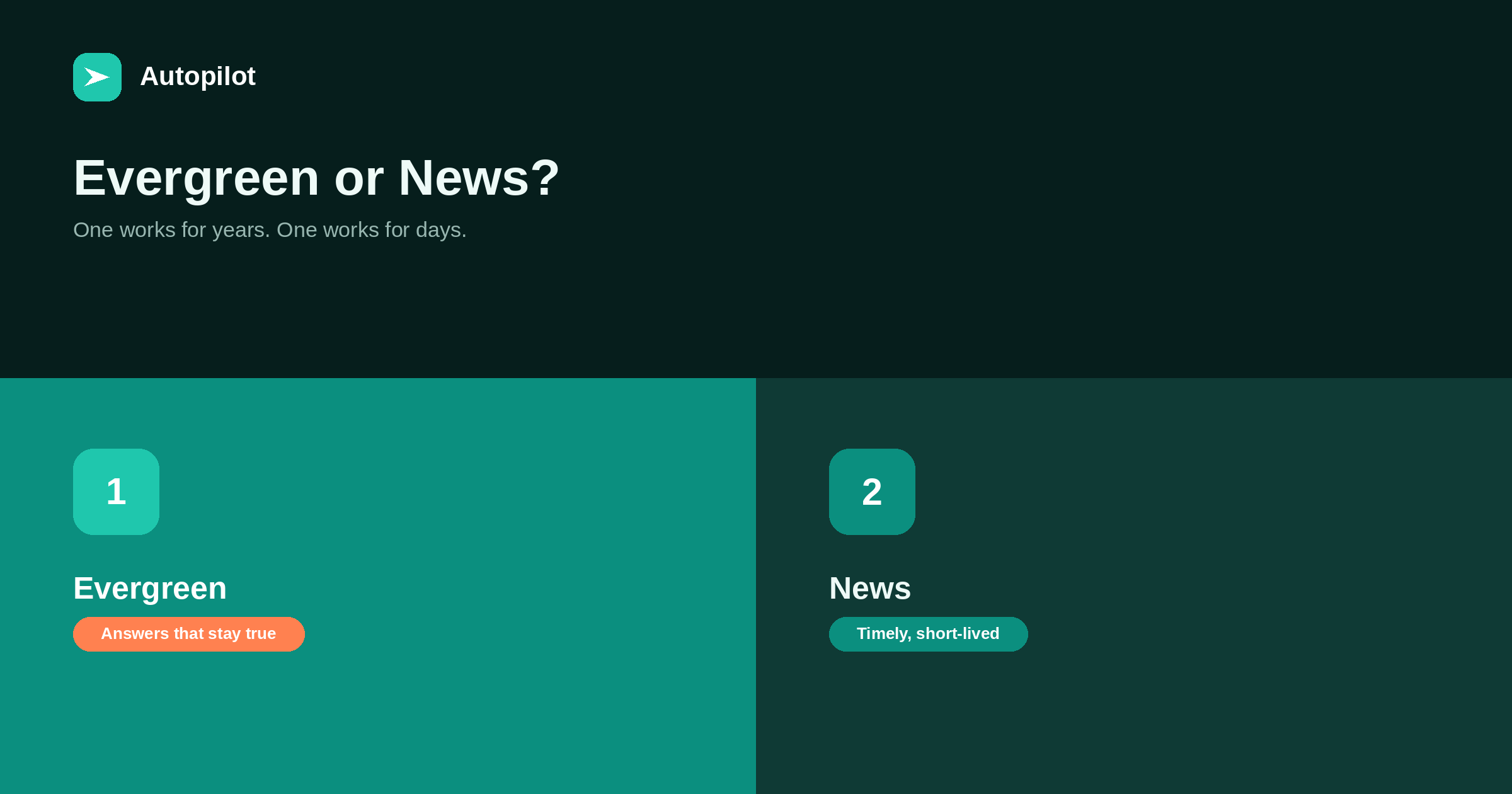
Short answer: evergreen content answers questions that stay relevant for years — how to do something, how to choose, what something means — and keeps attracting readers long after publication. News content covers something that just happened and is read for days. For most business blogs, the large majority of articles should be evergreen, with news reserved for developments that genuinely affect your customers and that you can explain better than general news sites. Even then, write the news piece so the explanation outlives the announcement.
Every article is either an asset that keeps working or an event that passes. The difference is whether the question it answers will still be asked next year.
Business blogs frequently get the balance wrong, publishing a steady stream of industry news that costs as much to produce as an evergreen guide and stops being read within a week.
What makes content evergreen
An evergreen article answers a question whose answer does not depend on today’s date. How to write a content brief. What a canonical tag is. How to choose between a freelancer and an agency.
The answer may need occasional updating — a screenshot changes, a feature is renamed — but the question persists, and so does the demand for it.
That persistence is why evergreen articles make up the bulk of the traffic on almost every established blog. Each one is a small asset that keeps being found, month after month, long after its publication day.
What news content does well
News has genuine uses, just narrower ones than its share of many blogs suggests.
- Explaining a change that affects your customers — a new regulation, a platform policy, a deadline.
- Your own announcements — a new feature, a price change, an event.
- Showing you are paying attention in a fast-moving field.
What it does badly is compete. General news sites publish faster, and within days the story is covered everywhere. A business blog adds value only where it can explain what the change means for its specific readers better than anyone else.
The comparison
The two differ on almost every dimension that matters for a blog.
| Factor | Evergreen | News |
|---|---|---|
| Useful life | Years | Days to weeks |
| Traffic pattern | Slow start, steady | Spike, then nothing |
| Competition | Varies; specific questions winnable | Intense and fast |
| Maintenance | Occasional updates | None, it simply ages |
| Value per hour of effort | Accumulates | Mostly spent at once |
For most businesses, the right proportion is mostly evergreen — often the great majority of articles — with news kept for changes that genuinely matter to customers.
Making news pieces last
When a news article is justified, it can be written so part of it stays useful.
Lead with the change, briefly, then spend most of the article on what it means and what to do: the explanation, the steps, the decisions it forces. That part remains useful to anyone who meets the same situation later.
Better still, write the news as a short update that links to an evergreen guide on the underlying subject, and update the guide. The guide keeps the traffic; the update covers the moment.
Keeping evergreen content true
Evergreen does not mean permanent. Articles drift out of date as products change, prices move and advice evolves.
A yearly pass over the articles that bring the most traffic, checking claims and specifics, keeps them accurate — refreshing old posts describes the process. Avoid putting dates, counts or versions into titles and slugs, which is covered in writing URL slugs; they force edits that the content itself does not need.
Seasonal content, in between
Some subjects return every year at the same time: tax deadlines, holiday preparation, annual planning, back-to-school periods. They are neither purely evergreen nor news.
They are best treated as evergreen articles with an annual update and good timing, published a few weeks before demand rises. planning seasonal content covers planning them.
Converting news into evergreen
Many blogs already have a backlog of news posts that stopped being read years ago. Some of them contain an explanation worth saving.
Go through the old news posts and sort them. Pure announcements with no lasting explanation can stay as they are, or be removed if they are now misleading. Posts that explained a change still in force are worth turning into a proper evergreen guide: rewrite the opening around the question rather than the date, bring the details up to date, and keep the URL if it is neutral.
Where several news posts covered stages of the same development, merge them into one guide and redirect the rest, as described in deleting, merging or redirecting. One current explanation serves readers far better than five dated fragments, and it concentrates whatever links the old posts collected.
For the future, a simple rule prevents the backlog: every news post either links to an evergreen guide or becomes one.
Deciding for each article
A quick test for any proposed article: will someone search for this in eighteen months? If yes, write it as evergreen. If no, ask whether it matters enough to your customers to justify a piece that will be read for a week.
Applying that test in planning, as described in planning a month of articles, keeps the balance right without anyone having to monitor proportions. Neither type guarantees traffic; evergreen at least gives each article many months in which it might be found.
Related reading
If this was useful, these cover the questions that usually come next.
- Planning seasonal content — the middle ground between the two
- Refreshing old posts — keeping evergreen articles true
- Choosing what the blog is about — why news rarely belongs at the centre
The bottom line
Publish mostly evergreen articles that answer questions still asked next year, and keep news for changes that genuinely affect your customers. Write news pieces so the explanation outlasts the announcement, ideally linking to an evergreen guide you update. Treat seasonal subjects as evergreen with an annual refresh and good timing.
SSS
What is evergreen content?
Content that answers questions which stay relevant for years, such as how to do something or how to choose between options. It keeps attracting readers long after it is published.
Should a business blog publish news?
Sparingly: for changes that genuinely affect your customers and that you can explain better than general news sites, and for your own announcements.
What proportion of a blog should be evergreen?
For most business blogs, the great majority. Evergreen articles accumulate value over time, while news articles are mostly read within days.
How do I make a news article useful for longer?
Keep the announcement short and spend most of the article on what it means and what to do. Better still, link it to an evergreen guide on the underlying subject and update the guide.
Does evergreen content need updating?
Yes, occasionally. Check your highest-traffic articles yearly for claims, screenshots and specifics that have changed.
Is seasonal content evergreen?
Largely. Treat it as an evergreen article updated each year and published a few weeks before demand rises.