ENEnglish
 LTLietuviškai
 DEDeutsch
 FRFrançais
 RUРусский
 ESEspañol
 PLPolski
 ITItaliano
 UKУкраїнська
 CSČeština
 PTPortuguês
 JA日本語
JA日本語 LVLatviešu valoda
 ETEesti
 HUMagyar
 IDBahasa Indonesia
 TRTürkçe
 HIहिन्दी
 ELΕλληνικά
 ARالعربية
 THไทย
THไทย VITiếng Việt
 RORomână
 MSBahasa Melayu
 BNবাংলা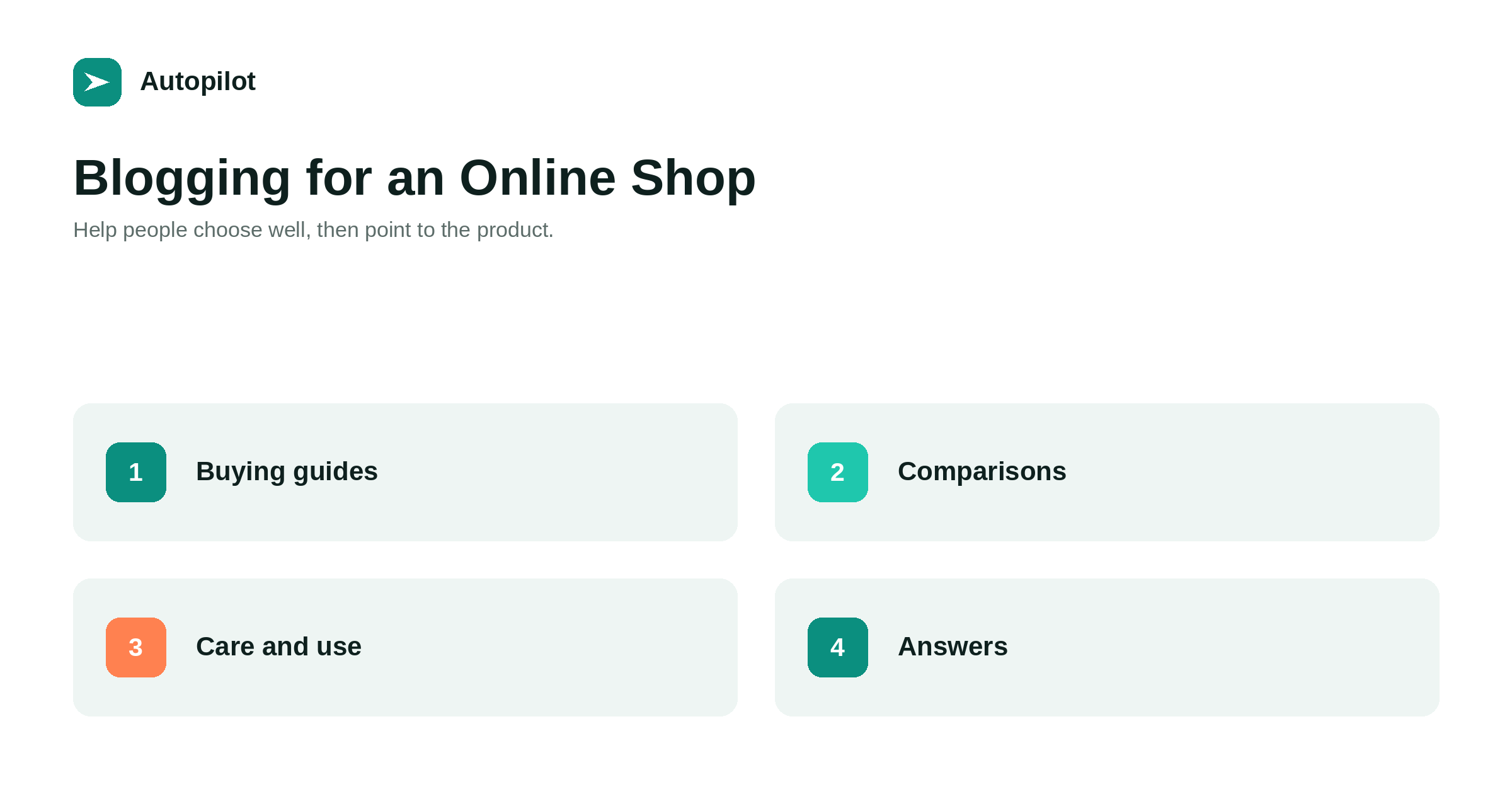
Short answer: a shop blog should help people choose and use products well: buying guides explaining how to choose within a category, honest comparisons between types or models, care and how-to articles for after the purchase, and answers to questions customers ask before buying. Each should link naturally to the relevant category or product pages. Avoid articles that compete with your own category pages for the same search, keep prices and stock details off the blog, and plan around the seasons that drive your sales.
An online shop already has pages built to sell: products and categories. A blog that only repeats their job adds nothing. The blog’s job is different — to help people who are not yet sure what to buy, and people who already bought and want to get the most from it.
Done well, it brings in readers who would never have found a category page, and sends them there better informed.
The four kinds of shop article
Most useful shop content falls into four types.
| Tür | Reader | Links to |
|---|---|---|
| Buying guide | Knows the category, not the choice | Category page, filtered |
| Comparison | Deciding between two or three types | Each product or sub-category |
| Care and how-to | Already bought, or about to | Accessories, related products |
| Question answers | Has a specific concern | The product that answers it |
Buying guides and comparisons bring new customers; care and how-to articles bring repeat customers and reduce returns and support questions.
Buying guides
A buying guide explains how to choose within a category: what matters, what does not, which features suit which kind of buyer, what to avoid.
The best ones are specific and honest, including when a cheaper option is enough. They link to the category page, ideally with the relevant filter already applied, so the reader moves from understanding to browsing without starting over.
They are also the articles most worth updating each year, as ranges change — the process in refreshing old posts.
Comparisons
Customers searching this or that are close to buying. A comparison that genuinely explains the difference and says who each suits helps them decide.
Keep it honest. If one option is better for most people, say so, even if the other has a higher margin. Readers who feel steered leave, and readers who feel helped come back. Keep factual claims checkable — fact-checking before you publish covers why.
Care and how-to articles
How to clean, maintain, set up, use, store or fix the things you sell. These articles serve customers after the purchase, which is where loyalty is built.
They reduce support questions and returns caused by misuse, they are often searched by people who bought elsewhere and might buy from you next time, and they link naturally to accessories and replacement parts. Your customer service inbox is the best source of topics.
Avoiding competition with category pages
A blog post targeting the same search as a category page competes with it, and search engines may show the article where the category page would have converted better.
Keep the targets distinct. The category page targets the product term; the article targets the question: how to choose, which is best for, what size, how to care for. landing page or blog post explains the principle, and Search Console shows when both appear for the same query.
Keeping prices and stock off the blog
Articles are read for months or years. Prices, stock levels and promotions change weekly.
Write guides that remain true: describe what distinguishes options and link to the product pages, which show current prices and availability. An article quoting a price that changed last month creates confusion at exactly the point a customer is deciding.
If an article must mention a price range, check it when you review the article, and prefer descriptions like entry-level and premium.
The shop calendar
Shops have strong seasons: holidays, weather, events, back-to-school, sales periods. Buying guides for seasonal categories should be published or updated six to eight weeks before demand rises, at the same URL every year — planning seasonal content covers the method.
Plan the year’s seasonal guides in one sitting, and let the rest of the calendar fill with evergreen care articles and customer questions.
Linking to products well
Every shop article should link to products or categories, but as a service rather than an interruption: where the reader would naturally want to look, with anchor text that says what they will find.
A short product box at the point of recommendation, and a link to the filtered category at the end, serves most articles. calls to action that fit the article covers matching the offer to the reader’s stage.
Using customer reviews and questions
Shops collect two sources of topics that most blogs lack: product reviews and pre-purchase questions. Reviews show what customers value and what disappoints them; questions show what they were unsure about before buying.
A pattern in either is an article waiting to be written. If several reviews mention that a product runs small, a sizing guide will prevent returns. If customers keep asking whether two items are compatible, a compatibility article will answer the next hundred. These articles contain exactly the specific, first-hand detail that makes a shop blog worth reading.
Measuring it
Shops can measure well: sessions starting on an article that include a product view, an add to basket, or a purchase, within the same visit or later.
Expect care articles to show fewer direct sales and more repeat visits, and buying guides to show more assisted sales. Neither type guarantees revenue; together they cover the customer journey that product pages alone cannot.
Related reading
If this was useful, these cover the questions that usually come next.
- Landing page or blog post — articles against category pages
- Calls to action that fit the article — linking articles to products
- Planning seasonal content — the shop calendar
The bottom line
Publish buying guides, honest comparisons, care articles and answers to customer questions, each linking naturally to the relevant category or product. Keep blog targets distinct from category targets, keep prices and stock off the blog, and plan seasonal guides ahead of each season at the same URL every year.
SSS
Does an online shop need a blog?
It helps when the blog covers what product pages cannot: how to choose, comparisons, and how to use and care for products. It brings readers who would not otherwise find the shop.
What should an ecommerce blog write about?
Buying guides, honest comparisons, care and how-to articles, and answers to questions customers ask before and after buying.
Should blog posts include product prices?
Generally no. Prices change far more often than articles are updated. Link to product pages, which show current prices.
Can blog posts compete with category pages?
Yes, if they target the same search. Give category pages the product terms and articles the questions around them.
How do I link blog posts to products?
Where the reader would naturally want to look, with descriptive anchor text, plus a link to the relevant filtered category at the end.
How do I measure an ecommerce blog?
By product views, add-to-basket actions and purchases in sessions that include an article, both immediately and later.