ENEnglish
 LTLietuviškai
 DEDeutsch
 FRFrançais
 RUРусский
 ESEspañol
 PLPolski
 ITItaliano
 UKУкраїнська
 CSČeština
 PTPortuguês
 JA日本語
JA日本語 LVLatviešu valoda
 ETEesti
 HUMagyar
 IDBahasa Indonesia
 TRTürkçe
 HIहिन्दी
 ELΕλληνικά
 ARالعربية
 THไทย
THไทย VITiếng Việt
 RORomână
 MSBahasa Melayu
 BNবাংলা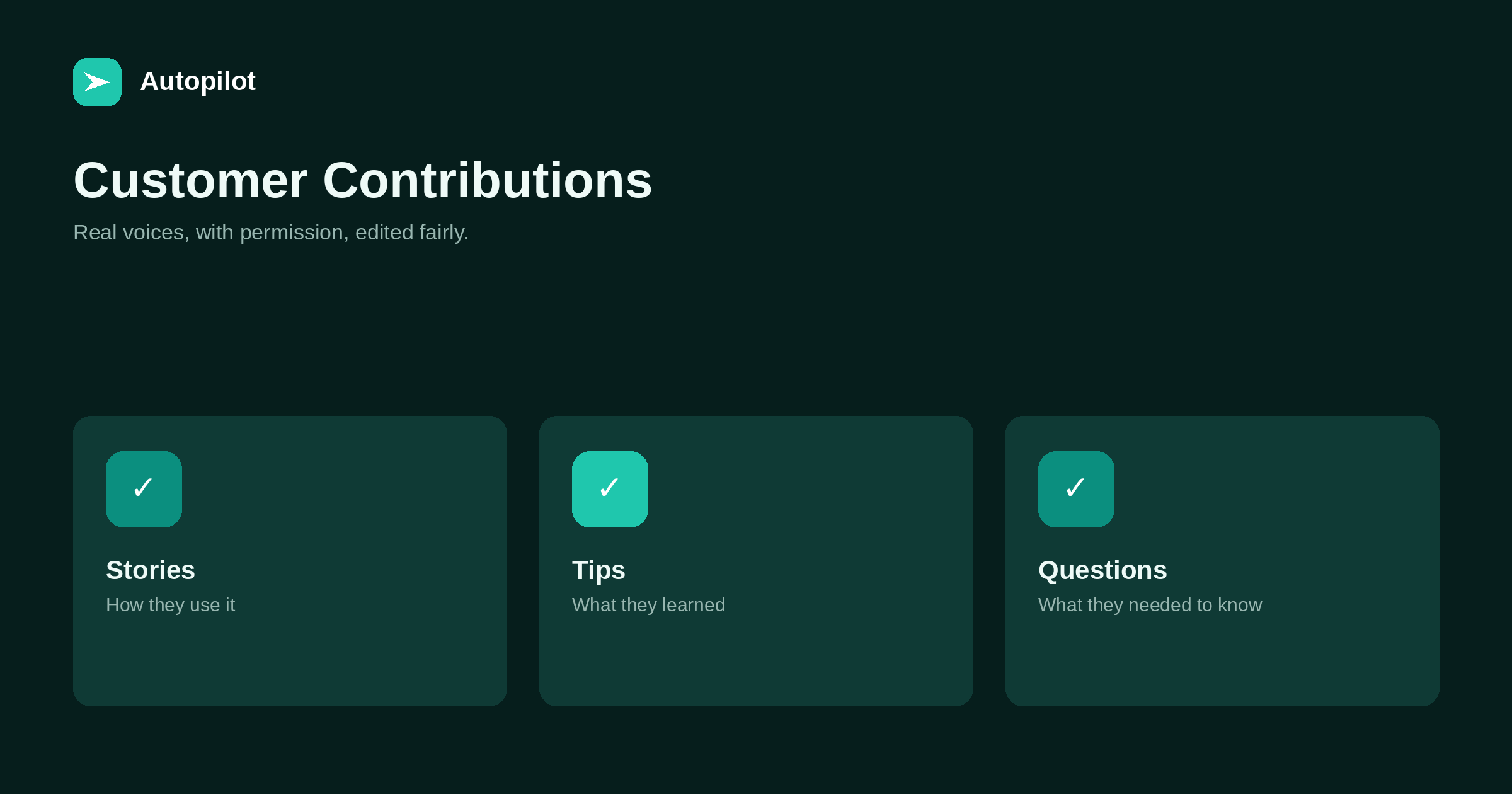
Short answer: customers can contribute short stories of how they use a product or service, practical tips from their experience, and questions that become articles. Invite contributions where customers already talk to you, make it easy to take part, edit for clarity without changing meaning, and get written permission to publish names and details. Present contributions honestly, never invent or alter testimonials, and check any claims about results. Real customer voices add credibility that the business’s own claims cannot.
A business saying its product works is expected. A customer saying how they use it, what they learned and what they would do differently is evidence.
Customer contributions can make a blog more specific, more credible and more useful to prospects. They need care in how they are gathered, edited and presented.
Kinds of contribution
Customers can contribute in several ways, from light to substantial.
| Kind | Effort for customer | Value |
|---|---|---|
| A question | Minimal | Topic ideas, FAQ entries |
| A tip or quote | Low | Specific experience in articles |
| A short story | Moderate | Evidence and relatable examples |
| A full case study | Higher | Detailed proof for prospects |
| A guest article | High | A customer’s own perspective |
Most businesses get the most value from quotes, tips and short stories, which are easy for customers to give.
Inviting contributions
Ask where customers already talk to you: at the end of a successful project, in support conversations that go well, in the newsletter, in account reviews.
Make it easy: a couple of specific questions rather than an open request to write something. Most people will answer three questions by email but will not write an article.
Permission
Get written permission to publish a customer’s name, company, quote or story, and agree what will be published. Let them check the final text. Respect requests to anonymise or to remove content later.
For photographs, get permission separately, and never use stock images to represent real customers.
Editing fairly
Edit contributions for clarity and length, but never change meaning or add claims the customer did not make. If a quote needs significant changes, send the edited version back for approval.
Keep the customer’s voice. Over-polished contributions sound like marketing copy and lose the credibility that made them worth including.
Claims about results
Customers may describe results enthusiastically. Check any specific claims — numbers, timescales, outcomes — before publishing, and present them as that customer’s experience, not as typical. Advertising rules in many places apply to testimonials, including requirements that they are genuine and not misleading.
fact-checking before you publish covers checking claims.
Never invent
Invented testimonials, composite customers presented as real, and altered quotes are dishonest, often unlawful, and damaging when discovered. If you do not yet have customer stories, publish without them rather than making them up.
Using contributions in articles
Customer quotes and tips work well inside articles, at the point where they illustrate something: the common mistake, the practical tip, the real result. They add the experience that general explanation lacks — adding something original.
Longer stories can become case studies — writing a case study.
A simple request template
A short email works well: we are writing an article about a subject, and we would love to include your experience. Could you answer three questions: what problem you were trying to solve, what made the biggest difference, and what you would tell someone starting out? We will send you the final wording to approve before anything is published.
Specific questions, a clear promise of approval, and a short commitment make most customers willing to help.
Anonymous contributions
Some customers are happy to share experience but not their name, often for commercial or privacy reasons. Describe them by role, sector and size — an operations manager at a mid-sized manufacturer — and remove details that could identify them.
Anonymous contributions are less persuasive than named ones, but still more credible than the business’s own claims, and they respect the customer’s wishes.
Questions as contributions
Customer questions are the easiest contribution to collect and among the most valuable. Each one asked in support, sales or comments can become an FAQ entry or an article, with the customer’s wording in the title.
Finding the gaps in your blog covers building those questions into a topic list.
Keeping contributions current
Customer stories age: the customer’s business changes, the product changes, the person leaves. Review published stories yearly, confirm the customer is happy for them to stay, and update or remove those that no longer reflect reality.
Balancing voices
Include a range of customers where you can: different sizes, sectors and experiences, including ones who found parts of the process difficult. A blog featuring only glowing stories from one type of customer is less persuasive than one reflecting the variety of people who actually use the business.
Guest articles from customers
Occasionally a customer wants to write a full article. It can work well if they have a genuinely useful perspective, but it needs editing to fit your standards and review for accuracy. Agree in advance what will be edited, who owns the published text, and how the author will be credited.
Avoid publishing customer articles that are thinly disguised promotion for the customer’s own business; readers notice, and it weakens the blog.
Contributions and search
Genuine customer experience adds the kind of specific, first-hand detail that makes pages more useful and more trustworthy. It does not guarantee rankings, and it should never be fabricated or inflated in the hope of doing so.
A contributions log
Keep a simple record of each contribution: who, what, when permission was given, which articles use it, and when it was last confirmed. It makes reviews and removal requests quick, and it proves consent if ever questioned.
The log also shows which customers have helped before, so you can spread requests fairly rather than asking the same few people every time.
Thanking contributors
Thank contributors personally, link to their business where appropriate, and let them know when the article is published so they can share it. Contributors who feel valued often contribute again and recommend you to others.
Related reading
If this was useful, these cover the questions that usually come next.
- Writing a case study — the structured version
- Interviewing experts — gathering customer input
- Blog comments — another way customers take part
The bottom line
Invite customers to contribute questions, tips, quotes and short stories where they already talk to you, with a few specific questions. Get written permission, edit for clarity without changing meaning, check any claims about results, present them as individual experience, and never invent or alter testimonials.
SSS
How can customers contribute to a business blog?
With questions, tips, quotes, short stories, case studies or occasionally guest articles.
Do I need permission to publish a customer’s story?
Yes, in writing, including agreement on names, details and photographs.
Can I edit customer quotes?
Lightly, for clarity, without changing meaning. Send significant edits back for approval.
Are testimonials subject to rules?
In many places, yes: they must be genuine and not misleading, and results should not be presented as typical if they are not.
What if I have no customer stories yet?
Publish without them. Never invent testimonials or present composites as real customers.
How do I get customers to contribute?
Ask at good moments, such as after a successful project, with a few specific questions by email.