ENEnglish
 LTLietuviškai
 DEDeutsch
 FRFrançais
 RUРусский
 ESEspañol
 PLPolski
 ITItaliano
 UKУкраїнська
 CSČeština
 PTPortuguês
 JA日本語
JA日本語 LVLatviešu valoda
 ETEesti
 HUMagyar
 IDBahasa Indonesia
 TRTürkçe
 HIहिन्दी
 ELΕλληνικά
 ARالعربية
 THไทย
THไทย VITiếng Việt
 RORomână
 MSBahasa Melayu
 BNবাংলা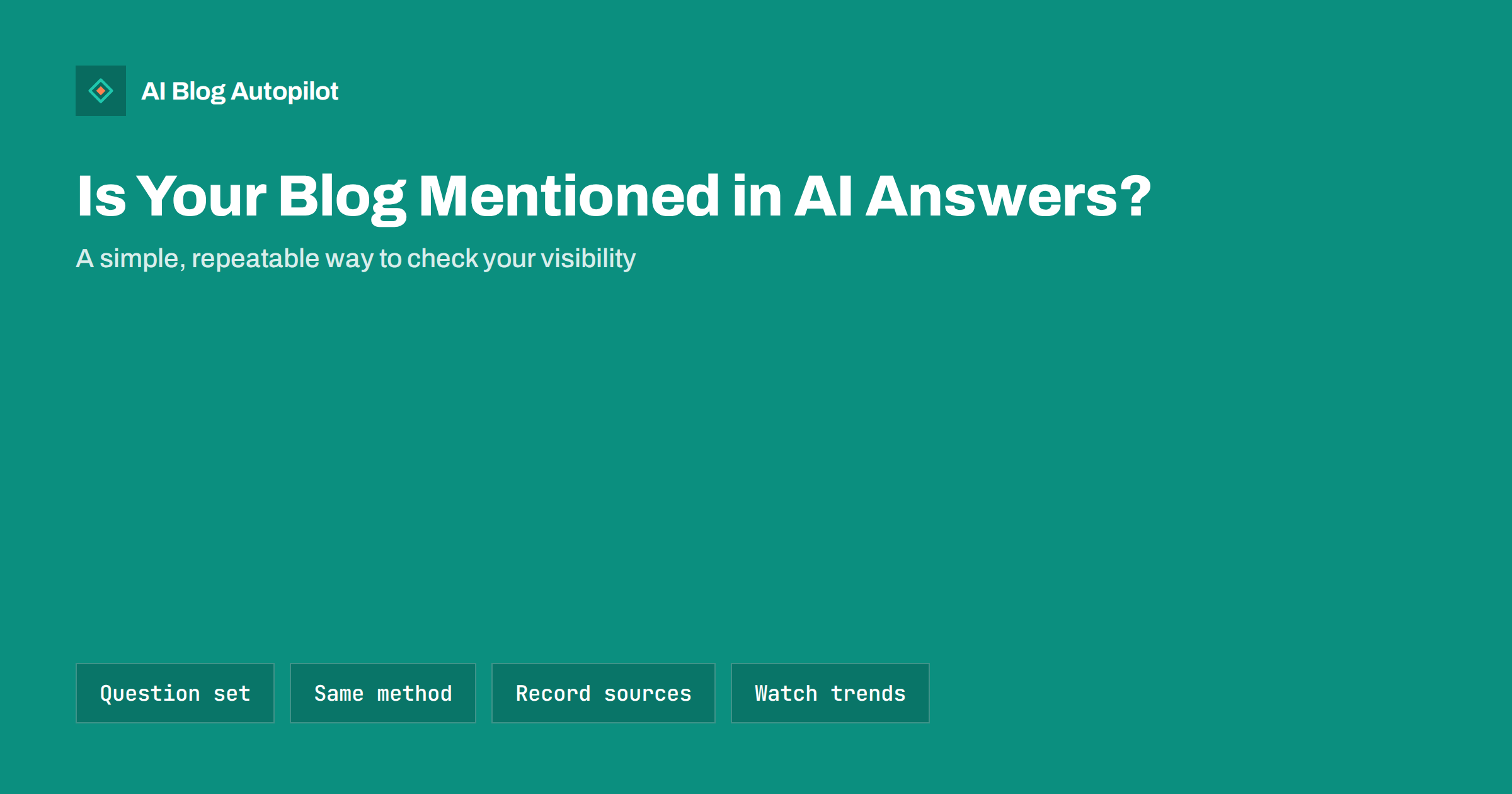
Short answer: to check whether AI assistants mention your blog, build a fixed set of 20 to 50 real questions your readers ask, run them regularly in the assistants your audience uses, and record whether your site is cited as a source, your brand is mentioned, or neither. Use clean sessions and the same wording each time, keep notes in a simple spreadsheet, and judge the trend over months rather than single answers. Combine this with referral data in analytics, because AI answers vary between runs and no single check is definitive.
AI assistants and AI answers in search results now answer many of the questions blogs used to be found for. For site owners, that raises a practical question: are we part of those answers or not? Unlike classic search rankings, there is no position number to look up, and dedicated monitoring tools are still young and often expensive.
The good news is that a careful manual method gives a useful picture at almost no cost. This guide describes how to set it up, how to run it consistently and how to interpret what you find without over-reading it.
Why checking AI visibility is different from checking rankings
A traditional ranking check is fairly stable: search a query, see where your page appears. AI answers behave differently in several ways that affect how you measure them.
- Answers vary. The same question can produce different answers, with different sources, from one run to the next.
- Context changes answers. Previous messages in a conversation, account settings and saved preferences can influence what the assistant says.
- Location and language matter. Answers may differ by country and by the language of the question.
- Sources are not always shown. Some assistants cite sources with links, some only in certain modes, and some answer from their training without citing anything.
- Systems change often. Updates to the underlying models and retrieval can shift results without warning.
So the goal is not to find “your position” but to estimate how often, and in what way, your site appears across a representative set of questions, and whether that is improving.
Step 1: Build a question set
Your question set is the foundation. It should reflect the questions your target readers genuinely ask, not the phrases you wish you ranked for.
- Start from your best content. List your most important articles and write the question each one answers, phrased the way a customer would ask it.
- Add real customer questions. Pull questions from emails, sales calls, support tickets and comments. These are the questions people will also ask an assistant.
- Add longer queries from Search Console. Question-style queries your site already appears for are a good source of wording.
- Include a few recommendation questions if relevant, such as “What tools help with X?” or “Who offers X in Y?”, where your business could be named.
- Keep a mix. Include definitions, how-to questions, comparisons and decision questions. They trigger different kinds of answers.
As an illustration, a small accounting firm’s set might include “Do freelancers need to register for VAT?”, “What expenses can a sole trader claim for a home office?”, “Is it worth hiring an accountant as a freelancer?” and “How do I choose an accountant for a small online shop?”. Each maps to an article the firm has published or plans to publish, and each is phrased the way a client would say it on the phone.
Twenty to fifty questions is a practical size for a small team. Fewer gives an unreliable picture; many more becomes too time-consuming to repeat. Write each question down exactly and never change the wording between rounds, or you will not be able to compare results.
Step 2: Choose where to test
Test in the places your audience actually uses. For many businesses that means search engines with AI answers, plus one or two general AI assistants. For some audiences, especially developers or researchers, other tools may matter more. Ask a few customers what they use if you are unsure.
Note which mode you use. Some assistants answer differently when web search is switched on, or offer a separate research mode. Pick one mode per assistant and stick with it, preferably the one that shows sources, because that is where your site can be cited.
Step 3: Run the checks consistently
Consistency matters more than volume. A few rules keep results comparable:
- Use a clean session. Start a new conversation for each question, and where possible use a logged-out window or an account without saved history or custom instructions.
- Ask each question once, cold. Do not add follow-ups before recording the first answer.
- Keep location and language constant. Test from the same country and in the same language each round.
- Run each question two or three times if you have time, and note whether your site appears in any, most or all runs. This smooths out random variation.
- Test at a regular interval, such as monthly. More often rarely adds insight; less often makes trends hard to see.
Step 4: Record what you see
A simple spreadsheet works well. For each question and each assistant, record:
- Date and the assistant and mode used.
- Cited: is one of your pages linked or listed as a source? Which URL?
- Mentioned: is your brand or site named in the text, with or without a link?
- Accuracy: if you are mentioned, is the description correct?
- Competing sources: which other sites are cited? Note the two or three most common.
- Answer type: short definition, step list, comparison, recommendation list or no clear answer.
Keep the notes short and factual. A typical row might read: “Question 12, assistant with web search on, cited: yes, /home-office-expenses/, mentioned: no, top competing sources: a government guidance page and a large accounting software blog, answer type: step list”. Screenshots of notable answers are useful too, especially when an answer describes your business inaccurately, because you may want to compare them later after fixing the cause.
From this you can calculate a simple share: out of all question-and-assistant combinations, in how many were you cited, and in how many mentioned? That percentage, tracked month by month, is your visibility trend.
Step 5: Interpret the results honestly
Treat the numbers as directional, not precise. A few guidelines help:
Look at patterns across many questions. Appearing in one answer this month and not the next means little. Appearing for most questions in one topic cluster and none in another is meaningful.
Study the sources that win. When other sites are cited for your questions, open them. Do they answer more directly? Are they more specific, more up to date, better structured or more widely referenced? That is your most useful insight.
Check accuracy. If an assistant describes your business or advice incorrectly, look for the source of the confusion: outdated pages, inconsistent profiles or unclear wording on your own site.
Connect with traffic data. In your analytics, look at referrals from AI assistants where they are identifiable. Rising citations with no referral traffic is common, because many people read the answer and do not click, but a combination of the two gives a fuller picture.
Do not chase single answers. Rewriting a page because it was missing from one answer on one day is a waste of effort. Make changes based on consistent patterns.
What to do with the findings
The improvements that tend to increase AI visibility are the same ones that make content better for people:
- Answer the core question clearly in the first paragraph of the relevant article.
- Cover the common follow-up questions in clearly labelled sections or an FAQ.
- Update outdated facts, dates and examples, and show when a page was updated.
- Strengthen internal links between related articles so your expertise on a topic is visible.
- Make sure your site is accessible to the crawlers used by the services you care about, by checking robots.txt rules.
- Earn mentions on other reputable sites, since many answers draw on several sources.
After changes, keep testing on the same schedule with the same questions. It may take weeks or months for updates to be reflected, and some systems refresh their knowledge more slowly than others.
Paid monitoring tools: when they are worth it
A growing number of tools automate this process by running large question sets across several assistants and reporting share of voice. They can save time for larger sites, agencies and brands tracking many topics. Before paying, check how they collect answers, how often they run, which assistants and regions they cover and whether they account for answer variability. For a small blog, the manual method above usually gives enough insight to guide decisions.
How AI Blog Autopilot helps
AI Blog Autopilot writes long-form articles with a clear structure, an FAQ section, tags and SEO meta, planned around real search queries for your topics. That answer-first structure gives AI systems clean passages to use, and a steady publishing pace widens the set of questions your site can answer. Checking whether those articles appear in AI answers, as described above, remains a useful habit alongside it. See how AI Blog Autopilot works.
Related reading
- How to Get Your Blog Cited by ChatGPT, Perplexity and Google AI Overviews
- AI Answers in Search Results: What They Mean for Traffic
- Brand Mentions: Why AI Answers Recommend Some Businesses
- Conversational Queries: Writing for How People Ask AI
The bottom line
You can get a useful picture of your AI visibility without special tools. Build a fixed set of real questions, test them in the assistants your audience uses under consistent conditions, record citations, mentions and competing sources, and watch the trend over months. Learn from the sources that win, fix inaccuracies and improve the content itself. No method guarantees inclusion, but regular, honest measurement shows whether your efforts are moving in the right direction.
SSS
How can I tell if an AI assistant uses my blog as a source?
Ask the questions your articles answer in an assistant mode that shows sources and check whether your URLs are cited. Repeat with the same wording over time, and check analytics for referrals from AI assistants.
Why do I get different answers each time I ask?
AI answers are generated fresh and can vary between runs, sessions, locations and system updates. That is why checks should use many questions, clean sessions and repeated runs rather than a single test.
How many questions should I track?
For a small blog, 20 to 50 questions is a practical range. It is large enough to show patterns across topics and small enough to repeat monthly without taking too much time.
Is being mentioned without a link still valuable?
Yes. A mention builds awareness and may lead people to search for you directly, even if it does not send a click. Track mentions and citations separately so you can see both.
Do I need a paid tool to monitor AI visibility?
Not for most small sites. A consistent manual process gives useful directional data. Paid tools become worthwhile when you track many topics, brands or regions and need automation.