ENEnglish
 LTLietuviškai
 DEDeutsch
 FRFrançais
 RUРусский
 ESEspañol
 PLPolski
 ITItaliano
 UKУкраїнська
 CSČeština
 PTPortuguês
 JA日本語
JA日本語 LVLatviešu valoda
 ETEesti
 HUMagyar
 IDBahasa Indonesia
 TRTürkçe
 HIहिन्दी
 ELΕλληνικά
 ARالعربية
 THไทย
THไทย VITiếng Việt
 RORomână
 MSBahasa Melayu
 BNবাংলা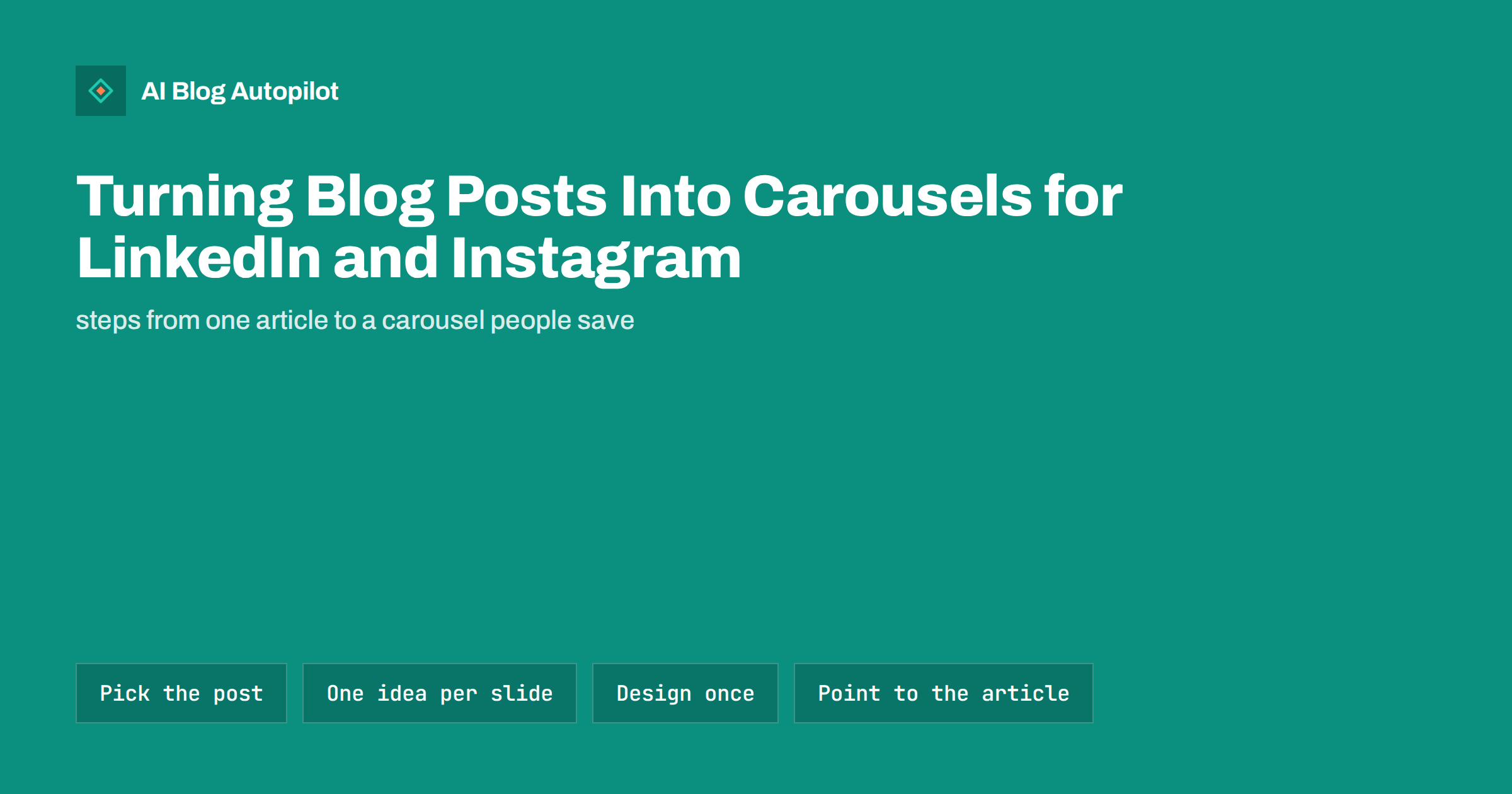
Short answer: a carousel is a set of slides that readers swipe through in one post. It works well for blog articles with steps, lists, comparisons or frameworks. Turn the article’s structure into six to ten slides with one idea each: a hook slide, the key points, and a final slide that names the article and says where to find it. On LinkedIn, carousels are usually shared as PDF document posts; on Instagram, as multi-image posts. Design one reusable template so each new carousel takes minutes, not hours.
Carousels are one of the most effective formats for turning written expertise into social content. They keep people on the post longer, they are easy to save for later, and they let you teach something in a format the platform wants to show. For a blog, they are also a natural fit: a well-structured article already contains the outline of a good carousel. This guide explains how to choose articles, structure the slides, design efficiently and connect the carousel back to your blog.
Why carousels suit blog content
A blog article and a carousel share the same skeleton: a promise, a sequence of points and a conclusion. The difference is density. An article explains each point in paragraphs; a carousel states each point in a sentence or two, with the article as the place for detail.
- They deliver value without a click. Networks prefer content that keeps people on the platform. A carousel teaches the essentials in the feed, which earns attention and trust.
- They are saved and shared. Practical carousels, such as checklists and step-by-step guides, are the kind of content people save to use later.
- They reuse work you already did. The research and structure are in the article. The carousel is a new format, not a new topic.
- They create curiosity. A reader who found the summary useful is more likely to want the full explanation, examples and FAQ in the article.
Which articles make good carousels
Not every article translates well. Good candidates have a clear structure that survives compression:
- Step-by-step guides: each step becomes a slide.
- Checklists: each item or group of items becomes a slide.
- Mistakes and fixes: one mistake per slide with the fix underneath.
- Comparisons: one criterion per slide, showing both options.
- Frameworks and definitions: one component per slide, with a simple diagram if helpful.
Opinion pieces, detailed case discussions and articles that rely on long explanations are harder. For those, a single quote image or a short text post usually works better. The guide to repurposing an article covers matching formats to content.
Structuring the slides
A structure that works for most blog-based carousels:
- Hook slide. State the problem or promise in a few words: “7 checks before you publish a blog post”. This slide decides whether anyone swipes, so keep it bold and specific.
- Context slide (optional). One sentence on why this matters, or who it is for.
- Content slides. One point per slide. A short heading and one or two supporting lines. Number them if the order matters.
- Summary slide. The points in a compact list, which is the slide people screenshot or save.
- Final slide. The article title, where to find it, and a simple next step such as “Full guide with examples on our blog”.
To see how this works in practice, imagine an article that sets out eight checks to run before publishing a blog post, similar to our pre-publication checklist. Its sections map almost directly onto slides:
- Slide 1: “Before you hit publish: 8 checks that catch most mistakes”.
- Slide 2: “Takes ten minutes. Saves embarrassing corrections.”
- Slides 3 to 8: one check each, such as “Read the title aloud: does it promise what the article delivers?” or “Click every link once”.
- Slide 9: the eight checks as a compact list.
- Slide 10: “The full checklist with explanations is on our blog.”
Notice that nothing new had to be researched. The work is choosing the strongest points, rewriting each one in a single clear line and deciding what to leave for the article. That editing step is where the quality of a carousel is decided.
A useful discipline is to write the slide text before opening the design tool. A plain list of ten lines in a document shows immediately whether the sequence makes sense, whether any slide is doing two jobs and whether the hook is strong enough. Fixing those problems in text takes seconds; fixing them after the slides are designed takes much longer.
Six to ten slides is a comfortable length for most topics. Fewer can feel thin; many more and readers drop off before the end, which is where your pointer to the article is.
Writing text for slides
Slide text follows different rules from article text:
- Few words. Aim for a heading of a few words and at most two short lines beneath. If it needs a paragraph, it belongs in the article.
- Large type. Most people view carousels on phones. Text that looks fine on a desktop screen is often unreadable on a phone.
- Consistent phrasing. Start each point the same way, for example with a verb: “Check…”, “Remove…”, “Add…”.
- Accurate claims. Compression is where exaggeration creeps in. If the article says “often”, the slide should not say “always”.
- Plain language. Avoid jargon unless the audience uses it daily.
Design once, reuse every time
The main cost of carousels is design time, and most of it can be removed with a template. Set up a master design in whatever tool you use with:
- Fixed dimensions for each network. A portrait format, such as 4:5, takes more space in feeds and suits both LinkedIn documents and Instagram posts.
- Your brand colours and one or two fonts, matching your blog’s featured images so readers recognise the connection.
- Layouts for hook, content, summary and final slides.
- Space for slide numbers and a small logo or name.
- Safe margins, so nothing important is cropped by the platform interface.
With a template, making a new carousel is mostly copying headings from the article into the slides. Avoid white backgrounds if your brand has a strong colour; bolder slides stand out better in busy feeds.
Publishing on LinkedIn and Instagram
On LinkedIn, carousels are typically shared as document posts: export the slides as a PDF and upload them as a document. Give the document a clear title, because it is shown with the post. Write a post text that explains what the carousel covers and why it matters, and add the article link in the post text or in a comment, depending on what works for your audience. The guide to LinkedIn for B2B blogs covers the wider strategy.
On Instagram, upload the slides as images in one post. Links in captions are not clickable, so the final slide and caption should point to your profile link or a Story with a link sticker. The guide to sharing blog posts on Instagram explains those options.
On both networks, add alt text for the images where the platform allows it, so that people using screen readers can follow the content.
Measuring carousel performance
Carousels are designed to perform inside the platform, so judge them on platform numbers as well as clicks:
- Saves and shares show that the content was useful enough to keep or pass on.
- Comments often contain questions that are good ideas for new articles.
- Profile visits and follows after a carousel show interest in you, not only in the topic.
- Visits to the article, measured with tagged links, show how many readers wanted the full version.
Compare carousels with other formats you use for the same articles. If carousels consistently earn more saves and follows, make them the default for step-by-step and checklist articles.
Common mistakes
- Screenshots of paragraphs. Pasting the article’s text onto slides produces unreadable walls of words.
- A weak first slide. A generic title such as “Blog tips” gives nobody a reason to swipe.
- No pointer to the article. Readers who want more need to know where to go.
- Inconsistent design. Each carousel looking different makes your content harder to recognise in the feed.
- Too many carousels from one article. One strong carousel per suitable article is usually enough; split only when an article genuinely covers two topics.
- Forgetting the date. Carousels keep circulating through shares and saves long after posting, so avoid details that go out of date quickly.
How AI Blog Autopilot fits in
AI Blog Autopilot writes structured long-form articles with clear headings and an FAQ, which gives you a ready outline for a carousel. It also shares each article to your connected social networks, including LinkedIn and Instagram, with text written for each network and posted at its own time. Designing carousel slides remains a separate step in your design tool. See how Autopilot works.
Related reading
- Turning an Article Into Social Posts That Get Read
- Screenshots, Diagrams and Charts in Blog Articles
- How to Write a List Article That Is Not Filler
The bottom line
Carousels turn the structure of a good article into a swipeable summary that people save and share. Choose articles with steps, lists or comparisons, write one idea per slide in large type, reuse a branded template and end with a clear pointer to the full article. The article holds the depth; the carousel earns the attention.
SSS
How many slides should a carousel have?
Six to ten slides suits most topics. That is enough for a hook, the key points, a summary and a final slide pointing to the article, without losing readers before the end.
How do I post a carousel on LinkedIn?
The common way is to export the slides as a PDF and upload it as a document post. Give the document a clear title and write post text that explains what readers will learn.
Which blog posts work best as carousels?
Articles with a clear structure: step-by-step guides, checklists, mistakes and fixes, comparisons and frameworks. Long narrative or opinion pieces are usually better shared in other formats.
Should the carousel include a link to the article?
Include a clear pointer on the final slide. On LinkedIn you can add the link in the post text or a comment. On Instagram, point readers to your profile link or a Story link sticker, because caption links are not clickable.
What size should carousel slides be?
A portrait format such as 4:5 takes more space in feeds and works on both LinkedIn and Instagram. Keep important text away from the edges so it is not covered by the platform interface.
Can I reuse the same carousel on both networks?
Usually yes, with small changes. The slides can be the same, but the post text, the way you point to the article and the hashtags should be adapted to each network.