ENEnglish
 LTLietuviškai
 DEDeutsch
 FRFrançais
 RUРусский
 ESEspañol
 PLPolski
 ITItaliano
 UKУкраїнська
 CSČeština
 PTPortuguês
 JA日本語
 LVLatviešu valoda
 ETEesti
 HUMagyar
 IDBahasa Indonesia
 TRTürkçe
 HIहिन्दी
 ELΕλληνικά
 ARالعربية
 THไทย
 VITiếng Việt
 RORomână
 MSBahasa Melayu
 BNবাংলা
Short answer: for the first year, set goals in this order: publish steadily, get pages indexed and seen, learn which topics attract the right readers, and only then expect enquiries. Use goals you control, such as articles published and questions answered, alongside slower ones such as impressions, clicks and leads, and review them every quarter.
A new blog does not behave like an old one. It has no history, few links and little trust with search engines, so it grows slowly at first. Owners who expect hundreds of visitors in the first month are often disappointed and give up just before results appear.
This guide proposes a practical way to set goals for the first twelve months. It separates goals you control from results you influence, suggests what to expect in each quarter and explains how to review progress without chasing vanity numbers.
Start with the purpose of the blog
Before any numbers, write one sentence about why the blog exists. It might be to answer customers’ questions, to bring in enquiries for a service, to build a reputation, to support sales staff or to attract applicants. The purpose shapes every other goal.
Different purposes call for different measures. A blog meant to bring enquiries should track calls, forms and quote requests. One meant to support sales should be measured by how often staff use its articles. A blog for reputation might track mentions and links. Choose one main purpose and one secondary one, and resist the urge to measure everything.
Share the purpose with everyone who will contribute or review. A clear sentence on the wall prevents drift and settles arguments about topics. The guide to choosing what your business blog is about helps you find it.
Separate controllable goals from results
Some things are in your hands: how many articles you publish, how well they answer questions, how quickly you fix errors and whether you share each one. Others depend on search engines, competitors and chance: rankings, traffic and leads. Set firm goals for the first group and expectations for the second.
Controllable goals could include: publish two good articles a week, cover twenty core customer questions by month six, update the five best posts every quarter and review Search Console monthly. These are clear and either done or not done.
Result goals should be ranges and trends, not promises. For instance, “see impressions grow each quarter” is more realistic than “reach 10,000 visitors”. Nobody can guarantee a ranking, so avoid goals that treat it as a fact. The guide on how long until a new blog ranks sets out typical timelines in general terms.
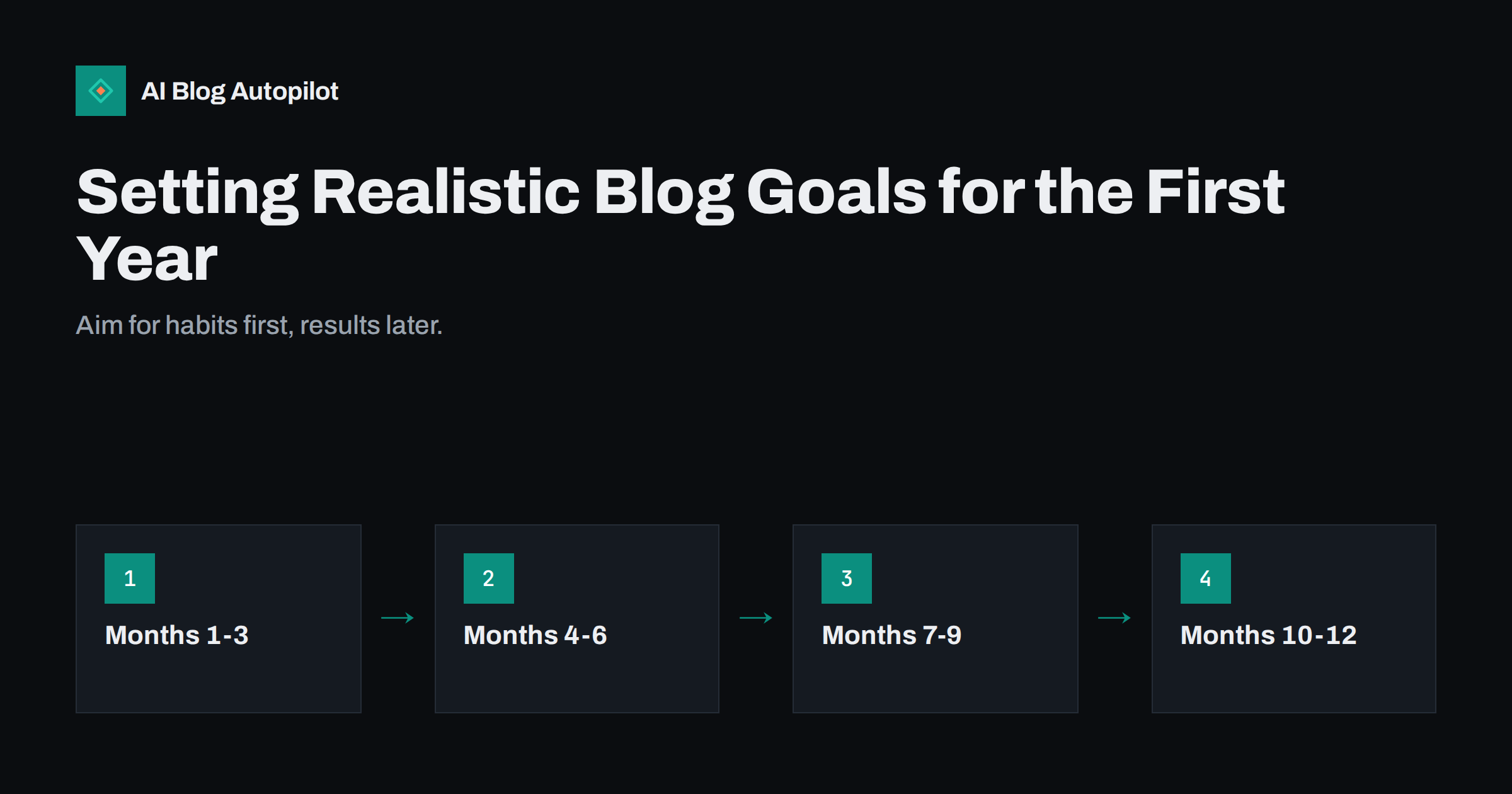
Months 1 to 3: build the habit
The first quarter is about foundation. Set up the blog, connect analytics and Search Console, choose your categories and write your first articles. Aim for a steady rhythm you can sustain, not the highest possible output. Missing weeks teaches the wrong habit.
Cover the basics: who you are, what you do, the most common customer questions and the policies readers need. Add an about page, a contact page and a start-here page. The guide to your first ten blog posts suggests what to publish.
Do not worry about traffic yet. At this stage, success means published articles, indexed pages and no technical errors. Check that sitemaps work, that pages load quickly and that internal links connect your articles. Expect small numbers and treat them as a baseline.
Expect uneven progress. Search impressions often rise in steps, with plateaus in between, as pages are discovered, tested and re-evaluated. A week of falling numbers is not a disaster, and a week of rising numbers is not a victory. Look at the direction over several weeks, and avoid changing strategy based on a short run of data.
Months 4 to 6: earn first visibility
In the second quarter, some pages begin to appear in search for specific, low-competition queries. Look at Search Console to see which queries bring impressions and clicks, even small numbers. These show what search engines already associate with your site.
Use that information. Improve titles and descriptions for pages with impressions but few clicks, add missing details to pages that rank on page two and write more articles around queries that show promise. The guide to striking-distance keywords shows how.
Set goals for visibility, such as a number of pages with impressions or clicks, not for sales. Also begin promoting your articles: share them, mention them in emails and link them from your key pages. By the end of the quarter you should know your first few reliable topics.
Talk to customers directly. Ask a few of them what they searched for before contacting you, which pages they read and what almost stopped them from buying. Their answers are worth more than many charts, and they often reveal content gaps that no tool shows. Record what they say in their own words, since these words make excellent headings and keywords.
Look at the second-order effects of the blog as well. Has it reduced repetitive questions to staff? Do salespeople share articles with prospects? Have partners linked to a guide? These benefits are real even when they do not show up in a traffic report, and they belong in your review.
Months 7 to 9: learn what works
By the third quarter, you have enough data to see patterns. Which topics get the most impressions? Which pages keep readers? Which ones are never visited? Review the numbers with an open mind, and resist the urge to read too much into small samples.
Compare article types: how-to guides, comparisons, local pages, opinion pieces and answers to short questions. Double down on those that bring the right readers and rethink those that do not. Update older articles with new details and links to newer ones.
Set learning goals: identify your five best topics, find three content gaps and fix the five weakest pages. The guide to how to audit a blog offers a method. Keep notes on what you learn, since they become the foundation of next year’s plan.
Months 10 to 12: link content to leads
In the final quarter, focus on conversion. Check which articles lead to enquiries, calls or sign-ups, and make the path clear. Add relevant calls to action, update contact details and make sure forms work on phones. Ask new customers how they found you and record the answers.
Set modest goals for leads based on your earlier data. If a few articles already bring an enquiry each month, aim to improve those and repeat their pattern. Avoid targets taken from other businesses. The guide to measuring blog return on investment explains how to link effort to results.
Prepare the second-year plan. Review what you achieved against your first-year goals, note what slowed you down and decide what to change. Celebrate the work done, since a year of steady publishing is a real asset.
Set a budget of time and money for the year, too. A goal is realistic only if the resources match. If you can spare two hours a week, plan for what two hours can produce, and consider tools or helpers for the rest. Write down the hours, the costs and who is responsible, and compare them with actual figures each quarter to see whether the plan was fair.
Include maintenance in your plan. New articles are only part of the work; updating old ones, fixing broken links, answering comments and checking facts also take time. A common mistake is to plan only for creation, then discover that the existing pages have started to age. Reserve some part of every month for care of what you already have.
Avoid vanity goals
Some numbers look good but tell little. Total page views can be inflated by bots or irrelevant visitors. Social likes do not equal customers. Follower counts may not reflect real interest. Prefer numbers tied to your purpose: relevant clicks from search, enquiries, time on key pages and returning readers.
Be careful with comparisons. A competitor’s traffic estimate may be wrong, and their situation differs from yours. Use others as a loose guide, not as a target. Focus on your own progress from one quarter to the next.
Beware of goals that encourage poor behaviour. A target of ten articles a week might push you to publish thin, repetitive pages, which harms the blog. Quality targets, such as answering a question fully and checking facts, protect the standard. See blog traffic versus leads for guidance on choosing numbers.
Write your goals down in a place everyone can see, with dates. A goal that exists only in someone’s head is easy to forget or reinterpret. A shared page with the purpose, the controllable goals, the expected trends and the review dates takes ten minutes to create and gives the whole team a common reference for the year ahead.
Review every quarter
Plan a short review at the end of each quarter. Compare actual results with your goals, note what worked, adjust topics and rhythm and write down decisions. Keep the meeting short and the notes clear. A simple one-page record is enough.
Include people who see customers. Sales staff, receptionists and service teams know which questions are still unanswered. Their input keeps goals connected to real needs. The monthly blog review agenda provides a ready list.
Be flexible. If a goal turns out to be unrealistic, change it and say why. If a result surprises you, investigate. The aim of a first year is to learn how to run a blog that serves your business, and goals are a tool for learning.
How AI Blog Autopilot helps
Steady output is the goal most within your control, and AI Blog Autopilot helps with it: it plans the month from your topics and writes full articles with FAQ, tags and SEO meta, with an automatic quality check. Try the three free articles and see the plans.
Related reading
The bottom line
In year one, set firm goals for output and learning, expect trends instead of guarantees for traffic, link content to leads late in the year and review every quarter.
SSS
What is a realistic goal for a new blog in the first year?
Publish steadily, get indexed, see growing impressions, learn which topics work and begin to link articles to enquiries.
Should I set a traffic target?
Use ranges and trends, not promises. Nobody can guarantee rankings, so focus mainly on goals you control.
Which numbers are vanity metrics?
Raw page views, likes and follower counts that are not tied to your purpose, such as enquiries or relevant search clicks.
How often should I review goals?
Every quarter, with a short note of what worked, what changed and what you will do next.
When should I expect leads from a blog?
Often later in the year, once enough useful articles are indexed, though it varies by market and competition.