ENEnglish
 LTLietuviškai
 DEDeutsch
 FRFrançais
 RUРусский
 ESEspañol
 PLPolski
 ITItaliano
 UKУкраїнська
 CSČeština
 PTPortuguês
 JA日本語
 LVLatviešu valoda
 ETEesti
 HUMagyar
 IDBahasa Indonesia
 TRTürkçe
 HIहिन्दी
 ELΕλληνικά
 ARالعربية
 THไทย
 VITiếng Việt
 RORomână
 MSBahasa Melayu
 BNবাংলা
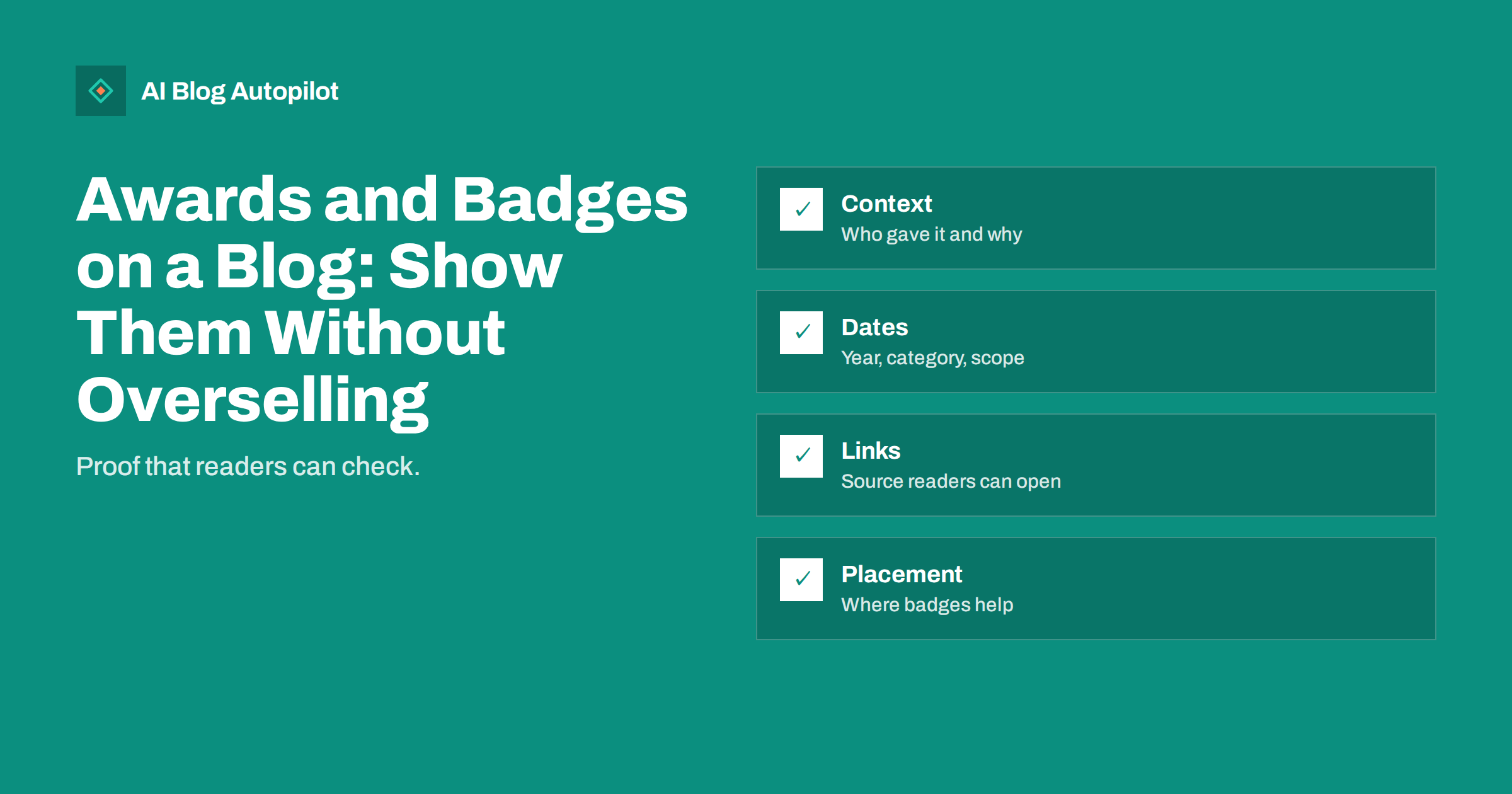
Short answer: show an award or badge only if it is real, current and from a source readers can check. State who gave it, in which year, for what and how it was decided, link to the original, and place it where it supports a decision rather than crowding every page. Do not imply an endorsement you do not have, do not pay for empty titles and remove anything that has expired.
Awards look like easy trust. A logo in the footer, a ribbon on the homepage or a line in an article saying the company was named best in its field can reassure a visitor in a second. They can also do the opposite. Readers have learned to doubt vague badges, and search tools and assistants read the surrounding text, not just the image. A badge with no context is noise at best and a warning sign at worst.
This guide explains how to choose which recognition to show, how to word it, where to place it, what to avoid and how to keep it current. It applies to prizes, ratings, certifications, memberships, press mentions and review scores alike.
Separate awards, certifications and memberships
Three kinds of recognition are often mixed up. An award is a judgement: someone compared several candidates and chose one. A certification is a check against a standard: the business passed an audit or exam. A membership means the business belongs to an association, often after paying a fee and agreeing to a code. All three can be useful, but each says something different, and your wording should say which it is.
Write accordingly. Say the company won an award in a given year in a given category, or that it holds a certification covering a defined scope, or that it is a member of a named association. Avoid words such as accredited or approved unless they are the formal terms. A reader who knows the difference will notice if you blur it, and one who does not know will still sense vagueness.
Keep a simple register with the name of the body, the title, the year, the scope, the link and the date of the next renewal. It takes ten minutes to create and prevents many embarrassing mistakes later.
Judge whether an award is worth showing
Not every prize deserves space. Ask how the winners were chosen: by independent judges, by a transparent set of criteria, by customer votes, by sales of entries or by a fee for the right to use the logo. Ask how many entrants there were and whether the award is known in your field. If you cannot answer, readers cannot either.
Be wary of offers that arrive by email promising a title if you pay to receive a plaque or use a badge. Some are legitimate competitions with entry fees, but many are designed to flatter. If the only requirement is a payment, the badge says little about your quality, and showing it may weaken trust. When in doubt, leave it out or show it quietly on a page about the company’s history.
Prefer recognition that connects to your reader’s decision. A customer choosing a plumber cares about a licence and a local award for service, not a general prize for a website. The advice in using evidence in marketing content helps to decide which claims to support with which proof.
Consider the order in which you tell the story. Most visitors will not read an entire awards section, so lead with the one recognition most relevant to the page and put the rest after it. For a small business, a single well-explained prize is stronger than a row of six logos nobody recognises.
Word it with context, dates and scope
Good wording answers four questions: who, what, when and how. Compare two lines. The first says the company is an award-winning provider. The second says the company received a named regional award for customer service in a given year, decided by a panel of judges, with a link to the announcement. The second is longer and far more persuasive.
Always include the year. An award from eight years ago is not wrong, but presenting it as current is. If the recognition is annual and you won it several times, list the years. If a certification has an expiry date, show it or promise to remove it when it ends, and then do so.
State the scope. A certification may cover one site, one product line or one process, not the whole company. An award may be for a single branch. Overstating scope is the most common mistake and the one most likely to bring complaints. When you are unsure, ask the issuing body how you may describe the recognition, and keep the reply.
Ask for permission when you quote people. If a judge, a journalist or a customer said something kind about you, check that you may reproduce the words and credit them correctly. Copy the quote exactly, mark any cut with an ellipsis and never change the meaning by omission. Keeping the original message makes it easy to answer questions later.
Link to the source and keep the proof
A link is the cheapest form of evidence. Where an award or listing has a public page, link to it in the text and let readers see the official wording. If the body does not publish winners, keep the certificate or letter and say on the page where it can be inspected on request. Do not link to a page that no longer lists you.
Use real images from the issuer, with permission, and follow the rules for using logos. Many bodies provide guidelines on size, colour and the words that must accompany the logo. Do not redraw or alter a badge, and do not combine badges into a single decorative strip that hides which is which.
If you quote a review score, give the platform, the number of reviews and the date, and link to the profile. Never choose only the best month or quote a score you cannot reproduce. The guide on customer quotes and testimonials used honestly covers the same principle for individual comments, and customer reviews in AI answers explains how scores are read by assistants.
Test the effect rather than assuming it. If a page with a trust line near the contact form gets more enquiries than one without, keep it; if nothing changes, simplify the page. Compare like with like over a few weeks, and note that results from small numbers of visitors can be misleading. A modest, honest test is better than copying what a larger company does.
Remember readers who use assistive tools. Write the alt text as a description of the recognition, such as the name, the year and the issuer, not as a list of keywords. Place the same facts in normal text near the image, so that screen readers, search tools and people on slow connections all receive them.
Place badges where they help
Put recognition where a visitor is deciding. On a service page, a short line near the price or the contact form works well. On a pricing or checkout page, a certification related to security or quality may reassure. On the about page, a fuller list with years and links fits naturally. In blog posts, mention an award only where it supports the point being made, for example when an article explains a method the award was given for.
Avoid sprinkling badges over every page. Too many logos slow the page, distract from the content and look desperate. Compress images, give them alt text that says what the recognition is, and do not rely on the image alone to carry the information, since some readers and tools will not see it. The guide on contact and trust pages shows where such details belong.
Keep a short press or recognition page for the complete list, with dates and links, and point to it from the footer or the about page. The advice in a press or media page for a small business explains how to structure it so journalists and customers can find what they need.
Assign an owner. Without a name next to the register, nobody updates it, and old badges stay for years. Add a calendar reminder for each renewal date, and ask the person who handles invoices or contracts to tell the owner when a membership is not renewed. Small habits like these keep the site truthful without much effort.
Keep everything current and honest
Review recognition twice a year. Remove anything expired, anything whose issuer has stopped existing and anything you no longer qualify for. Update scores and counts. Compare the wording on the site with the wording in profiles, brochures and press releases, so that the same title is not described three ways.
Do not exaggerate in social posts. A short post celebrating a prize is natural; a claim that the company is the best in the country on the strength of a regional award is not. If someone challenges a claim, respond calmly, show the proof and correct the text if needed. A quick correction is better than a long defence.
Think about the opposite case too: criticism, a lost certification or a poor rating. A business that removes a badge quietly is normal. A business that continues to show something it has lost risks complaints to the issuer, to advertising regulators and to the customers who notice. Rules on advertising claims differ by country, so check the local guidance when you are not sure.
How AI Blog Autopilot helps
AI Blog Autopilot can write and publish articles on your chosen topics, with FAQ sections, tags and SEO meta, and share them to your social networks. Give it your own register of recognition, and check every title, year and source link before each article goes live. See the pricing page for plans and monthly credits.
Related reading
- Claims You Can Back Up: Using Evidence in Marketing Content
- Customer Quotes and Testimonials in Blog Posts, Used Honestly
- A Press or Media Page for a Small Business Website
The bottom line
Show only real, current recognition, say who gave it and when, link to the source and review the list twice a year.
SSS
Should every award go on the homepage?
No. Show the few that matter to a visitor’s decision, and keep a full list with dates and links on an about or press page.
Is a paid award worth showing?
Only if the judging is real and known in your field. A title that only needs a payment adds little and can reduce trust.
How do I describe a certification correctly?
Name the standard, the body, the scope and the validity dates, and use the issuer’s wording where it gives rules.
How often should badges be reviewed?
At least twice a year, and whenever a certificate renews, expires or a score changes.
Do awards help with search or AI answers?
They can add context if described in text with a source. A logo image alone says little to a search tool.