ENEnglish
 LTLietuviškai
 DEDeutsch
 FRFrançais
 RUРусский
 ESEspañol
 PLPolski
 ITItaliano
 UKУкраїнська
 CSČeština
 PTPortuguês
 JA日本語
JA日本語 LVLatviešu valoda
 ETEesti
 HUMagyar
 IDBahasa Indonesia
 TRTürkçe
 HIहिन्दी
 ELΕλληνικά
 ARالعربية
 THไทย
THไทย VITiếng Việt
 RORomână
 MSBahasa Melayu
 BNবাংলা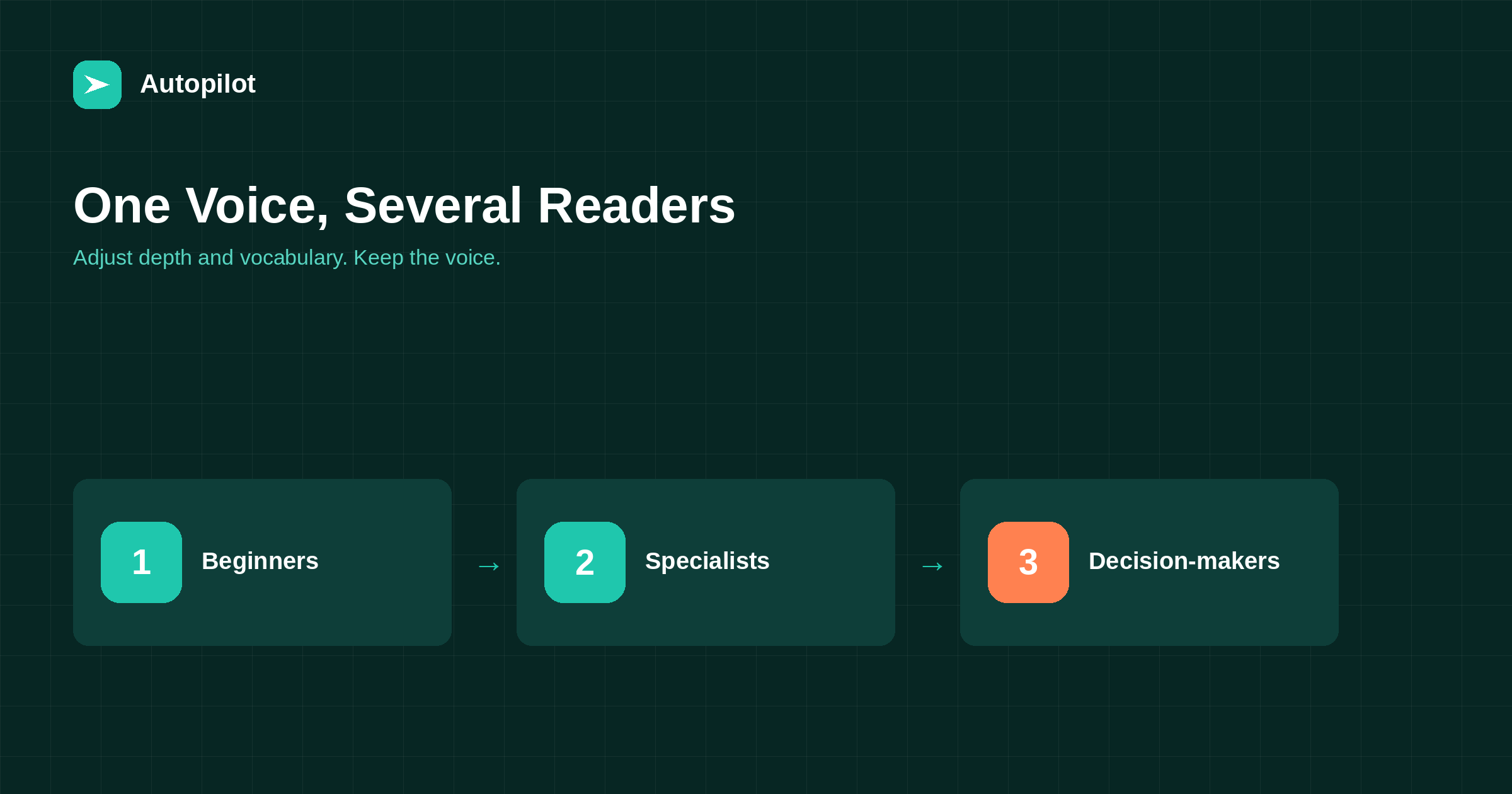
Short answer: keep the constant parts of your voice — values, directness, honesty, what you never say — the same for every reader, and adjust the variable parts: depth of explanation, technical vocabulary, formality and what comes first. Beginners need plain terms and more context; specialists need precise terms and less explanation; decision-makers need outcomes and trade-offs first. Record each reader profile in your instructions, and specify the reader in each brief so articles are pitched correctly.
A business blog often serves several kinds of reader: beginners discovering the subject, specialists looking for detail, managers deciding whether to buy. One tone rarely suits all of them.
The answer is not a different voice for each, which makes a blog feel inconsistent, but one voice with adjustable settings.
Constant and variable
Separate what stays the same from what changes.
| Constant | Variable |
|---|---|
| Honesty and directness | Depth of explanation |
| Values and positions | Technical vocabulary |
| What you never say | Formality |
| Clarity and plain language | What comes first |
| Respect for the reader | Length of context |
The constant column is your voice — writing down your brand voice. The variable column is tone, adjusted for each reader.
Writing for beginners
Beginners need terms explained, context provided, and steps spelled out. Assume intelligence, not knowledge. Avoid jargon or define it on first use, give examples, and link to foundational articles for readers who need more.
Writing for specialists
Specialists want precision and efficiency. Use correct technical terms without over-explaining, get to the substance quickly, and include the detail and edge cases a beginner would not need.
Over-explaining basics to specialists signals that the article is not for them.
Writing for decision-makers
Decision-makers need the conclusion, the costs and the trade-offs first, in business terms, with detail available for those who want it — writing for decision-makers.
Signalling the reader
Make the intended reader clear early: a sentence saying who the article is for helps readers decide whether it suits them. Beginner and advanced labels, or a note linking to a simpler or more detailed version, help readers find the right article.
Profiles in the instructions
Write a short profile for each main reader: what they know, what they want, what vocabulary suits them. Keep these alongside the voice guide.
In each brief, name the reader. That one field changes how an article is pitched, whether it is written by a person or drafted by a tool — writing a brief an AI can use.
Avoiding inconsistency
Adjusting tone should not change the business’s personality. A blog that is formal and cautious in one article and flippant in the next confuses readers. Read articles for different readers side by side occasionally; they should sound like the same business speaking to different people.
Plain language for everyone
Even for specialists, plain language is usually better than dense prose. Technical vocabulary is fine; convoluted sentences are not — readability.
An example of the same point three ways
Take the point that application passwords are safer than sharing an administrator login.
For a beginner: WordPress lets you create a separate password just for a tool, so you never share your own login; if you stop using the tool, you delete that password and nothing else changes. For a specialist: use an application password on a dedicated Editor-role account; it authenticates REST requests only and can be revoked independently. For a decision-maker: connecting the tool through a limited account means it cannot change site settings or users, and access can be removed in one click if you stop using it.
Same fact, same honesty, same plain style; different depth, vocabulary and emphasis.
Mixed audiences
Some articles must serve several readers at once. Lead with the answer in plain language, give the detail in clearly labelled sections, and let each reader take what they need. A short answer at the top serves decision-makers, a clear body serves beginners, and a detailed section or linked article serves specialists.
How to structure an article covers building articles that work for readers who skim and readers who read everything.
Tone in other languages
Formality conventions differ between languages and cultures. A direct, informal tone that suits one market may read as rude or overly casual in another. For multilingual blogs, the voice guide should include notes for each language on formality and forms of address, written by someone fluent in that culture.
Common mistakes
Two mistakes are especially common. Writing for beginners in a condescending tone, with phrases like as everyone knows or simply do this, which alienates the very readers it targets. And writing for specialists by adding jargon rather than depth, which makes articles harder without making them more useful.
Both come from confusing tone with vocabulary. Respectful, plain writing suits every reader; only the depth and technical precision should change.
Checking a draft’s pitch
Read the first three paragraphs of a draft and ask: who does this assume the reader is? If the answer does not match the brief, adjust before editing anything else. A draft pitched at the wrong reader needs restructuring, not polishing.
Common signs of a mismatch are definitions of terms the intended reader already knows, or unexplained terms the intended reader would not know.
Asking readers
Occasionally ask a reader from each group to read an article meant for them and say whether it felt pitched right. A few honest answers are more reliable than assumptions about what beginners or specialists want.
Separate articles for separate readers
When a subject matters to very different readers, separate articles often work better than one compromise: a beginner’s guide and an advanced guide, linked to each other. Each can be pitched precisely, and readers can move between them as their needs change. Make the relationship clear at the top of each, so a reader who landed on the wrong one can find the right one in a click.
Measuring fit
If beginner articles attract specialists who leave quickly, or specialist articles lose beginners, the pitch may be off. Engagement on articles aimed at different readers, and questions readers ask, show whether each is landing. Tone does not guarantee results; the right pitch makes articles useful to the readers they are meant for.
Related reading
If this was useful, these cover the questions that usually come next.
- Writing down your brand voice — the constant part
- Writing for decision-makers — one reader in detail
- Readability — plain writing for everyone
The bottom line
Keep the voice constant — honesty, directness, values, plain language — and adjust depth, vocabulary, formality and order for each reader. Write short reader profiles, name the reader in every brief, signal the intended reader early in each article, and check that articles for different readers still sound like the same business.
SSS
Can one brand voice suit different readers?
Yes, if the constant elements stay the same while depth, vocabulary and formality adjust.
How should I write for beginners?
Explain terms, provide context and examples, and assume intelligence rather than knowledge.
How should I write for specialists?
Use precise terms, get to substance quickly, and include detail and edge cases.
How do I tell automated drafts which reader to target?
Name the reader in each brief and keep reader profiles in the standing instructions.
Should articles say who they are for?
A sentence early on helps readers decide whether the article suits them.
How do I keep tone consistent across articles?
Compare articles for different readers side by side; they should sound like the same business.