ENEnglish
 LTLietuviškai
 DEDeutsch
 FRFrançais
 RUРусский
 ESEspañol
 PLPolski
 ITItaliano
 UKУкраїнська
 CSČeština
 PTPortuguês
 JA日本語
JA日本語 LVLatviešu valoda
 ETEesti
 HUMagyar
 IDBahasa Indonesia
 TRTürkçe
 HIहिन्दी
 ELΕλληνικά
 ARالعربية
 THไทย
THไทย VITiếng Việt
 RORomână
 MSBahasa Melayu
 BNবাংলা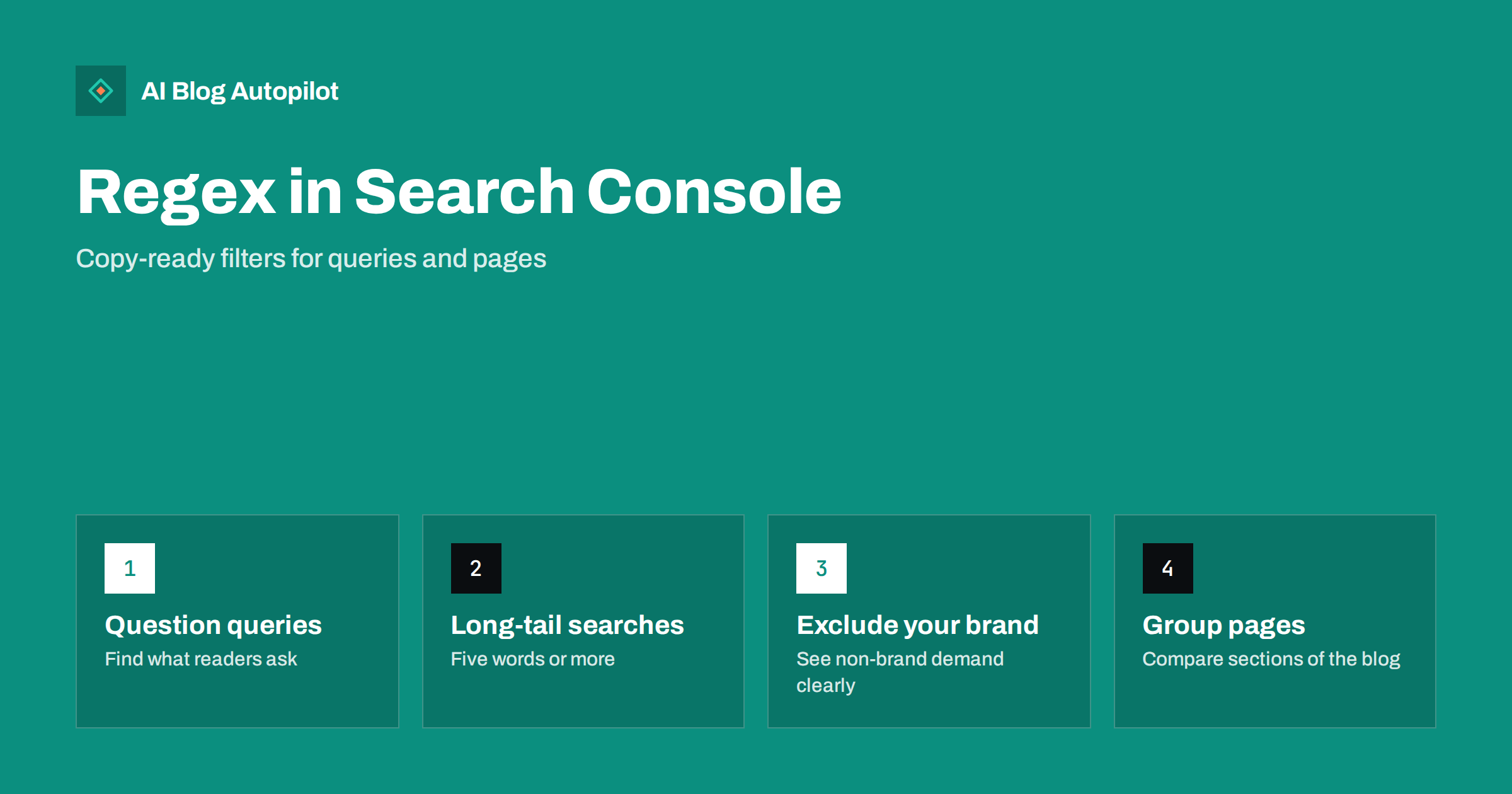
Short answer: the Performance report in Search Console lets you filter queries and pages with regular expressions (regex) by choosing “Custom (regex)” in the filter. That turns a long list of queries into focused views: questions people ask, long-tail searches, non-brand traffic, comparison queries or groups of pages. Search Console uses RE2 syntax, matches anywhere in the text unless you anchor the pattern, and is case-sensitive unless you add (?i) at the start.
Search Console’s query data is one of the most valuable free resources a blogger has, but the default table is a long list sorted by clicks. Useful patterns hide in it: dozens of question queries you have never answered directly, long specific searches that reveal exactly what readers want, and sections of your blog that quietly outperform others. Simple “contains” filters can only find one word at a time. Regex finds many at once.
You do not need to become a regex expert. This article explains the few rules that matter and gives you patterns you can paste and adapt.
Where regex works in Search Console
In the Performance report for search results, click “Add filter” (or the “+ New” button), choose Query or Page, and open the dropdown that normally says “Queries containing”. Select Custom (regex). You can then choose between “Matches regex” and “Doesn’t match regex” and paste a pattern.
A few things to know:
- Syntax is RE2. It supports the common features (alternatives with
|, groups, character classes, repetition) but not lookaheads or lookbehinds. - Matching is partial. A pattern matches if it appears anywhere in the query or URL. Use
^for “starts with” and$for “ends with”. - It is case-sensitive by default. Queries are usually lowercase, but URLs may not be. Adding
(?i)at the very start makes the pattern case-insensitive. - There is a length limit on patterns, so very long lists of alternatives may need to be split.
- Anonymised queries are not included. Rare queries are hidden for privacy, so totals under a query filter will be lower than the site total.
The five regex building blocks you need
Almost every useful Search Console pattern uses just these:
|means “or”:price|costmatches either word.( )groups alternatives:^(how|why)matches queries starting with “how ” or “why “.^and$anchor to the start and end.\bmarks a word boundary, so\bseo\bmatches “seo” but not “seoul”..*means “anything”, and{5,}means “five or more of the preceding item”.
With these five, you can build every recipe below.
If regex is new to you, test patterns on a small scale before relying on them. Apply the filter, look at the first twenty results and check that every one of them belongs there. Then switch to “Doesn’t match regex” with the same pattern and scan the top of that list for queries you expected to be included. Those two quick checks catch most mistakes, such as a missing word boundary or an alternative you forgot, and they build the confidence to use the filters in real decisions.
Five recipes bloggers use most
The following patterns cover the questions most bloggers ask of their data. Each one can be pasted as it is, and each is easy to adapt once you see how it is built.
Recipe 1: question queries
Questions are ideal material for FAQ sections, new articles and answer-first rewrites.
^(who|what|when|where|why|how|which|can|could|does|do|is|are|should|will)\b
This matches queries that start with a question word. Sort the results by impressions and look for questions with many impressions but few clicks: your page appears but does not clearly answer them. Those are the easiest wins, often solved by adding a direct answer under a question heading.
For example, a post about houseplant care might show “why are my monstera leaves turning yellow” with hundreds of impressions at position eight and almost no clicks. The article mentions yellow leaves in passing, but never answers the question directly. A new section headed with that question, opening with a two-sentence answer, is a small change that matches what searchers want.
A broader version also catches questions phrased mid-sentence:
\b(how to|what is|what are|why do|why does|can i|should i)\b
Recipe 2: long-tail queries
Long queries are specific, often show strong intent and are underserved by big sites. This pattern finds queries with at least six words:
^(\S+\s+){5,}\S+$
In plain terms, the pattern says: a run of non-space characters followed by spaces, repeated at least five times, then one final word. Change 5 to 4 for five words or more, or to 7 for eight or more. Reading the long-tail list for a key article is one of the fastest ways to discover sub-topics readers expect, which you can add as sections or FAQ entries.
Recipe 3: excluding your brand
Brand searches inflate numbers and hide how well you do for general topics. Use “Doesn’t match regex” with your brand and its common misspellings:
(?i)acme|acm e|acmee|acme\.com
The remaining queries show non-brand demand, which is the traffic your blog content actually earns. Save the comparison between brand and non-brand clicks month by month; it tells you whether the blog is bringing new people or mainly serving people who already know you.
Recipe 4: commercial and comparison intent
These queries indicate readers close to a decision, which usually matters most for a business blog.
- Comparisons:
\b(vs|versus|or|compared|comparison|alternative|alternatives)\b - Evaluation:
\b(best|top|review|reviews|recommended)\b - Cost:
\b(price|prices|pricing|cost|costs|cheap|free)\b
If commercial queries land on general blog posts, consider whether a dedicated comparison or cost article would serve them better, or whether the existing post needs a clearer section for that intent.
Recipe 5: grouping pages
Switch the filter to Page to compare sections of the blog or sets of articles.
- All blog posts in a folder:
/blog/ - Several specific articles:
/(keyword-clustering|search-intent|topical-authority)/ - Everything except the home page: “Doesn’t match regex” with
^https://example\.com/$ - Posts with a year in the slug:
/[a-z0-9-]*20[0-9]{2}[a-z0-9-]*/
Grouping pages by topic cluster lets you see whether a cluster is gaining or losing impressions as a whole, which is often more meaningful than tracking individual posts.
More useful patterns
| Goal | Filter | Pattern |
|---|---|---|
| Queries mentioning a year | Query, matches | \b20[0-9]{2}\b |
| Local intent | Query, matches | \b(near me|nearby|in [a-z]+)\b |
| Definitions | Query, matches | ^(what is|what are|meaning of|definition of)\b |
| How-to intent | Query, matches | \b(how to|guide|tutorial|step by step|steps)\b |
| Problems and errors | Query, matches | \b(not working|error|fix|problem|broken|issue)\b |
| Single-word queries | Query, matches | ^\S+$ |
Combining filters and comparing periods
Regex becomes more powerful when you combine it with the report’s other controls.
- Query plus page. Apply a question-query filter and a page filter for one article at the same time. You get the exact list of questions that article is shown for, which is an excellent outline for an update.
- Regex plus comparison dates. Use the date comparison mode with a filter applied, such as this quarter against the previous one, to see whether a type of query is growing. A growing share of question queries often signals that more searchers are looking for direct answers in your topic.
- Regex plus country or device. Filter long-tail queries by mobile only, for example, to see whether phone users search differently from desktop users.
- Two regex filters. You can use one filter that matches a pattern and another that excludes one, for example question queries that do not contain your brand.
Search Console does not save custom filters as named views, so keep your favourite patterns in a simple text file or spreadsheet. The URL of a filtered report includes the filter, so bookmarking the filtered page is another quick way to return to it. Once you have a small library of five or six patterns, a monthly review of your blog’s search data takes minutes rather than an afternoon.
Turning filtered data into actions
A filter is only useful if it leads to a decision. A simple routine for each recipe:
- Apply the filter and set the date range to the last three months.
- Show impressions, clicks, CTR and position.
- Sort by impressions and scan the top of the list.
- For each promising query, note which page ranks for it by switching to the Pages tab with the query filter still applied.
- Decide: add a section or FAQ answer to the existing page, improve the title for CTR, or plan a new article if no page fits the intent.
Export the filtered list to a spreadsheet if you want to work through it over several sessions. Revisit the same filters every month or quarter to see what changed.
Common mistakes with regex filters
- Forgetting partial matching.
seoalso matches “seoul” and “seoptimizer”. Use\bor anchors when it matters. - Using unsupported syntax. Lookaheads such as
(?!...)do not work in RE2. Use the “Doesn’t match regex” option instead. - Not escaping dots. In regex,
.means any character. Write\.for a literal dot in domains and file names. - Stray spaces. A space inside a pattern must match a space in the query. Trailing spaces copied by accident can make a filter return nothing.
- Reading totals as complete. Query filters exclude anonymised queries, so filtered totals are always partial.
How AI Blog Autopilot fits
AI Blog Autopilot plans articles around topics and keywords you define. On the Pro and Agency plans it can also import topics from Search Console, so queries your site already appears for feed directly into new articles. The regex views above are a good way to decide which themes to weight more heavily in your plan. See the Autopilot home page for what each plan includes.
Related reading
- Google Search Console: The Five Reports That Matter
- Using People Also Ask as a Content Source
- Long-Tail Keywords: Why a New Blog Should Start There
- Search Console vs Analytics: Why the Numbers Never Match
The bottom line
Regex filters turn Search Console’s long query list into focused views: questions, long-tail searches, non-brand traffic, commercial intent and groups of pages. Learn five building blocks, remember that matching is partial and case-sensitive, and use “Doesn’t match regex” instead of unsupported syntax. Then turn every filtered list into a concrete decision about a page.
FAQ
Does Search Console support regular expressions?
Yes. In the Performance report, add a Query or Page filter and choose Custom (regex). You can use “Matches regex” or “Doesn’t match regex”. The syntax is RE2.
Is the Search Console regex filter case-sensitive?
Yes, by default. Add (?i) at the start of the pattern to make it case-insensitive. This matters more for URL filters than for queries, which are usually lowercase.
How do I find question queries in Search Console?
Use a Query filter with the pattern ^(who|what|when|where|why|how|which|can|does|is|are|should)\b. Sort by impressions and look for questions with many impressions but few clicks.
Why does my regex filter return nothing?
Common causes are unsupported syntax such as lookaheads, a stray space, an unescaped dot, or anchors that are too strict. Test a simpler version of the pattern first, then add parts back one at a time.
Can I exclude several words at once?
Yes. Choose “Doesn’t match regex” and separate the words with a vertical bar, for example brand|brandname|brand\.com. Queries containing any of them are excluded.