ENEnglish
 LTLietuviškai
 DEDeutsch
 FRFrançais
 RUРусский
 ESEspañol
 PLPolski
 ITItaliano
 UKУкраїнська
 CSČeština
 PTPortuguês
 JA日本語
JA日本語 LVLatviešu valoda
 ETEesti
 HUMagyar
 IDBahasa Indonesia
 TRTürkçe
 HIहिन्दी
 ELΕλληνικά
 ARالعربية
 THไทย
THไทย VITiếng Việt
 RORomână
 MSBahasa Melayu
 BNবাংলা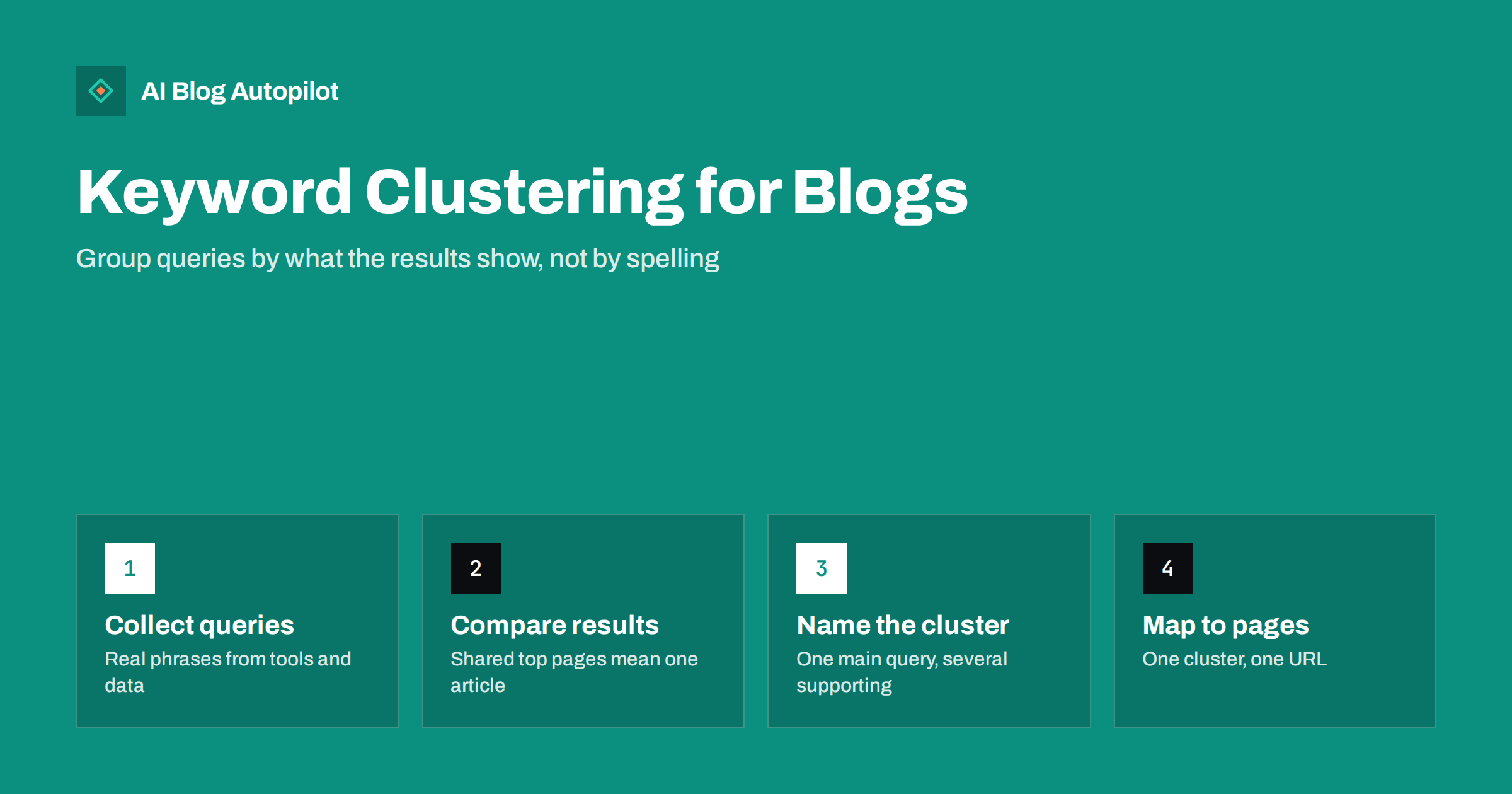
Short answer: keyword clustering means grouping search queries that can be satisfied by the same article, so you write one strong page instead of several thin ones. The most reliable way to decide whether two queries belong together is to compare their search results: if the same pages rank for both, one article can usually serve both. Group first, then assign each cluster to one URL, and only then start writing.
Keyword research tends to produce long lists. A few hundred phrases is normal even for a small niche, and many of them are variations of each other: singular and plural, different word order, questions and statements, with and without a location. Treat each phrase as its own article and you end up with a blog full of near-identical posts that compete with each other. Merge too aggressively and you miss queries that genuinely need their own page.
Clustering is the step between the raw list and the content plan. This guide explains how it works, which methods are worth using on a small blog, and how to turn clusters into a plan you can actually publish.
What a keyword cluster is, and what it is not
A keyword cluster is a set of search queries that share the same intent and are best answered by one page. For example, “how to clean a coffee grinder”, “cleaning a burr grinder” and “how often should you clean a coffee grinder” are different phrases, but a reader searching any of them wants roughly the same article. One well-structured guide can answer all three.
A cluster is not the same thing as a topic cluster or pillar structure, although the names are confusingly close. A topic cluster is a group of articles linked around a central page. A keyword cluster is a group of queries assigned to one article. You usually do keyword clustering first, and the resulting articles then become the building blocks of topic clusters.
It is also not simply grouping by a shared word. “Coffee grinder cleaning” and “coffee grinder reviews” share two words and almost nothing else. One is a how-to, the other a buying decision. Grouping by vocabulary alone is the most common clustering mistake.
Why clustering matters for a blog
There are three practical reasons to cluster before you write.
- It prevents your own posts from competing. When two articles target the same intent, search engines have to pick one, and the choice often flips between them. Neither ranks as well as a single combined page would.
- It makes each article more complete. The supporting queries in a cluster tell you what sub-questions readers have. Those become sections, FAQ entries and examples, which makes the page more useful and more likely to rank for the whole group.
- It shrinks the content plan to something realistic. A list of 300 phrases might become 60 clusters. Sixty articles is a plan. Three hundred near-duplicates is a problem you will have to clean up later.
Search engines are good at understanding that different phrasings mean the same thing. Writing a separate page for every variation is a habit left over from a time when that was less true. Today it mostly produces thin content.
Three ways to cluster keywords
There is no single official method. In practice, people use one of three approaches, often in combination.
1. Clustering by meaning
You read the list and group phrases that obviously mean the same thing. This is fast and works well for small lists, but it relies on your judgement, and judgement is where the vocabulary trap catches people. It is a good first pass, not a final answer.
2. Clustering by search results overlap
You look at the top results for each query and group queries whose results share several of the same URLs. If “burr grinder cleaning” and “how to clean a coffee grinder” return mostly the same pages, the search engine is telling you it treats them as one intent. This is the most reliable method because it uses the search engine’s own view rather than yours.
A common rule of thumb is to group two queries when three or more of their top ten results are shared. The exact threshold is a choice, not a law. A lower threshold creates bigger, broader clusters; a higher one creates smaller, tighter ones.
3. Clustering with tools
Many keyword tools now offer automatic clustering. Most of them use results overlap, sometimes combined with language similarity. They save time on large lists, but the output still needs a human check, because tools occasionally merge queries that look similar in the data but need different page types.
A step-by-step method for a small blog
You do not need an expensive tool to cluster a few hundred keywords. A spreadsheet and some patience will do.
- Collect and clean the list. Pull queries from a keyword tool, Search Console, People Also Ask boxes and your own customer questions. Remove obvious junk, brand names you cannot serve and exact duplicates.
- Sort by rough theme. Do a quick meaning-based pass so related queries sit next to each other. This makes the next step much faster.
- Check the results for the main candidates. For each group, search the two or three most important phrases in a private window and note the top results. If they largely match, keep the group together. If they diverge, split it.
- Check the page type. Even when URLs differ, look at what kind of pages rank: guides, lists, product pages, tools, videos. A query dominated by shop category pages probably does not belong in a blog article cluster at all.
- Pick a main query for each cluster. Usually the clearest phrase with the most demand. It guides the title and the H1. The rest become supporting queries that shape headings, sections and FAQ.
- Record the cluster in your plan. One row per cluster: main query, supporting queries, intent, page type and the URL it will live on (or already lives on).
Expect some queries not to fit anywhere. That is fine. Park them and revisit them when you have more data or more content.
How to tell whether two queries need separate articles
The hardest decisions are the borderline ones. These signals help.
| Signal | Suggests one article | Suggests separate articles |
|---|---|---|
| Top results | Several of the same URLs rank for both | Little or no overlap |
| Page type | Same format ranks (for example, guides) | Different formats (guide vs comparison vs product page) |
| Reader stage | Same stage of the decision | One is learning, the other is ready to buy |
| Answer length | One query is a sub-question of the other | Each needs a full article to answer properly |
| Audience | Same reader | Different reader (beginner vs professional) |
When the signals conflict, start with one article. It is easier to split a strong page later, once you see which queries it actually ranks for, than to merge two weak ones after they have been competing for months.
Common clustering mistakes
- Grouping by shared words. As mentioned above, shared vocabulary is a weak signal. Always check intent.
- Making clusters too large. A cluster with forty queries covering several intents produces a sprawling article that answers nothing well. If a cluster needs more than a handful of H2 sections just to mention each query, split it.
- Ignoring what already exists on your site. Before you plan a new article, check whether an existing post already covers the cluster. Often the right move is to expand that post, not to write a new one.
- Trusting tool output blindly. Automatic clusters are a starting point. A quick look at the actual results catches most errors.
- Clustering once and never again. Search results change. A query that shared results with another a year ago may have drifted. Recheck important clusters when you refresh content.
From clusters to a content plan
Once you have clusters, the content plan almost writes itself. Each cluster becomes one article, and the supporting queries form its outline. Clusters that relate to each other become candidates for internal links, and a group of related clusters around a broad subject becomes a hub or pillar structure.
Prioritise clusters by a mix of business relevance, realistic difficulty and total demand across all queries in the cluster, not just the main one. A cluster of ten small, specific questions can bring more qualified readers than one broad phrase with a big number next to it.
Keep a simple mapping sheet: cluster name, main query, URL, status (planned, drafted, published, needs update). This sheet is also your defence against accidental duplicates later. Before anyone writes a new post, they check the sheet.
How AI Blog Autopilot fits in
AI Blog Autopilot plans articles around the topics, keywords and audience you give it, and writes each one as a long-form article planned around a real search query, with FAQ, tags and SEO meta. That structure suits clustered planning: the main query drives the article, and related questions become sections and FAQ entries. You still decide which topics matter to your business; the tool handles the writing and publishing to your WordPress blog, and shares each article to your social networks. You can see how Autopilot plans and publishes articles on the home page.
Related reading
- How Many Keywords Should One Article Target?
- Search Intent: The Four Types and What Each Needs
- Content Clusters and Pillar Pages, Explained Simply
- Keyword Research for an Automated Blog
The bottom line
Keyword clustering turns a long list of phrases into a short list of articles. Group queries by what the search results show, not by shared words, give each cluster one main query and one URL, and use the supporting queries to build a more complete article. The result is fewer, stronger posts that do not compete with each other.
FAQ
What is keyword clustering in SEO?
Keyword clustering is grouping search queries that share the same intent so that one page can target all of them. Instead of writing a separate article for every variation of a phrase, you write one complete article for the whole group.
How do I know if two keywords belong in the same cluster?
Search both and compare the top results. If several of the same pages rank for both queries and the page types match, one article can usually serve both. If the results and formats differ, they likely need separate pages.
Do I need a paid tool to cluster keywords?
No. For a few hundred phrases, a spreadsheet plus manual checks of the search results works well. Tools save time on large lists, but their output still needs a human review.
How many keywords should be in one cluster?
There is no fixed number. A cluster is the right size when one article can answer every query in it without becoming unfocused. If you need many unrelated sections to cover it, split the cluster.
What is the difference between a keyword cluster and a topic cluster?
A keyword cluster is a group of queries assigned to one article. A topic cluster is a group of related articles linked around a central pillar page. Keyword clusters are the building blocks; topic clusters are how those articles connect.