ENEnglish
 LTLietuviškai
 DEDeutsch
 FRFrançais
 RUРусский
 ESEspañol
 PLPolski
 ITItaliano
 UKУкраїнська
 CSČeština
 PTPortuguês
 JA日本語
JA日本語 LVLatviešu valoda
 ETEesti
 HUMagyar
 IDBahasa Indonesia
 TRTürkçe
 HIहिन्दी
 ELΕλληνικά
 ARالعربية
 THไทย
THไทย VITiếng Việt
 RORomână
 MSBahasa Melayu
 BNবাংলা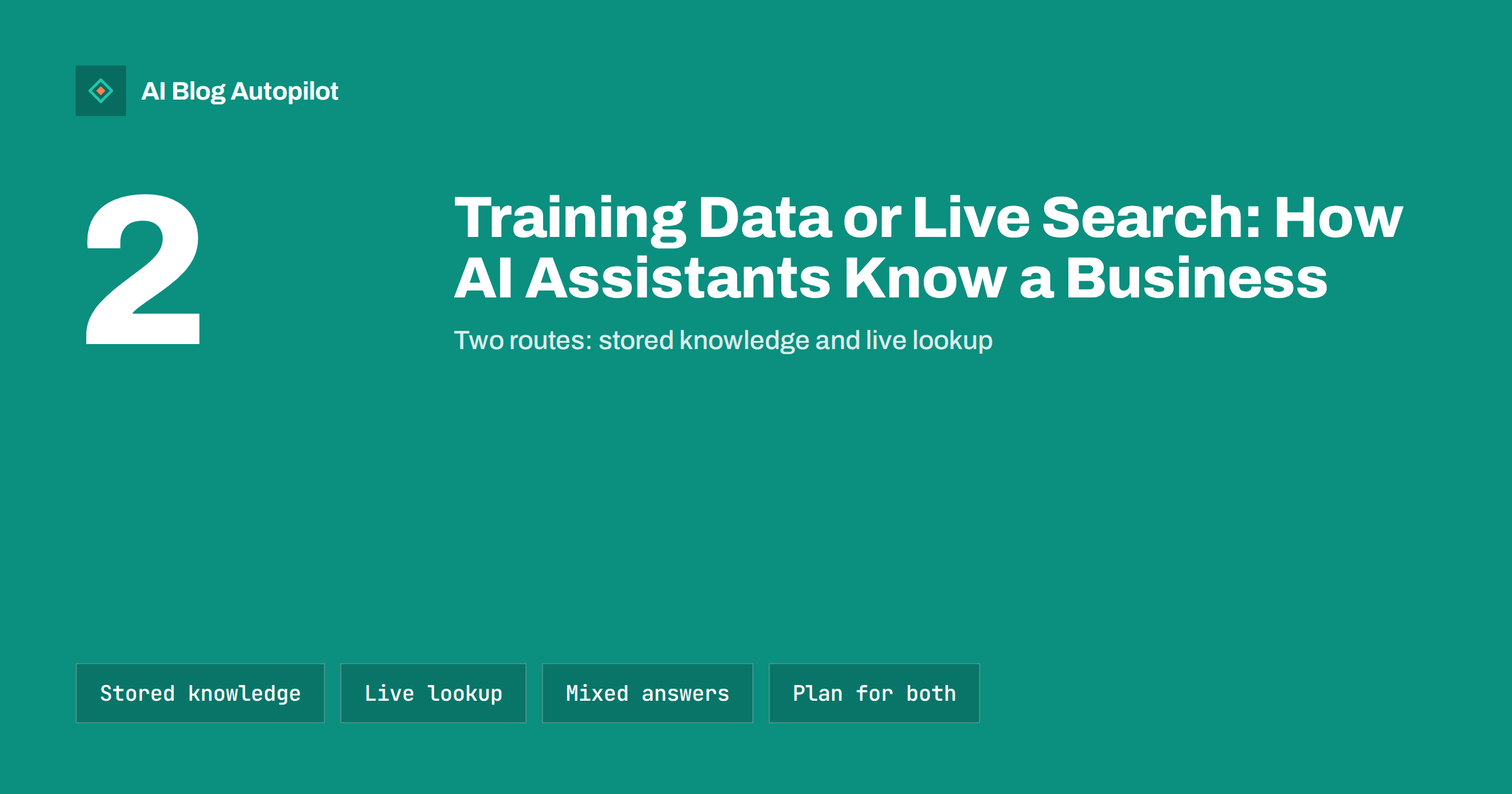
Short answer: an AI assistant can know about your business in two broad ways. It may have absorbed information from text collected before a cutoff date, which changes only when the system is rebuilt, or it may look things up on the web while it answers, which can reflect a page you changed recently. Most assistants mix the two, and the mix differs by product and by question. So keep your public pages accurate and consistent, expect live changes to appear sooner than stored knowledge, and test with real questions.
When a customer asks an assistant about your company, the answer can come from very different places. Understanding the two routes explains several things that puzzle site owners: why an old address still appears months after a fix, why one assistant quotes a new page while another does not, and why the same question gets different answers on different days. This article explains the routes in plain language, what each one means for your content and how to plan updates, without pretending that anyone outside these systems knows exactly how they work.
Route one: knowledge learned in advance
Language models are built from very large collections of text. During that process they pick up patterns and facts, including some about businesses, products and people. The collection stops at a point in time, often called the cutoff, and anything published after it is unknown to the model unless it is supplied another way.
This has several consequences for a business.
- Old facts can persist. If your prices, address or product range changed after the cutoff, the stored version may be out of date.
- Small businesses may be thin or missing. A company with little written about it elsewhere leaves little for a model to learn, so the model may know nothing or may confuse it with another.
- You cannot edit the stored knowledge directly. Changes come only with later versions, on a schedule you do not control.
- Confident wrong answers happen. When a model lacks facts it may produce a plausible guess. That is a known limitation, not a sign that your site is at fault.
The practical lesson is to make the public record about you clear and consistent over time, so that any future collection of text describes you correctly.
Route two: looking things up while answering
Many assistants and search features can fetch pages while producing an answer. They search, read a few results, and write a response that may cite them. In this route your current pages matter directly, because the system reads what is there now.
- Freshness is possible. A corrected page can be used in answers soon after it is crawled or fetched, though the time varies and cannot be guaranteed.
- Ranking and retrievability matter. The page must be reachable, readable without special steps and relevant to the question, much as in ordinary search.
- Clear passages help. Sections that answer a question on their own are easier to lift into a response.
- Blocked pages are invisible. If a page needs a login, hides its text behind scripts, or is disallowed to crawlers, a live lookup will not see it.
Whether a given assistant uses lookup at all depends on the product, the settings and the question. Some questions are answered from stored knowledge alone.
Why answers are often a mixture
In practice an answer can combine both routes. The model may recall a general description of your industry from its stored knowledge, then add details from a page it just read. If the two disagree, the result can be confusing: an outdated name in one sentence and a current price in the next.
That is why consistency matters. If your site, your directory listings and your social profiles all state the same facts, whichever route supplies them gives the same answer. If they conflict, a mixture can reproduce the conflict.
- Use the same business name, address, description and key facts everywhere you appear.
- When something changes, update the source pages first, then the third-party listings you control.
- Keep older pages that mention outdated facts either updated or clearly dated, so that a lookup does not present them as current.
What you can influence, and what you cannot
It helps to separate the levers into those you hold and those you do not.
- You can influence: the content and structure of your own pages, whether crawlers can reach them, the accuracy of listings you control, and the clarity of the facts you publish.
- You can partly influence: what other sites say about you, through honest outreach, corrections requests and good work that earns mentions.
- You cannot influence: the cutoff of a model, which sources a given assistant prefers, or how quickly it refreshes.
Spend effort on the first group, be patient with the second, and do not pay for anyone’s promises about the third. No one outside the providers can guarantee that you will be named in an answer.
How to write pages that work for both routes
Good pages serve a model that may learn from them later and an assistant that may read them today. Several habits do both.
- State facts in plain sentences. “We are a family-run bakery in Kaunas that opened in 2012” is easier to learn and to quote than a slogan.
- Put the main facts on stable pages such as an About page and a contact page, and keep them current.
- Date what is time-sensitive. Prices, offers and statistics should show when they were true.
- Use headings that match real questions, so a passage can stand alone.
- Add structured data where it fits, since it states facts in a machine-readable form, but keep it identical to what the page shows.
- Avoid contradictions between pages. Two pages that give different opening hours teach the wrong thing and invite a mixed answer.
Planning updates around the lag
Because the routes move at different speeds, a change takes effect in layers. A good plan accepts that and sequences the work.
- Day one: fix your own pages and listings. Check that the pages load, can be crawled and show the new facts.
- First weeks: use the tools search engines provide to request a fresh crawl of important pages, and ask a few real questions to see whether live answers have changed.
- Following months: request corrections from third-party sites that repeat the old fact, and keep the new fact visible in fresh content.
- Longer term: accept that stored knowledge will update only when the systems are rebuilt, and keep the record consistent until then.
Keep a short log of what you changed and when. If an answer is still wrong after a few weeks, the log helps you see whether the fix has simply not propagated or whether a source you missed is repeating the error.
Testing what assistants say about you
You do not need special tools to see where you stand. Ask a few assistants questions a customer might ask: who you are, what you offer, where you are, how much it costs and how you compare with a named alternative. Record the date, the question and the answer, and note whether the system cited sources.
- Repeat the same set monthly, so that you see trends and not single results.
- Look at the cited pages. If they are old or from third parties, that tells you where to work.
- If no sources are cited and the answer is vague, the system may be relying on stored knowledge, and fixing your pages will not show up immediately.
- Do not over-react to a single odd answer. Variation is normal.
Common misunderstandings
A few beliefs about how assistants learn lead site owners to waste effort or to worry unnecessarily.
- “If I publish it, the assistant knows it at once.” Only a live lookup can use a page quickly, and only when the system decides to look. Stored knowledge does not update when you publish.
- “A special file will fix it.” Files that describe your site to crawlers can help systems that choose to read them, but no file forces an assistant to use your version of the facts.
- “One wrong answer means my site is broken.” Wrong answers often come from gaps in the available information, not from errors on your pages.
- “Paying for a listing guarantees a mention.” Listings can help the record, but no payment guarantees how an assistant describes you.
- “All assistants behave the same.” They differ in sources, settings and refresh patterns, so test more than one.
Keeping these in mind makes it easier to focus on work that pays off: accurate pages, consistent facts and steady, useful publishing.
How AI Blog Autopilot helps
AI Blog Autopilot publishes new articles with a FAQ, tags and SEO meta on a steady schedule, so your site keeps producing clear, current text that both routes can use. It is instructed never to make up statistics, quotes or sources, but it cannot know your private business facts, so state them on your own pages and keep them current. A content map shows what has been published and where. See the pricing page for plans.
Related reading
- How AI Search Picks Which Pages to Cite
- Entities and AI Search: Making Your Business Easy to Understand
- When AI Answers Get Your Business Wrong: What to Do
- Checking Whether AI Assistants Mention Your Blog
The bottom line
An assistant may know your business from text gathered before a cutoff, from pages it reads while answering, or from both. Stored knowledge changes slowly and outside your control, while live lookups can use your current pages. Keep your facts accurate, consistent and easy to read, sequence your updates, test with real questions on a regular schedule and avoid anyone who promises guaranteed mentions. Clear public information is the one thing that helps in every case.
FAQ
Why does an AI assistant still show my old address?
It may be relying on stored knowledge from before the change, or on an old page or listing it found. Update your own pages and listings, then check again after a few weeks.
Can I make an assistant use my newest page?
Not directly. You can make sure the page is crawlable, clear and linked, but each assistant decides what to read and cite.
Do all AI assistants search the web?
No. Some do, some only when asked or only for certain questions, and some answer from stored knowledge alone. Behaviour differs and changes over time.
What is a training cutoff?
It is the point in time after which a model has seen no new text during its building. Anything published later is unknown to it unless supplied in another way, such as a live search.
How often should I test what assistants say about my business?
Monthly is enough for most small businesses. Use the same questions each time and record the date, the answer and any cited pages.