ENEnglish
 LTLietuviškai
 DEDeutsch
 FRFrançais
 RUРусский
 ESEspañol
 PLPolski
 ITItaliano
 UKУкраїнська
 CSČeština
 PTPortuguês
 JA日本語
JA日本語 LVLatviešu valoda
 ETEesti
 HUMagyar
 IDBahasa Indonesia
 TRTürkçe
 HIहिन्दी
 ELΕλληνικά
 ARالعربية
 THไทย
THไทย VITiếng Việt
 RORomână
 MSBahasa Melayu
 BNবাংলা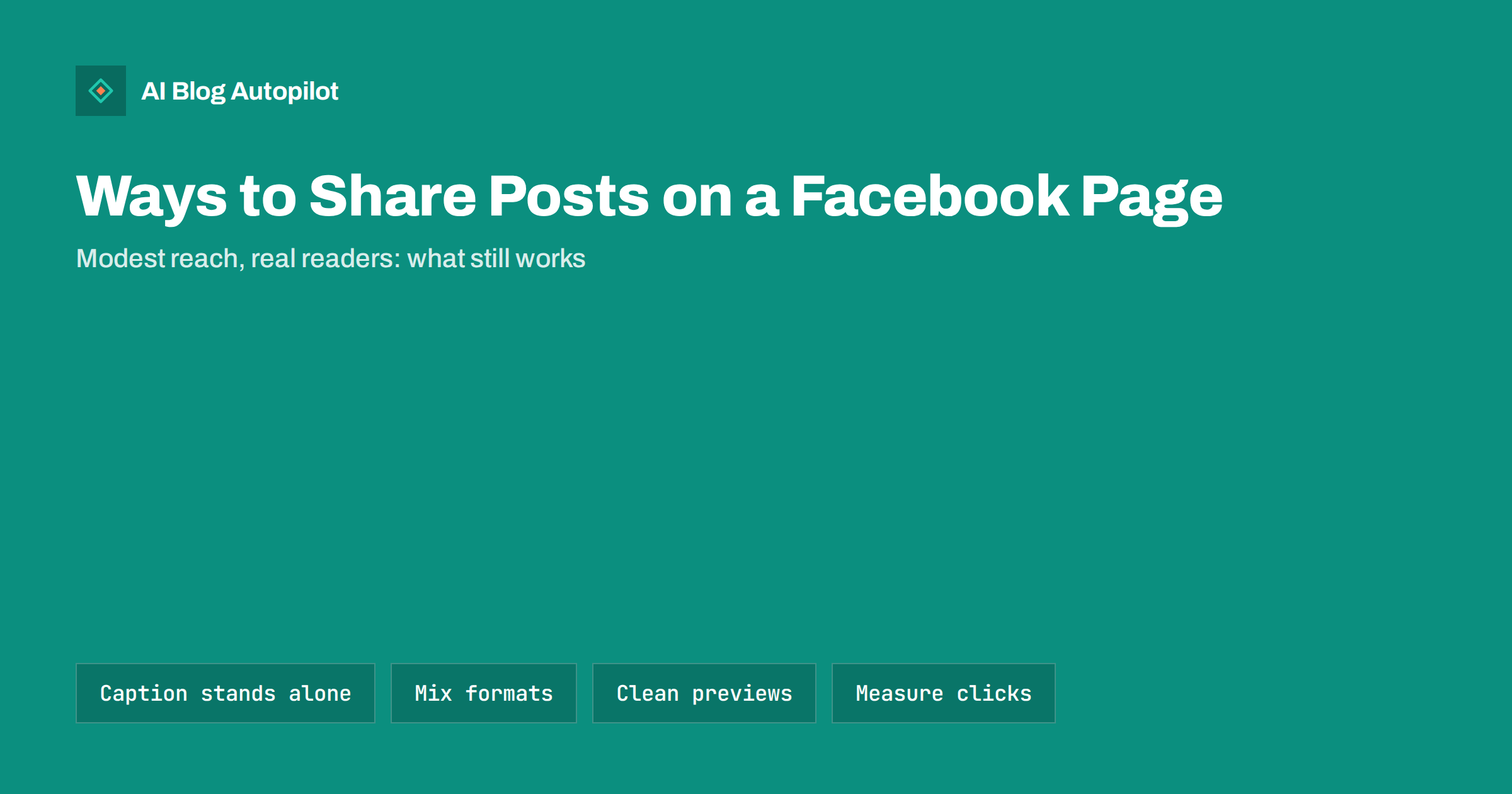
Short answer: a Facebook Page can still send readers to a blog, but organic reach is usually modest, so each post has to earn attention on its own. Write a caption that gives value before the link, make sure the link preview shows the right image and title, mix link posts with image, text and short video posts, and post consistently rather than in bursts. Measure clicks with tagged links and Page insights, and avoid engagement bait, which Facebook actively demotes.
Many business blogs have a Facebook Page that was set up years ago and now receives an automatic link every time a post is published. The numbers are often discouraging: a handful of reactions, a few clicks. It is tempting to conclude that Facebook no longer works for blogs. The more accurate conclusion is that it no longer works on autopilot with no thought behind the posts.
This article covers what realistically works when sharing blog posts on a Facebook Page, for small businesses, bloggers and agencies managing client Pages.
Set realistic expectations
Organic reach for Pages, meaning how many followers see a post without paid promotion, is typically a small share of the follower count. Facebook’s feed prioritises content from friends, groups and posts people interact with, and it has been open about showing more recommended content from accounts people do not follow.
That has two practical consequences for bloggers:
- Follower count matters less than it used to. A useful post can reach people who do not follow you, and a weak post may not reach most of your followers.
- Each post is judged on its own. Early interaction, how long people look at it and whether they click all influence how far it travels.
Facebook is rarely the largest source of blog traffic for a small business, but for some audiences, such as local customers, hobby communities and older demographics, it remains an important one. Check your analytics before deciding how much effort it deserves.
Write a caption that works without the click
The most common mistake is posting a link with the article title and nothing else. The preview already shows the title; repeating it adds nothing. A good caption gives the reader a reason to stop scrolling and, ideally, something useful even if they never click.
- Lead with the most interesting point. A surprising fact from the article, a common mistake, a clear answer to a question your readers have.
- Speak to one reader. “If your tomato leaves are curling in August, it is probably not a disease” is better than “Check out our latest gardening article”.
- Keep it short. Two to four lines usually fit before the “See more” cut-off on mobile. Put the hook in the first line.
- Give a small takeaway. One practical tip in the caption builds trust and makes the post worth interacting with.
- End with the link and a plain reason to click. “The full guide covers the three other causes and how to tell them apart.”
Here is the difference in practice. A weak caption: “New on the blog: How to Choose Running Shoes.” A stronger one: “Most running shoe problems start in the shop, not on the road: people buy for the foot they have standing still, not the one they have after five kilometres. Shop in the afternoon, when your feet are at their largest, and bring the socks you run in. Our guide covers the four other checks that prevent sore toes and blisters.” The second caption is useful on its own, shows expertise and gives a concrete reason to read more.
Get the link preview right
For link posts, the preview card does much of the work. Facebook builds it from your page’s Open Graph tags.
- Use a strong featured image in a landscape format that crops well. Images with a clear subject work better than generic stock photos or logos.
- Check the title and description the card shows. They come from your SEO settings; make sure they read well outside search results too.
- Test new posts in Facebook’s Sharing Debugger if the preview looks wrong, and ask it to scrape again after changes.
- Do not share before the post is finished. Facebook caches the first version it sees.
Mix formats instead of posting only links
A Page that posts nothing but links trains its audience to scroll past. Blog content can be turned into several formats that feel native to Facebook:
| Format | How to make it from a blog post | Best for |
|---|---|---|
| Link post | Strong caption plus the article link and preview | Driving clicks to the article |
| Image post | One key tip, checklist or chart from the article as an image, with the link in the caption | Reach and saves |
| Text post | A short opinion or question drawn from the article | Comments and discussion |
| Short video (Reels) | A 20 to 60 second walk-through of one tip | Reaching people who do not follow you |
| Carousel or album | Steps or examples, one per image | How-to content |
You do not need to use every format for every article. A simple rhythm, such as a link post on publication day and an image or text post from the same article a week later, already doubles the article’s chances of being seen.
Timing and frequency
There is no universal best time. Your Page insights show when your followers are online, and that is a better guide than any general chart. Beyond that:
- Be consistent. A few good posts every week tend to work better than a burst of posts one week and silence the next.
- Do not post several links in a row. Space out posts so each one gets its chance.
- Reshare evergreen articles. An article that was useful last year is still useful now. Share it again with a new caption and angle, a few months apart.
- Leave a gap after publishing. Sharing an hour or two after the post goes live gives you time to check the page and the preview.
Groups, comments and conversation
Facebook groups are often where real discussion happens. Sharing your articles there can work, but only on the group’s terms.
- Read the rules. Many groups ban self-promotion or allow it only on specific days or threads.
- Contribute first. Answer questions in the group; share an article only when it genuinely answers something someone asked.
- Reply to comments on your own Page. Early replies keep a conversation going and show readers a real person is there.
A simple weekly routine for a small Page
If you manage a Page alongside everything else, a light routine keeps it active without taking over your week.
- Publication day: share the new article as a link post with a strong caption, checked preview and tagged link.
- Two or three days later: post one tip from the same article as an image or text post, with the link in the caption.
- Once a week: reshare one older evergreen article with a fresh angle, for example tied to the season or a question a customer asked.
- Every day or two: spend five minutes replying to comments and messages.
- Once a month: review link clicks by post and adjust the mix of formats and topics.
That is three or four posts a week from a single new article plus your archive, which is enough to keep a small Page visible without producing content specially for Facebook.
Tactics to avoid
- Engagement bait. Posts that ask people to “like if you agree” or “tag a friend” to boost reach are demoted by Facebook.
- Clickbait captions. Withholding the point to force a click tends to backfire, both with readers and with how the feed treats your posts.
- Identical posts everywhere. Copying the same text to every network ignores how each audience reads. Adapt the caption for Facebook.
- Hashtag walls. A long list of hashtags looks spammy on Facebook and adds little. One or two relevant tags are plenty, if any.
- Buying likes or followers. It inflates numbers with people who will never read your posts and can hurt reach.
Measure what matters
Reactions are pleasant, but for a blog the key question is whether Facebook brings readers who stay. Two sources help:
- Page insights in Meta Business Suite show reach, interactions and link clicks for each post.
- Your analytics shows what visitors from Facebook did on your site. Add UTM parameters to the links you share so these visits are clearly attributed.
Once a month, list your five best-performing posts by link clicks and look for patterns in topic, format and caption style. Do more of what worked.
How AI Blog Autopilot helps
AI Blog Autopilot shares every new article to your connected networks, including Facebook, with text written for each network rather than a bare link. With AUTO timing, Facebook gets its post about two hours after the article appears on your blog, and higher plans include evergreen reshares of older articles. If a post fails, for example because a connection needs renewing, the content map shows why. Without a website, Autopilot can also create native social posts on its own. See how Autopilot shares your articles.
Related reading
- Turning an Article Into Social Posts That Get Read
- Auto-Post Every New Blog Article to Social Media Automatically
- Repurposing an Article: One Piece, Several Formats
- Link Preview Not Updating? Fixing Stale Social Share Cards
The bottom line
Facebook Pages no longer reward automatic, caption-free link posts, but thoughtful sharing still brings readers. Write captions that give value first, check the preview, mix formats, post consistently, take part in relevant groups on their terms and measure clicks rather than likes. Keep your expectations realistic and let your analytics decide how much effort Facebook deserves.
FAQ
Is it still worth sharing blog posts on a Facebook Page?
For many audiences, yes, especially local businesses and hobby communities, but organic reach is usually modest. Check how much traffic Facebook sends in your analytics and invest effort accordingly.
Should I put the link in the post or in the comments?
Both approaches are used, and there is no official guidance favouring one. A link in the post gives a clear preview card and is simpler for readers. Test both with your own audience and compare link clicks in your insights.
How often should a blog post to its Facebook Page?
Consistency matters more than volume. A few good posts a week, spaced out and mixing formats, usually work better than many links in a short burst.
Why does my Facebook post show the wrong image?
Facebook reads the Open Graph image from your page and caches it. Check the og:image tag, clear your site cache, then use the Sharing Debugger to scrape the page again.
Do hashtags help on Facebook?
They play a much smaller role on Facebook than on some other networks. One or two relevant hashtags are fine; long lists look spammy and rarely add reach.