ENEnglish
 LTLietuviškai
 DEDeutsch
 FRFrançais
 RUРусский
 ESEspañol
 PLPolski
 ITItaliano
 UKУкраїнська
 CSČeština
 PTPortuguês
 JA日本語
JA日本語 LVLatviešu valoda
 ETEesti
 HUMagyar
 IDBahasa Indonesia
 TRTürkçe
 HIहिन्दी
 ELΕλληνικά
 ARالعربية
 THไทย
THไทย VITiếng Việt
 RORomână
 MSBahasa Melayu
 BNবাংলা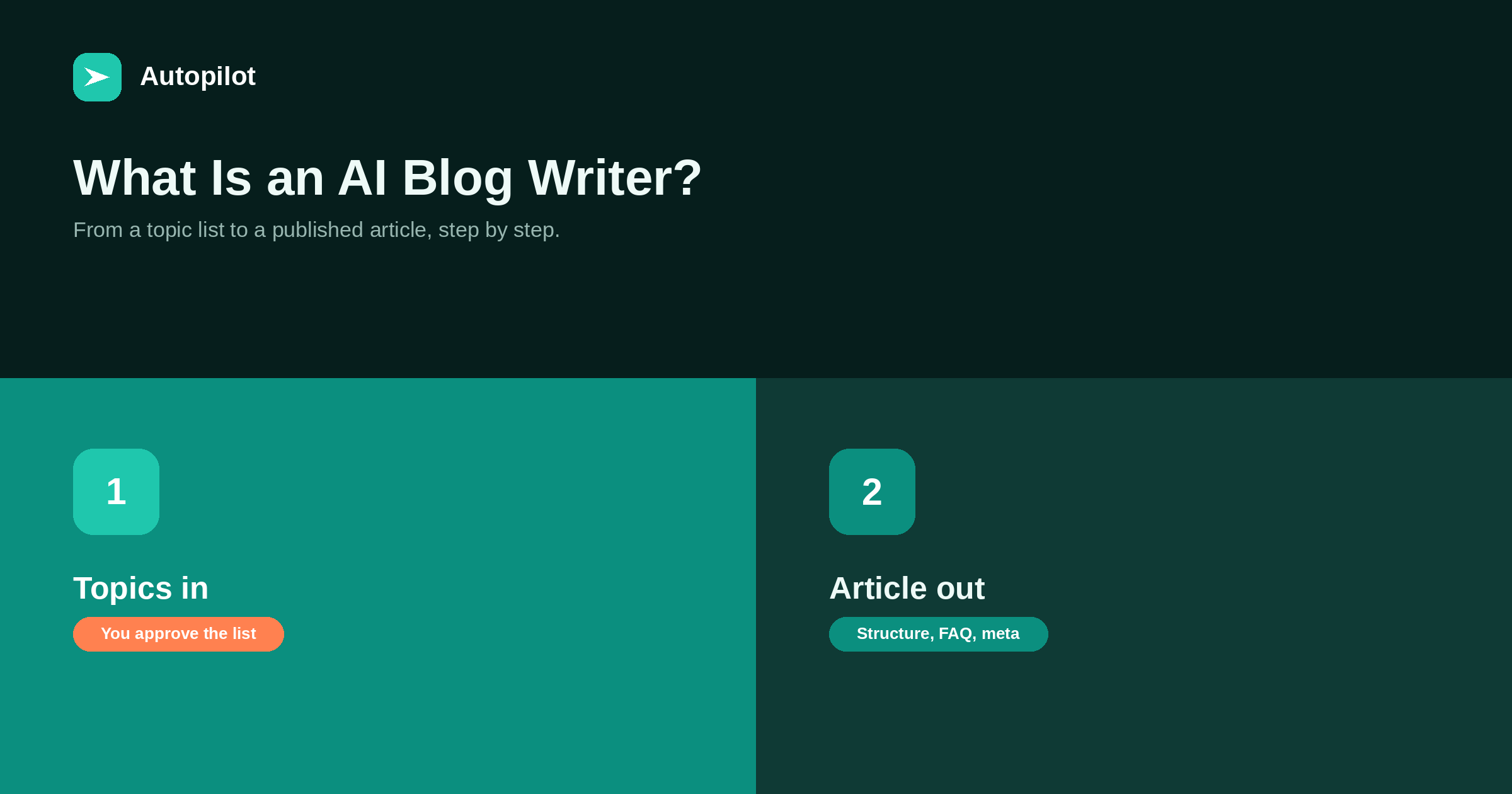
Short answer: an AI blog writer is software that turns an approved topic into a structured article and publishes it, usually to a website and to social accounts. It does not choose what your business should be known for, and it does not verify claims about your product, prices or industry. Everything it produces is downstream of the topic list and the brief you give it, which is why those two things decide the quality of the result more than the tool does.
"AI blog writer" covers tools that do very different amounts of work. Some produce a draft you paste somewhere. Others run the whole pipeline: topic, article, image, publication, distribution. Knowing which kind you are evaluating matters more than any feature list.
This is a plain description of how the full pipeline works, what each step involves, and where a person has to stay in the loop.
The pipeline, step by step
Every automated blog runs through the same stages, whichever tool you use.
- A topic enters the queue. From a list you approved, from search data, or from someone adding one by hand.
- The brief is assembled. The question, the audience, the tone, the length, any rules about what not to say.
- The article is drafted. Structure first, then sections, then the FAQ and the meta description.
- An image is produced or chosen. A featured image so listings and social cards are not blank.
- It is published. To a CMS as a live post or a draft, depending on your review setting.
- It is distributed. Shared to the social accounts you connected.
Steps three and four are what people picture when they hear "AI writer". Steps one, two, five and six are where most of the time saving actually is.
What the software decides
Inside a single article, the tool makes real decisions: how to structure the piece, which sub-questions deserve sections, how to phrase headings, what belongs in the FAQ, how to write the meta description, and which internal links make sense.
These are craft decisions, and they are the ones that make a piece feel organised or shapeless. They are also the ones a competent tool makes consistently, which is its main advantage over a tired human at the end of a week.
What it cannot decide is whether the topic was worth writing. That judgement comes from knowing your customers, and it is the reason planning a month of articles matters more than prompt wording.
What it should never decide
Three categories belong to a person, permanently.
Claims about your own product. Features, limits, prices and availability change, and a confident wrong sentence about your own service is worse than no sentence.
Specific figures. Statistics, study results, dates and quotes are the most checkable part of any article and the least reliable part of a generated draft. Either they come from a source you can link or they come out.
Anything regulated. Medical, legal and financial guidance needs a qualified person, whatever produced the first draft.
Draft tools and pipeline tools
The practical difference between the two categories, since the marketing rarely makes it obvious.
| Draft tool | Pipeline tool | |
|---|---|---|
| Produces | Text in an editor | A published, illustrated post |
| Topic source | You type one each time | An approved topic list |
| Publishing | Manual copy and paste | Direct to the CMS |
| Images | You find one | Generated per article |
| Distribution | You post it | Automatic to connected accounts |
| Fits | Occasional writing | A blog with a schedule |
Neither is better in the abstract. If you publish twice a month and enjoy the writing, a draft tool is enough. If the problem is that nothing gets published at all, a draft tool does not solve it, because the missing step was never the typing.
How Autopilot fits the description
AI Blog Autopilot is a pipeline tool. It writes 2,000–3,000-word articles with an FAQ section and a meta description, publishes them to WordPress, and shares each one to your social accounts, with the publishing side handled by PostRSS. Content is written natively in 25 languages rather than translated, and it works without a website if social posts are all you need.
The first three articles are free, which is the sensible way to judge it: run them on subjects you know well, where you will notice a weak paragraph. Plans, monthly article limits and which features come with each tier are on the pricing page. Everything in automating a blog without losing quality about keeping judgement on your side of the line applies here too.
What to check in the first month
Whatever tool you choose, the first month is an evaluation rather than a routine. Four things are worth watching deliberately.
Does it repeat itself? Read the first ten articles together rather than one at a time. Overlap between two pieces is far easier to see side by side, and it is the failure that compounds fastest.
Are the specifics right? Check every number, date and product claim in those ten. If the error rate is zero, sampling afterwards is reasonable; if it is not, the brief needs the missing facts adding to it.
Does it sound like you? Voice drifts quietly. Reading a published article next to something you wrote yourself usually settles the question in a minute.
Did anything actually reach an audience? Publication is not distribution. If the social side is not connected, half the value is sitting unused.
Where the time actually goes
A useful way to judge any of this: count what you stopped doing. Most teams find the saving is not in the writing at all but in the surrounding steps — choosing a subject under deadline, reformatting, writing the description nobody enjoys, and remembering to share the thing once it is live. Those are small individually and consume most of the week in aggregate. If a tool removes the writing and leaves those in place, it has solved the part that was never the bottleneck.
The bottom line
An AI blog writer is a pipeline, not a personality. It turns approved topics into structured, published, distributed articles, and it does that consistently in a way tired humans do not. What it cannot do is decide what deserves writing or vouch for a fact. Keep those two on your side, hand over the rest, and the arrangement works.
FAQ
Is an AI blog writer the same as a chatbot?
No. A chatbot answers you in a conversation. A blog writer runs a pipeline: topic, article, image, publication and distribution, usually without anyone watching.
Do I still need to edit the articles?
Read them, certainly, at least at first. Edit where a claim is specific or where the tone drifts. Many teams move from editing everything to sampling once they see the pattern.
Can it write about my industry?
For explanatory topics, generally yes. For anything depending on current internal facts, it needs those facts supplied rather than assumed.
What happens if it gets something wrong?
You correct the article, as you would any other. The lasting fix is to add the correct fact to the brief so future articles inherit it.
Does it need a website?
Not necessarily. Autopilot can publish only to social accounts, which suits brands with no site at all.
How many articles can it produce?
As many as the plan’s monthly credits allow. The real limit is how many distinct questions your audience has, which is covered in planning a month of articles.