ENEnglish
 LTLietuviškai
 DEDeutsch
 FRFrançais
 RUРусский
 ESEspañol
 PLPolski
 ITItaliano
 UKУкраїнська
 CSČeština
 PTPortuguês
 JA日本語
JA日本語 LVLatviešu valoda
 ETEesti
 HUMagyar
 IDBahasa Indonesia
 TRTürkçe
 HIहिन्दी
 ELΕλληνικά
 ARالعربية
 THไทย
THไทย VITiếng Việt
 RORomână
 MSBahasa Melayu
 BNবাংলা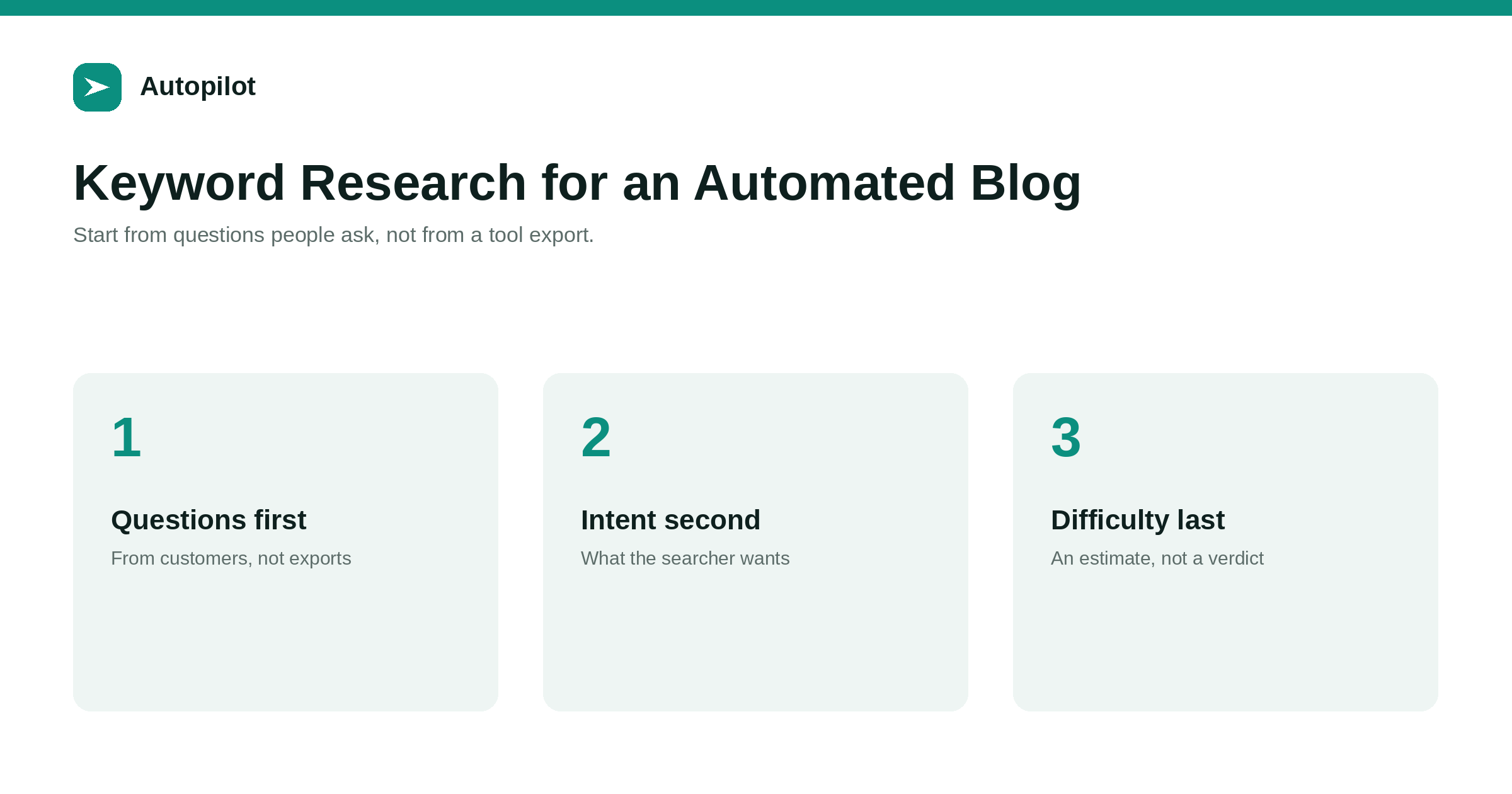
Short answer: start from questions your customers actually ask, then use tools to check whether anyone else asks them and how hard the query is. Reverse that order and you get a list of phrases with volume and no connection to your business. Read intent before difficulty: a query where people want to buy and a query where they want to understand need different articles, and mixing them is why some well-optimised pages never convert anything.
Keyword research has a reputation for being mechanical, which is why it so often produces mechanical blogs. A tool exports two thousand phrases, someone sorts by volume, and a content calendar appears that nobody in the business recognises.
The version that works runs the other way round, and it matters more when publishing is automated, because volume amplifies whatever the list contains.
Start with questions, not exports
Before opening any tool, write down every question you have been asked: in sales calls, in support, by a friend who did not understand what you do. Most businesses reach forty to a hundred before running dry.
This list has a property no export has: every item came from a person who wanted to know. Some will have search volume and some will not, and the ones that do not are often still worth writing, because they are what your customers ask before buying.
Now open the tools, and use them for what they are good at: telling you which phrasing people use, what related questions exist, and roughly how contested each one is.
Reading intent before difficulty
Every query carries an intention, and the article has to match it or nothing else matters.
| Intent | What the searcher wants | What to publish |
|---|---|---|
| Informational | To understand something | An explainer or guide |
| Comparative | To choose between options | A comparison with a table |
| Transactional | To buy or sign up | A product or pricing page, not a blog post |
| Navigational | A specific site | Nothing; they are not looking for you |
| Problem-led | To fix something broken | A troubleshooting guide |
The most common mistake is writing a blog post for a transactional query. If people searching that phrase want to buy, an article explaining the concept will rank badly and convert nothing even when it ranks.
The quickest way to read intent is to search the query and look at what already ranks. Search engines have far more data than you do about what satisfies it.
Is this an article or a paragraph?
Not every question deserves its own page. A query is an article when it has sub-questions of its own; it is a paragraph when the complete answer fits in three sentences.
Publishing a page for a three-sentence answer produces thin content that competes with your own better pages. Publishing one page for five distinct questions produces something that ranks for none of them.
The practical test: write the answer in one paragraph. If it is complete, it is an FAQ entry in a larger article — and FAQ sections that rank covers how to write those so they still get found.
What difficulty scores are, and are not
Difficulty scores are estimates built from link data. They are useful for sorting and misleading when treated as verdicts.
Two corrections worth carrying. First, a high score on a broad query often hides low-competition long-tail variants that are worth more to you. Second, a low score means little if the pages ranking are all from businesses like yours with a decade of history.
For a new blog, the honest filter is: could a genuinely better article than what currently ranks be written by us, this month? If yes, difficulty is a detail. If no, pick a narrower question.
Turning the list into a schedule
Group the questions into themes, weight the themes by what the business needs, and publish against the weights rather than against the volume column. That process is covered in detail in planning a month of articles.
Two habits keep the list alive. Add every new question a customer asks, the day they ask it. And review Search Console monthly for queries you already receive but never wrote about — those are the cheapest articles you will ever publish, because the demand is already proven. Autopilot can import topics from Search Console on the Pro plan and above; the current tiers are on the pricing page.
Common ways a topic list goes wrong
Four failures account for most unusable lists, and all are visible before anything is written.
- Volume without relevance. Phrases with traffic that your customers would never search, chosen because the number was large.
- Five variations of one question. They compete with each other, and the strongest one loses traffic to its own siblings.
- Queries you cannot serve. Ranking for something you do not sell brings visitors who leave immediately.
- Topics nobody in the business can check. If no one internally can confirm the article is right, publishing it is a risk rather than an asset.
A twenty-minute review of the list against these four catches nearly all of it, and it is far cheaper than discovering the same problems across thirty published pages.
Checking the list against reality
Before committing a quarter to a topic list, run one cheap test: search five of the questions and read what ranks. If the first page already answers them better than you plausibly could, pick narrower questions. If the first page is thin, outdated or written for a different audience, that is your opening. Ten minutes here saves months of publishing into a wall.
The bottom line
Write down the questions first, then use tools to check them, then read intent before you look at difficulty. Decide whether each question is an article or a paragraph, and keep the list fed from customer conversations and Search Console. That produces a blog that matches what people ask, which is the only version of keyword research that survives contact with a real audience.
FAQ
Do I need a paid keyword tool?
Not to start. Customer questions, the related searches on a results page and Search Console cover most of it. Paid tools mainly save time once you are publishing at volume.
Should I target high-volume keywords?
Only if you can genuinely outperform what ranks. A narrow question you answer better is worth more than a broad one where you finish on the second page.
What about zero-volume keywords?
Often worth writing. Tools underreport long questions, and a query with no recorded volume that three customers asked last month is real demand.
How many keywords per article?
One question per article. Related phrasings will appear naturally; deliberately stuffing several distinct queries into one page usually means it ranks for none.
How often should I redo keyword research?
A monthly twenty-minute review is enough: add new customer questions, check Search Console for queries you are already receiving, remove anything that turned out to be a duplicate.
Does this change when publishing is automated?
It matters more. Automation multiplies whatever is on the list, so a list built from volume alone produces a larger blog that nobody searched for.