ENEnglish
 LTLietuviškai
 DEDeutsch
 FRFrançais
 RUРусский
 ESEspañol
 PLPolski
 ITItaliano
 UKУкраїнська
 CSČeština
 PTPortuguês
 JA日本語
JA日本語 LVLatviešu valoda
 ETEesti
 HUMagyar
 IDBahasa Indonesia
 TRTürkçe
 HIहिन्दी
 ELΕλληνικά
 ARالعربية
 THไทย
THไทย VITiếng Việt
 RORomână
 MSBahasa Melayu
 BNবাংলা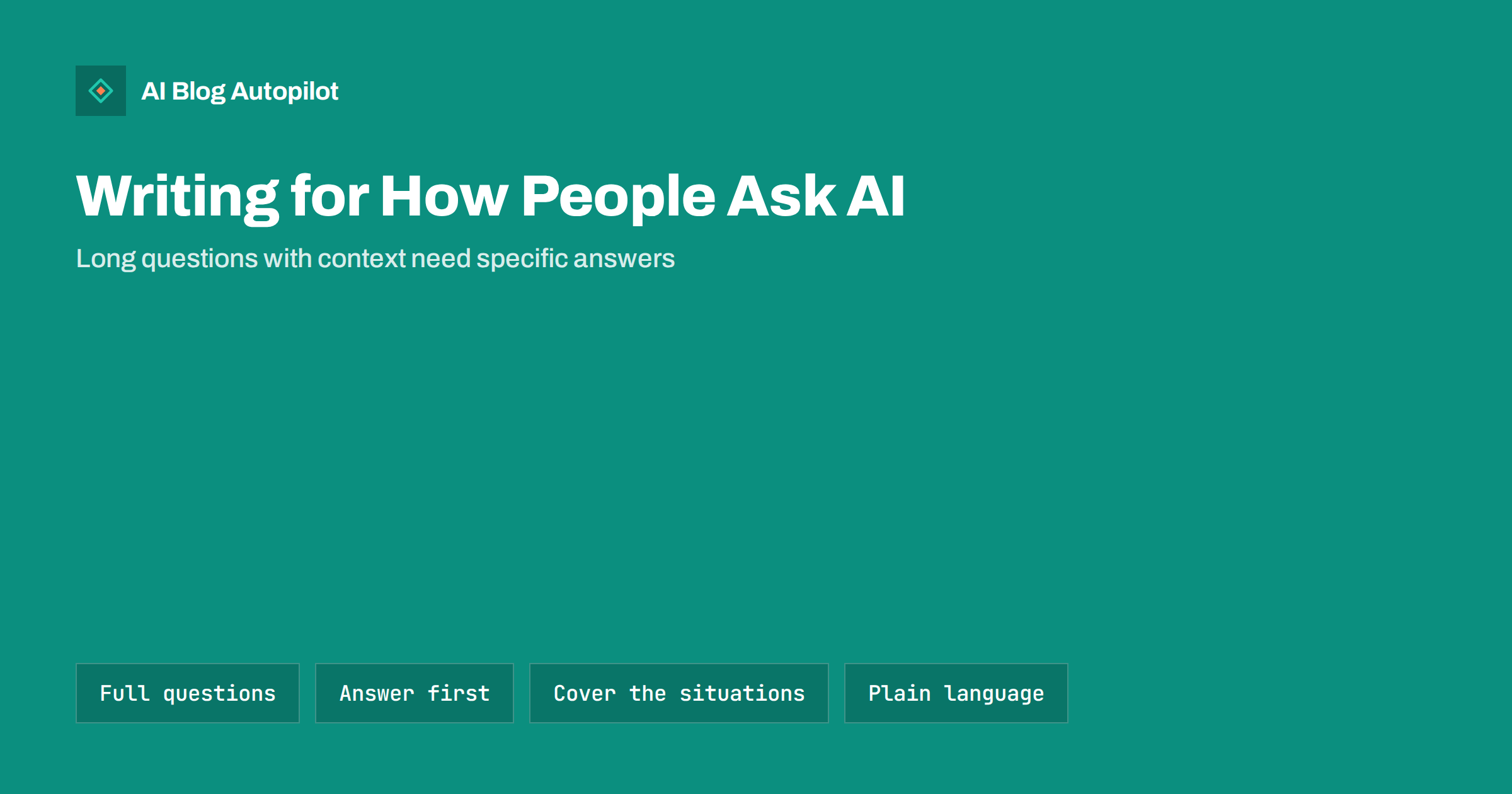
Short answer: conversational queries are the full, natural-language questions people type or speak to AI assistants and search engines, often with context such as their situation, budget or constraints. To be useful for them, a blog post should answer the core question directly near the top, then cover the common variations and conditions in clearly labelled sections, using the plain words readers use. Short keyword fragments still matter, but writing only for them misses how many people now ask.
For most of search’s history, people learned to talk to search engines in a kind of shorthand. They typed “best CRM small business” or “wordpress backup plugin” and scanned the results. AI assistants and conversational search have changed that habit. People now write things like “I run a two-person accounting firm, we mostly use spreadsheets, is it worth moving to a CRM and what should I look for?”
That shift affects what kind of content gets used in answers. This guide explains what conversational queries are, how they differ from traditional keywords, and how to write blog posts that serve them without turning your articles into awkward question-stuffed pages.
What makes a query “conversational”
A conversational query reads like something you would say to a knowledgeable colleague rather than type into a box. Typical features include:
- Full sentences. “How do I stop my blog posts competing with each other?” instead of “keyword cannibalisation fix”.
- Personal context. “for a small bakery”, “on a tight budget”, “without a developer”.
- Constraints and conditions. “if I only have two hours a week”, “when the site is on WordPress”.
- Comparisons and decisions. “should I”, “is it worth”, “which is better for”.
- Follow-up questions. In a chat interface, the second and third questions build on the first: “and what if I already have 200 posts?”
Voice search introduced some of these patterns years ago. AI assistants have made them normal in typed search as well, because people have learned that the system can handle detail and will try to give a single, tailored answer.
How conversational queries differ from keywords
Traditional keyword research groups searches into short phrases with estimated volumes. That remains useful: it tells you which topics people care about and how they name them. But conversational queries behave differently in a few important ways.
They are almost all long tail. Each exact wording may be unique. You will rarely find a volume figure for a specific twenty-word question, and chasing exact phrases is pointless.
The intent is more specific. “CRM” could mean anything. “Is a CRM worth it for a two-person firm that uses spreadsheets?” is a decision question with a clear situation. Content that addresses that situation is more useful than a generic overview.
The answer is often assembled. An AI answer may combine information from several sources to address different parts of the question. A page that covers one part clearly, such as the specific criteria for small firms, can be cited even if it is not a perfect match for the whole question.
Context from earlier turns matters. In a conversation, the assistant carries the previous questions forward. Content that anticipates natural follow-ups, such as cost, time, risks and alternatives, fits that flow better.
Finding the questions your readers actually ask
You cannot see what people type into AI assistants, but you can get very close by looking at sources that capture natural language:
- Your own inbox and sales calls. The questions customers ask in emails, chat and meetings are the best source you have. They come with context, and they are exactly the questions prospects will also ask an assistant.
- Search Console queries. Filter for queries that contain words like “how”, “should”, “can”, “why”, “is it” and “what if”. Longer queries in your data show how people phrase questions around your topics.
- People Also Ask and related searches. These show common follow-up questions for a topic and how they are phrased.
- Forums and communities. Discussions in industry groups and Q&A communities reveal the situations and constraints people describe when asking for help.
- Your site search. What visitors type into your own search box is often more conversational than what they type into a search engine.
Group the questions by the underlying need rather than by wording. “Can I do SEO myself?”, “Is SEO too technical for a small business owner?” and “What SEO can I do without an agency?” are one topic with several angles, not three articles.
Structuring an article for conversational questions
The structure that serves conversational queries is the same structure that serves busy human readers: answer first, detail after, clear labels throughout.
Open with a direct answer. In the first paragraph, answer the core question in two to four sentences. If the honest answer is “it depends”, say what it depends on. This opening is the passage most likely to be quoted.
Use headings that match real questions and situations. Headings such as “If you only have a few hours a week” or “When a CRM is not worth it” map directly onto the conditions people include in their questions. They also make the page easy to scan.
Cover the variations explicitly. If the right answer differs for a freelancer and a ten-person company, give each its own short section. Conversational queries often include this context, and a page that addresses it has a better chance of matching.
Anticipate follow-ups. After the main answer, cover the questions people ask next: how much time it takes, what it costs in general terms, what can go wrong and what the alternatives are. An FAQ section at the end is a natural place for short follow-up answers.
Keep each section self-contained. A section should make sense if someone reads only that section. Avoid relying on “as mentioned above” for essential information, because an answer engine may use a single passage out of context.
Writing style that fits natural questions
You do not need to write in a chatty tone to serve conversational queries. You need to be clear and specific.
- Use the words readers use. If customers say “my website isn’t showing up on Google”, use that phrase alongside the technical term “indexing”. Matching everyday language helps both readers and systems connect the question to your answer.
- Name the conditions. “For a local service business with one location, a single well-maintained business profile is usually enough” is more useful than “results vary”.
- Give decisions, not just information. Conversational queries often ask “should I”. State when the answer is yes, when it is no and what tips the balance.
- Define terms in one sentence. A short, plain definition helps readers who do not know the jargon and gives answer engines a clean passage to use.
- Avoid filler. Long introductions, generic history and repeated keyword phrases make it harder to find the actual answer.
A useful test is to read a section aloud as if replying to a customer who asked the question. If it sounds like a natural, helpful reply, it is probably in good shape.
Mistakes to avoid
Stuffing question phrases. Repeating “how do I” variants in every heading, or inserting clumsy exact-match questions into the text, reads badly and does not help. Cover the need, not every wording.
Creating a page for every phrasing. Separate thin pages for near-identical questions compete with each other and dilute your site. One strong page with clear sections is better.
Burying the answer. If the direct answer appears in paragraph seven, readers leave and answer engines are less likely to find a clean passage to quote.
Ignoring the situation. A generic article that never mentions company size, budget, skill level or other conditions misses what makes conversational questions different.
Over-promising. Answers that claim certainty where there is none, such as guaranteed results, undermine trust with readers and are unlikely to be the kind of source a careful system wants to cite.
Measuring whether it is working
There is no single report for conversational visibility, but several signals help. In Search Console, watch whether longer, question-style queries begin to show impressions and clicks for your updated articles. In analytics, look at referral traffic from AI assistants where it is identifiable. And periodically ask the assistants your customers use the kinds of questions your articles answer, noting whether and how your content appears. Treat all of this as directional: these systems change frequently, and no technique guarantees inclusion in an answer.
How AI Blog Autopilot helps
AI Blog Autopilot plans articles around real search queries from the topics, keywords, audience and tone you give it, and writes long-form articles with FAQ sections, tags and SEO meta included. That format, with a clear answer and follow-up questions, suits the way people now ask. On plans that include it, Search Console topic import can bring the questions your site already appears for into the planning. See how AI Blog Autopilot works.
Related reading
- How to Get Your Blog Cited by ChatGPT, Perplexity and Google AI Overviews
- Using People Also Ask as a Content Source
- Search Intent: The Four Types and What Each Needs
- How to Write FAQ Sections That Rank (and Feed AI Answers)
The bottom line
People increasingly ask search engines and AI assistants full questions with their own context attached. Serve them by finding the real questions your customers ask, answering the core question directly at the top, covering the common situations and follow-ups in clearly labelled sections and writing in plain, specific language. One strong, well-structured page per underlying need beats many thin pages chasing exact phrasings.
FAQ
What is a conversational query?
A conversational query is a search written in natural language, usually as a full question that includes context such as the person’s situation or constraints. They are common in AI assistants, voice search and increasingly in regular search engines.
Do I still need keyword research for conversational search?
Yes. Keyword research still shows which topics matter and how people name them. Conversational queries add detail on top, so use keywords to choose topics and real questions to decide what each article must cover.
Should I write a separate page for every question?
No. Group questions by the underlying need and answer them on one strong page with clear sections. Many thin pages for similar wordings tend to compete with each other and help nobody.
Where can I find the questions my customers ask?
Start with your own emails, chats and sales calls, then look at longer queries in Search Console, People Also Ask boxes, industry forums and your site search. These sources capture natural language with real context.
Does answering conversational questions guarantee AI citations?
No. It makes your content easier to understand and quote, but AI systems choose sources in ways that change frequently and cannot be controlled. Treat clear, specific answers as good practice rather than a guarantee.